2026 Outlook: Stabilisation arrives, but architects face harder feasibility tests
New Zealand’s construction pipeline is entering 2026 with its first signs of stability in two years — but architects are finding that stability comes with limits.

The rebound many expected has not arrived. Instead, the market is being shaped by tighter feasibility requirements and stricter delivery settings that are influencing design from the outset. That shift is captured in the latest Hubexo (formerly BCI Central) Construction Outlook report, which shows early-stage project values peaking in the March quarter of 2025, stabilising through the middle of the year and lifting again in Q3—the first indication that confidence is beginning to return.
Even so, momentum is limited. Deferrals have converged at about 1.4 per cent across the Northern, Central and Southern regions. Nationally, abandonments rose from 1.4 per cent in Q1 to 3.9 per cent in Q3, with residential recording the highest rate at 7 per cent. Projects are proceeding only when cost, funding and delivery align.
Regional conditions vary. The South Island accounts for 56 per cent of the national concept and design-stage value, supported by large industrial and infrastructure assets, including the proposed $3 billion Milburn Quadrant Inland Port and a $500 million Queenstown accommodation project.
The North Island represents 36 per cent, with feasibility driving tighter scopes, longer pre-design phases and greater cost scrutiny before work advances. For architects, more design work is occurring at the front of projects as clients seek cost alignment earlier and tolerate less design risk.
“Economic conditions remain delicate — finance is tight and demand uneven — but indicators suggest stabilisation rather than another downturn,” Hubexo’s APAC President, Ashleigh Porter, said. “Recovery is beginning to take shape, even if momentum is still fragile.”
Feasibility has become the primary constraint. Studios across the country are being brought into projects sooner to address rising costs, tougher lending conditions and higher expectations around resilience, sustainability and compliance. Architects report delays as a dominant challenge at every stage — approvals, post-approval and construction — and the same pressures are felt across the wider industry.
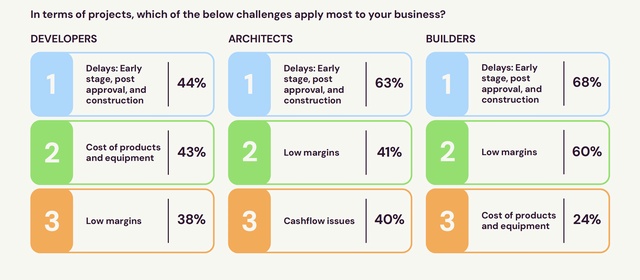
Hubexo’s Sentiment Survey shows 63 per cent of architects, 68 per cent of builders and 44 per cent of developers list delays as their biggest obstacle. Low margins follow, affecting 41 per cent of architects and 60 per cent of builders, while cashflow pressures remain a recurring issue.
Risk perceptions tell a similar story. Architects identify economic fluctuations (63 per cent), cost escalation (58 per cent) and builder insolvency (53 per cent) as the most significant risks in the year ahead. The margin for misalignment between design, cost planning and delivery is thin.
“Confidence is the commodity most in short supply. Demand exists, and capacity exists, but the key challenge is the cost equation,” Warren and Mahoney Principal John Coop told Hubexo. “That is why we focus on efficiency and lean design while ensuring our solutions endure and provide long-term value.”
Technology adoption is becoming essential to maintaining productivity. Firms point to BIM-led coordination, digital collaboration tools and integrated specification platforms as central to managing workload. The larger challenge is cultural: shifting entrenched workflows inside smaller and mid-sized practices. Projects that once moved steadily from concept to refinement now pass through feasibility checks that can stall, reduce or redirect the work. Early design decisions have a greater influence on whether a project advances.
Interviews in the Outlook depict a profession adjusting its entire design posture. Clients want certainty before they want form, shifting design from conceptual exploration to cost-aligned feasibility. Leaner structural options, simplified envelopes, adaptive reuse and modular construction are being introduced earlier as a way to manage delivery risk.
The consenting environment adds another layer of pressure. “The planning and resource consent regime is restrictive, limiting and time-consuming… We need greater balance and consistency in public investment,” Coop said.
Stop-start approvals force architects to redesign and resequence work as timelines shift. More than 30 per cent of practices identify technology adoption as a major challenge, but capability alone is no longer enough; collaboration, risk allocation and design-build literacy are becoming core requirements.
Peddlethorp Director Manuel Diaz said the pressure is reshaping behaviour across the industry. “The construction sector faces pressure to reduce costs… this environment is also pushing firms to think smarter, focus on productivity, collaborate more, and prepare for stronger times ahead,” he said.
Sustainability expectations continue to rise. Severe weather events, insurance pressures and embodied-carbon considerations are influencing design briefs, even as budgets tighten. According to the Sentiment Survey, cost (76 per cent), availability (75 per cent) and lead times (48 per cent) are driving material substitution, often at the expense of sustainability or architectural intent.
“We see a move to more design-build projects in the industry. And a greater emphasis on cost reduction, sometimes to the extent of compromising quality, sustainability objectives and shelving long-term whole-of-life considerations for short-term cost savings,” Jasper van der Lingen, Director at Sheppard & Rout, said.
Hubexo’s Ashleigh Porter describes 2026 as a year of reform rather than acceleration — one that sets the foundation for renewed growth in 2027.
“The tension shaping New Zealand right now isn’t demand — it’s capacity. The need for housing, infrastructure and essential upgrades is undeniable, but labour, capital and delivery bandwidth are the binding constraints. That’s why leading firms are tightening feasibility and leaning on technology to remove friction,” Porter said.
Across the profession, the message is consistent: Deliver efficiently, collaborate earlier and maintain quality as the market waits for clearer economic signals. When confidence returns, it will favour the practices that have adapted first.

Download the full and free report here.
ABOUT HUBEXO
Hubexo, formerly Byggfakta Group, was founded in Sweden in 1936. At the core of Hubexo’s offerings are five key product pillars — Market Intelligence, Project Information, Product Information, Specification and eTendering — that together create a powerful ecosystem spanning 1.3 million active projects, 50,000 customers and 25 countries. Hubexo’s global product network drives better decision-making, unlocks sales opportunities and promotes sustainable construction. Hubexo provides clients with the insights needed to navigate the complex construction landscape, boosting growth and driving efficiency through advanced technology solutions.
This content has been created with support from Hubexo.
ArchitectureNow works with a range of partners in the A&D supply sector to create and/or source appropriate content for this website and Architecture NZ magazine.
If your brand or clients are interested in similar creative content email mark.lipman@agm.co.nz to enquire.