After the rain: heavy haulage
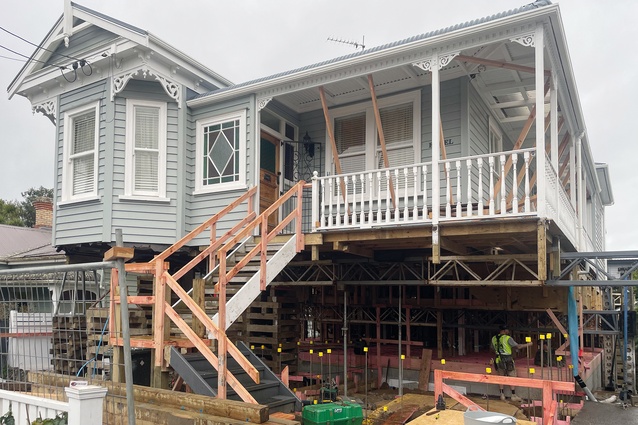
A character house has been placed in its new location.
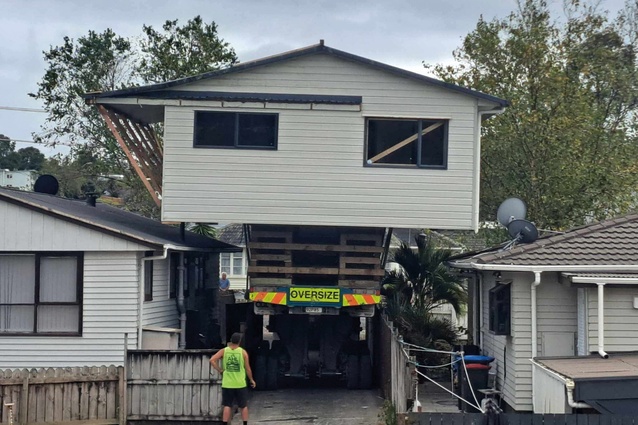
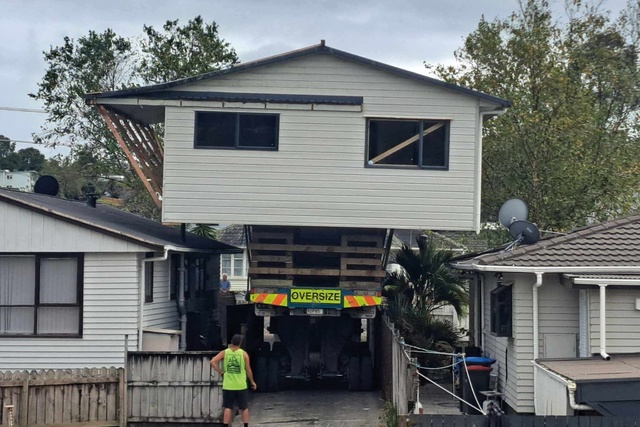
Movers can lift houses over potential obstacles.
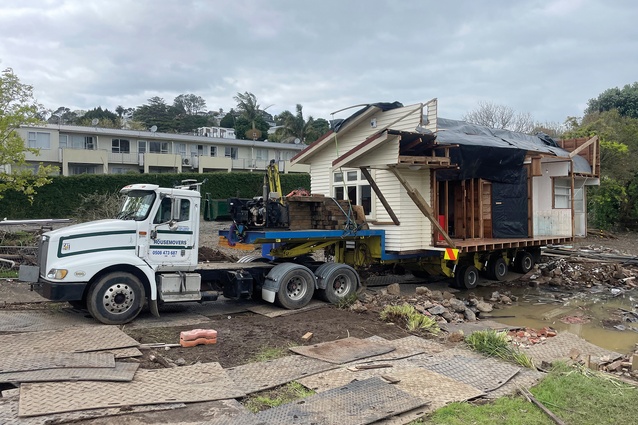
A section of a house is ready for relocation.
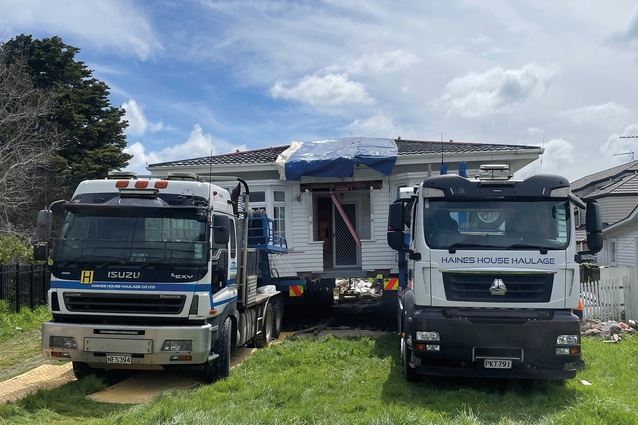
The process is under way for a multi-piece move.
In part four of this six-part-series, observing the disposal of disaster-compromised houses, Andrew Barrie considers the potential for relocation.
I recently found myself at Reikorangi, inland from Waikanae on the Kāpiti Coast, visiting the tiny hamlet’s Church Hall. Built in 1862 as the Scottish Kirk at Parewanui west of Palmerston North, it was constructed amid an intertribal dispute and has musket ports in the walls. The church was re-sited twice around Parewanui, then moved to another area in the 1960s, before (finally?) being moved to Reikorangi to serve as a church hall in 2001.
Buildings with such stories are not typical in Aotearoa New Zealand but neither are they unusual; our tradition of building with light timber frames has meant that relocation has long been part of our construction culture. Whare were moved in response to shifts in the shorelines of the rivers or coasts beside which they were often constructed. A whole industry has developed around moving our light timber-framed houses. When other kinds of building are of sufficient value, we find ways of shifting them, even when it is technically demanding. In the 1980s, the vast St Mary’s Cathedral Church in Parnell was dragged across the street on rollers; railway tracks were inserted under the 3000-tonne structure of what became Wellington’s Museum Art Hotel in 1993 so it could be moved to allow for the construction of Te Papa.
The fundamental issue for Claude Dewerse and Mike LeRoy-Dyson in their project to help deal with 1200 flood-compromised Auckland homes for the Tāmaki Makaurau Recovery Office at Auckland Council is that these houses can’t stay where they are. The most desirable solution is to relocate each house in its entirity. This retains the maximum value of the materials and labour invested in the building. Houses that can be moved as a single piece are the most valuable, as those moves are logistically straightforward. Multi-piece moves are more complex, requiring careful separation of houses into transportable sections, temporary work to keep the sections intact during transportation, and repairs to rejoin them. Our typical timber construction means our houses are both light and robust, and amenable to such techniques. By contrast, the relocation of old timber houses in Japan, for example, typically sees them completely dissembled and just the heavy structural elements reused, with walls and other secondary elements built anew in the new locations.
The usual economic equation works like this: Moving costs can be significant and, in many cases, exceed those of demolishing the building, leaving the house to be deconstructed. Dewerse and LeRoy- Dyson suggest such decision-making is myopic, in that it takes account only of the building’s current situation and not its less easily discernible future, where it can recover significant value. The Recovery Office’s most complex move to date was a large, highspec new house extracted from an unstable site in Muriwai. The multi-piece move cost around $400,000 but the relocated house was worth more than $1.0m, generating a huge windfall for the new owner. Lowervalue moves can similarly generate significant gains for those willing to undertake them. Relocation projects can also have social benefits. The One Dollar House project at One Tree Hill College in Auckland, led by multitasking teacher and postgrad architecture student Charlotte McKeon, took a rundown 1970s’ ex-Kāinga Ora house, relocated it temporarily to the school’s grounds and rebuilt it to Homestar Level 7 standard, teaching valuable trade skills to the College’s students along the way.
Many will have watched enough reality TV to know how Kiwi house-moving works. House-moving contractors excavate out under the house or lift it off its foundations sufficiently to allow specialist trucks to slip underneath. They detach the house from its foundations, carry out the move, navigating the inevitable obstacles along the route, before placing the house at its new location. TV shows necessarily amp up the drama of the moving process but the movers are experts and serious issues are rare fewer than one in a thousand moves encounters serious problems.
That is not to say there aren’t challenges. Building houses on concrete slabs rather than on piles became a regular feature of our industry in the 1950s, providing the lifestyle advantage, amongst others, of setting the floor level close to the surrounding ground. Such concrete slabs might seem fatal to ambitions to relocate but movers have workarounds — if the layout of the house is amendable, they can insert temporary bracing sufficient to allow transportation without a floor. Alternatively, they can detach the house from the slab and lift it to allow a timber floor to be built beneath the walls, and the resulting whole relocated.
Similarly, other design characteristics can provide impediments to relocation but moving contractors have developed solutions. Brick cladding might suggest immovability but this can be removed and new claddings installed at the new location; the list of the Recovery Office’s successful moves includes the long, low, brick-clad blocks of flats that proliferated in the 1960s. The less-than-compact house shapes generated by height-to-boundary regulations can present challenges but, while contemporary twostorey houses can prove tricky, they helpfully follow a common pattern: living spaces downstairs, with two or three bedrooms plus a main bedroom with en suite upstairs. The configuration of these upper floors is such that, while relocation of the whole house can be too demanding, often the upper floor can be detached, relocated and readily converted into a smaller two- or three-bedroom house.
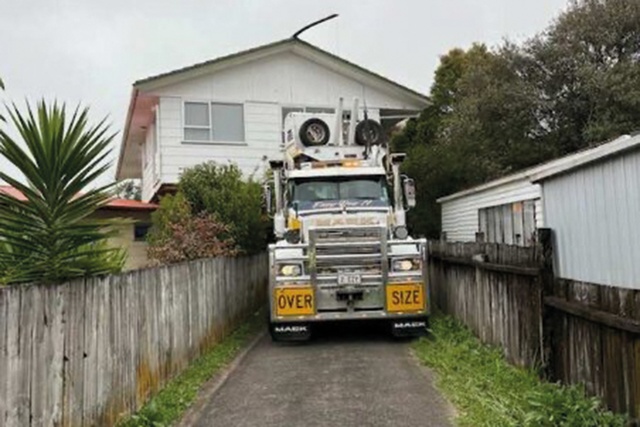
Even physical obstacles can be overcome. Moving contractors have dealt with obstructions such as narrow driveways and even neighbouring houses blocking the way. The latest generation of moving trucks can lift their loads as much as five or six metres above ground level; this is usually sufficient to clear fences and the eaves of adjacent houses. A recent Recovery Office move demonstrated the possibilities: the move required gaining permissions and careful coordination but it involved trucking a house out across a railway line that ran along the rear boundary of its site, as other routes weren’t viable.
In the past, gaining consents has been a challenge. Dewerse and LeRoy-Dyson report that, at present, many territorial authorities are willing to fast-track building consents for relocations or will allow relocations to take place and houses to be positioned temporarily while the necessary consents are obtained — so long as services are not connected nor the houses occupied.
While design-for-disassembly approaches are gaining traction, encouraged by sustainability certification programmes, Dewerse and LeRoy- Dyson accept that it is a stretch for architects to design buildings with the explicit possibility of future relocation in mind. A more plausible scenario for which they advocate is that architects starting work on projects diligently investigate the possibilities for the buildings already on their sites — ideally relocation and refurbishment within the site, but also shifting to another site, perhaps by finding a new owner. Of course, these more creative or complex solutions usually require time and effort to put together — those trying to move quickly are typically forced to default to demolition — but clients may be able to be convinced of the ecological and financial benefits. At present, demolition might be regarded as a failure of imagination; it is likely to become an architectural sin. The Council’s flood-recovery project has sometimes subsidised removals to lift a particular house from deconstruction to re-use. It may be that architects can make similar differences, with just a little extra effort or design ingenuity.
Read previous articles in the series here.