Burn the house down

Community Lane, Architectus’ development for Kāinga Ora in Auckland’s Avondale.

Two social housing towers, Wainui and Waiora, part of the Te Mātāwai development in central Auckland’s Greys Avenue. The developments consists of 200 state housing flats and 76 rentals.
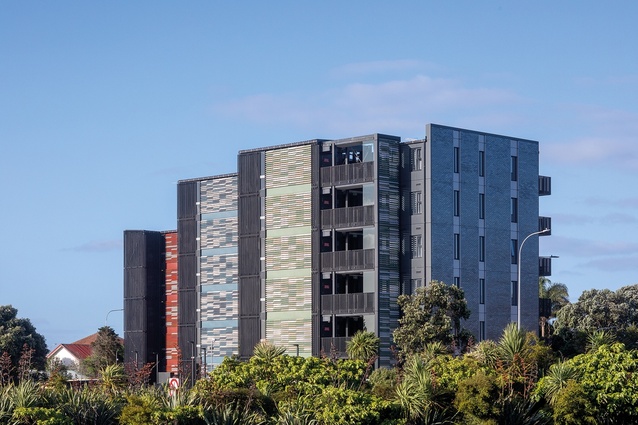
1243 Great North Road, in Auckland’s Point Chevalier. The Kāinga Ora project provides 61 dwellings for over-55-year-olds.
Editor of Architecture NZ Chris Barton discusses Bryce Wilkinson’s bonkers idea about ownership of New Zealand’s social housing assets.
“National governments generally favoured sales and private ownership, while Labour governments typically halted sales programs.” So says Bryce Wilkinson in the first of many half-truths as he introduces his bonkers proposition: ‘Owning less to achieve more: Refocusing Kāinga Ora’.
He could have said “building”. Such as: “Labour governments generally favoured building state/social housing, while National governments favoured undoing all that hard work and selling them off.” Which is precisely what Wilkinson’s report for the laissez-faire lobby group, The New Zealand Initiative, is proposing — selling social housing and giving tenants vouchers to spend on rent. In the process, Wilkinson sees a substantially diminished role for Kāinga Ora where “largescale government ownership is not critical”.

He’s talking about asset sales — the 77,000 homes valued at $46.7 billion, housing 198,000 people, representing just 3.8 per cent of New Zealand’s population that Kāinga Ora — Homes and Communities (KOHC) currently manages. As Wilkinson sees it, the problems of managing a $47-billion property portfolio are a distraction that ministers and officials could do without, giving them more time to focus on “their core policy functions, including setting rules, targeting subsidies, and enabling markets”.
Dishearteningly, that’s the direction this National coalition government seems headed, having decimated Kāinga Ora’s workforce in May by cutting 620 jobs and, in June, announcing that some 3500 planned homes would no longer be built and about 40 hectares (20 per cent) of its vacant land would be sold to private buyers. The building cancellations and job cuts were well signalled in a scathing review by former prime minister Sir Bill English in 2024. It cited concern about the organisation’s debt, which had grown from $2.3 billion in 2017/18 to $16.5 billion in 2023/24, and operating deficits, which grew from a $76-million surplus to a $722-million (pre-tax) deficit.
But, as former Kāinga Ora board member Philippa Howden-Chapman told Radio New Zealand when she resigned last year, Sir Bill English’s review “missed the critical point”. Kāinga Ora’s borrowing, she said, was what allowed it to ramp up construction of some 14,000 homes during the six years of the Labour-led government; that was the largest number of houses built since the post-war boom.
In an opinion piece for The Post in July 2024, Howden-Chapman, co-director of the He Kāinga Oranga/Housing and Health Research Programme at the University of Otago, Wellington, pointed out that, in the wider scheme of things, Kāinga Ora’s housing stock is now a substantial ($46.7 billion) government asset, helping underpin New Zealand’s triple-A international financial rating. And that, in 2022/23, Kāinga Ora’s total debt, borrowed to finance house builds, was $12.3 billion, “giving a debt-to-asset value ratio considerably lower than the Reserve Bank’s prudential restrictions on house lending”.
Writing for The Spinoff, Alan Johnson, co-convenor of the Child Poverty Action Group, was another who, in 2024, looked to the bigger picture. “Kāinga Ora was making progress and looked to be achieving an operational scale in redeveloping sites which, over a five- to 10-year period, would have made an appreciable difference. This is being wrecked by a debt narrative that ignores the real social and economic benefits gained from decent affordable housing for the poorest New Zealanders.”
In 2019, the Labour-led government set up Kāinga Ora as both a public housing landlord and an urban development agency. As such, Kāinga Ora was given a legislative mandate to “go beyond being a social landlord or urban development agency” so as to have “a much larger impact on New Zealand and the quality of New Zealanders’ lives”.

From 2019 to 2023, KOHC attempted to fulfil major state housing responsibilities and undertake challenging large-scale urban redevelopment projects, including KiwiBuild targets and experimental construction programmes. It bought land for development and spent hundreds of millions of dollars on scoping, planning and executing developments. Under this National-led government, the wider role has been culled and the agency “reset” to focus on its core role as a landlord not a developer.

That’s a shame because, in a number of areas in dire need of change, Kāinga Ora was leading the way and demonstrating innovative ways forward for the construction industry. These included, as reviewed in Architecture NZ magazine: high-density, mixed-tenure living (‘Warm walls and good manners’, Bill McKay, Nov/Dec 2023); reducing carbon emissions and building for disabled access and aged care (‘Generous and dignified social housing’, Jon Rennie, May/June 2025); and, reducing building costs through offsite manufacturing and modular construction (‘Learning from Lego and Minecraft’, Bill McKay, Jan/Feb 2025).
The National-led government’s vision for Kāinga Ora has no place for such aspirations — preferring instead to build fewer houses itself and offload building to community housing providers and the private sector. There is plenty of room for improving the efficient delivery of social housing in New Zealand, but the question remains as to just how far this government will go in dismantling what we already have. To frame government ownership of long-lasting, safe, affordable social housing for those who need it as “not critical” removes a powerful government-controlled market force that, at scale, can make a difference. To give that up, based on what Wilkinson describes as someone’s “ideological preference”, is indeed bonkers.