Courting excellence
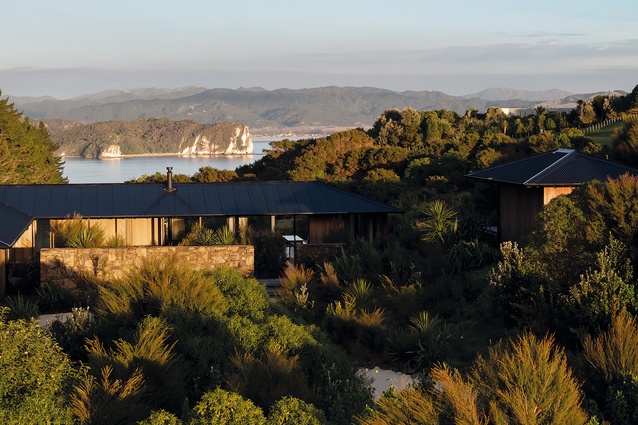
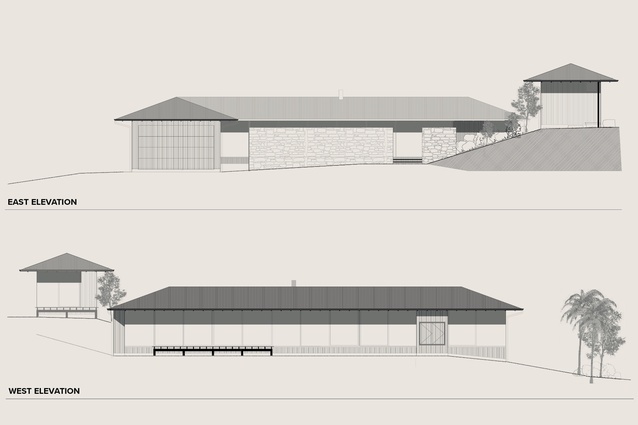
The Popadich House viewed from the east, with the walled garden in the foreground and studio/ guest house at right. Cooks Bay is to the west, with Whitianga in the far distance.
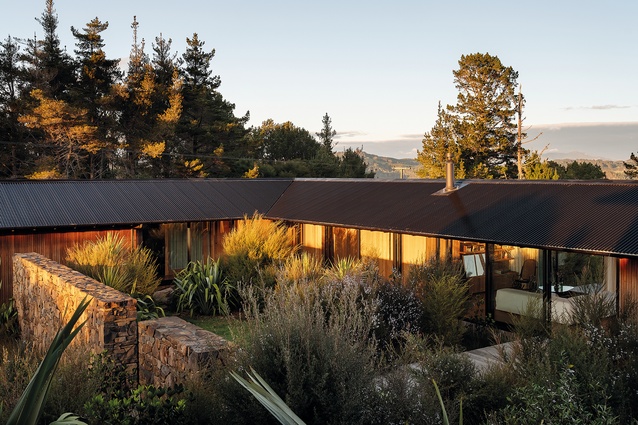
The green courtyard is framed by the house’s two wings and the wall built by Coroglen stonemason Mark Ulrich.
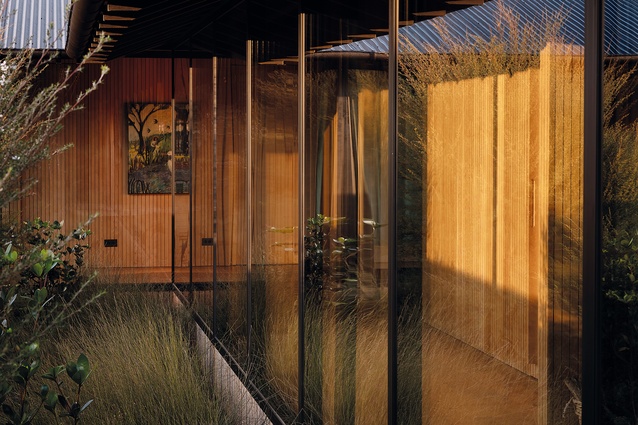
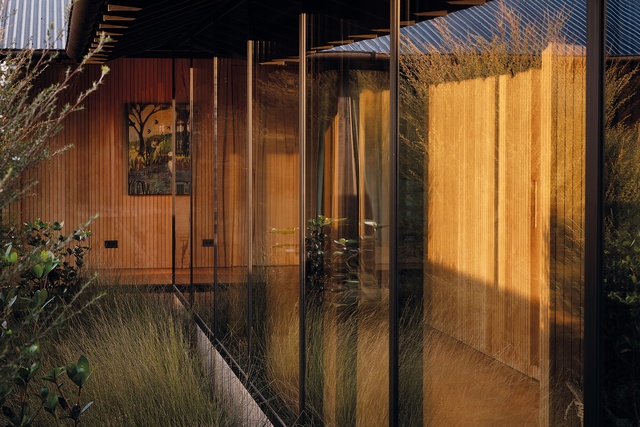
Circulation on the house’s eastern side serves as a gallery looking into the courtyard.
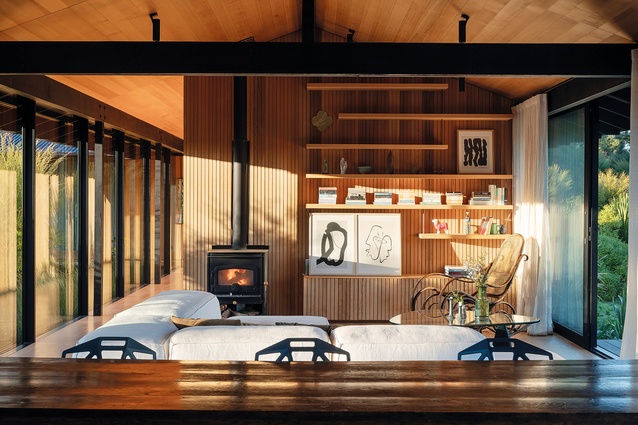
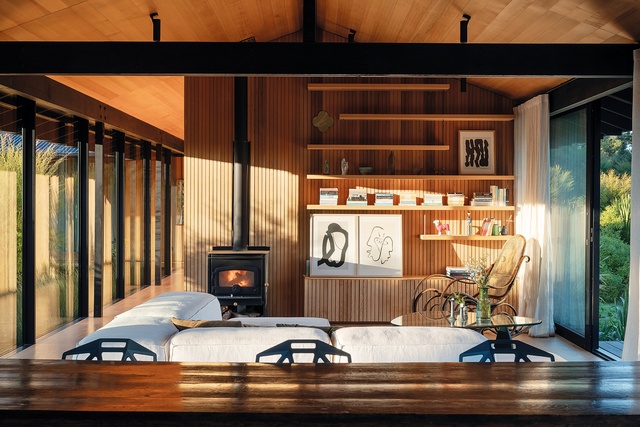
The living area, with the hallway/gallery at left an western deck at right.
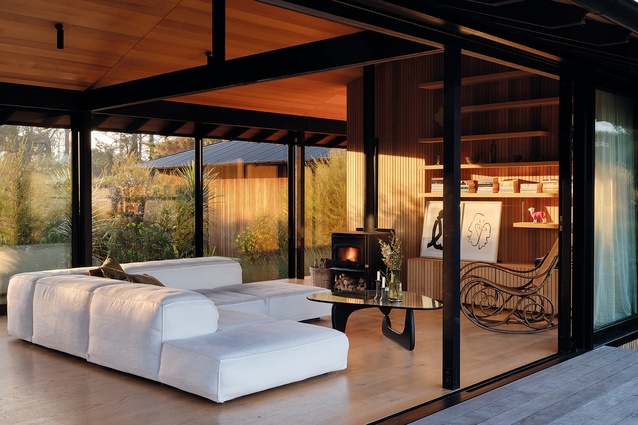
The living area and courtyard, viewed from the west-side deck.
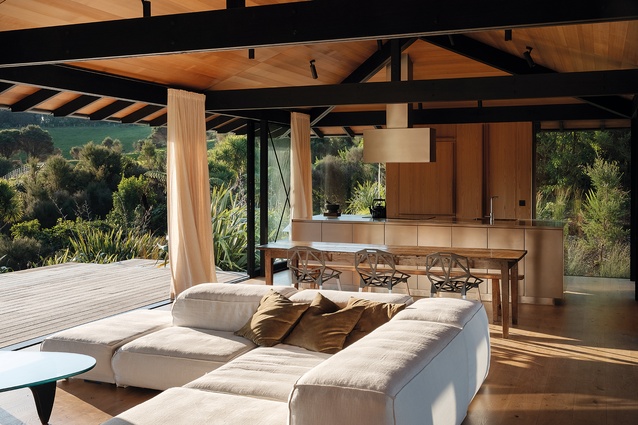
Living and dining areas and kitchen unit, with the west-facing deck at left. Several long beams are the only deviations from NZS 3604.
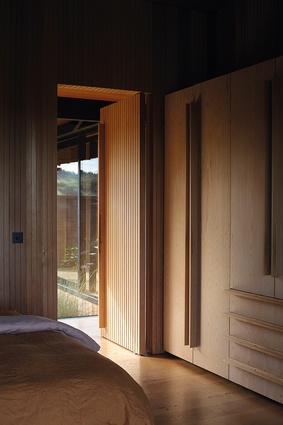
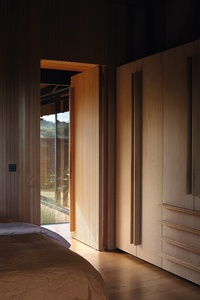
Looking from the main bedroom to the gallery and courtyard.
At a house on the Coromandel Peninsula, by Davor Popadich Architects, John Walsh encounters a realisation of Vitruvian principles in the winner of the Sir Ian Athfield Award for Housing at the 2025 Architecture Awards.
The house Davor Popadich has designed for his family sits on an elevated site in the rural hinterland of Hahei on the Coromandel peninsula. By any measure, this is an exceptionally well-favoured part of the country and anyone owning a bit of it, let alone committing architecture on it, should count their blessings. But the first thing to say about the Popadich House is that its architect and his family have certainly earned it. It must quickly be added that the house is, to cite the instinctive reaction of awards juries to impressive projects, bloody good. (These visceral appraisals are, of course, subject to subsequent embroidery.)
Professionally speaking, Davor Popadich has paid his dues. His CV, after graduation from the University of Auckland’s Architecture School — he was brought up in the ancient, Roman-founded town of Pula in Croatia — includes a stint at Jasmax and then 20 years, many of them in the role of practice director, with Patterson Associates. That firm’s ambitiousness suited him. “I liked working on projects with a high level of detail, for clients with high expectations,” he says. During his time at Pattersons, Popadich worked on exacting, and expensive, commissions, such as The Hills Golf Club (Arrowtown; 2007), Butterworth House (a.k.a. Local Rock House, Waiheke; 2010) and dwellings at Annandale on Banks Peninsula (2013). He proved he could cut his creations from a different cloth in designing his family’s previous home, an economical house (2015) with a boat-shed form, sited on an infill section in the Auckland maritime suburb of Narrow Neck.
In a personal sense, too, Popadich, his wife Abbe, and their three teenage children, have done the hard yards. For once, the term has literal meaning. The family, who had often gone on camping holidays around Hahei, sought and found their piece of the Coromandel about seven years ago. The three-hectare property is a portion of a subdivision of retired grazing land that crumples into gullies, now being returned to native planting. Some time-consuming infrastructural development was necessary before the section became buildable. It was three years before the Popadichs could finalise settlement on their land. Over that period, Popadich drew and modelled, and redrew and re-modelled, his proposed house. With the property title at last in hand, he says, “I was ready to get into it.”
The ‘it’ in question was, initially, more than a year of ecological restoration. This was not “pretty gardening”, as Popadich ruefully observes, but exhaustive manual combat against invasive species — gorse, blackberry, convolvulus and moth plant — so entrenched as to be practically endemic. (Among this noxious company, gorse is comparatively benign.) The struggle continues but biodiversity progress is significant and exemplified by the former bog that is now a healthy pond, big enough for swimming, if you don’t mind cohabiting with some sizeable eels.
From the start, the relationship of architecture and environment — in the sense of both immediate surrounds and wider context – was central to the building project. “The house doesn’t make sense without the planting,” Popadich says. Holistic claims are two-a-penny in architecture, but Popadich’s assertion is simply a statement of fact. In the era of the Covid lockdowns, the Popadichs got to know their property well. One of the family’s sojourns on site lasted four months, spent together in a large bell tent. The immersive experience of local conditions shaped and confirmed design decisions; surely, it will also have imprinted indelible family memories.
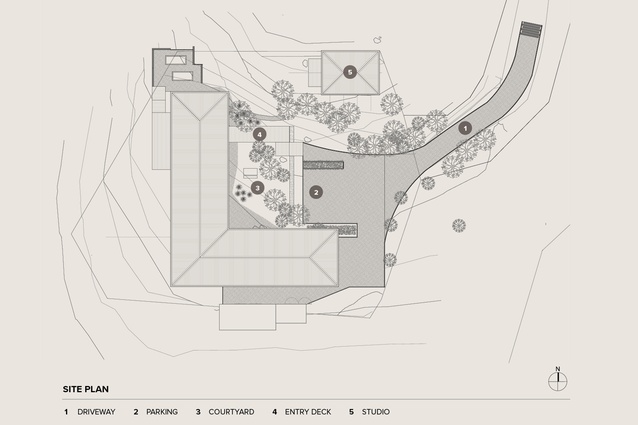
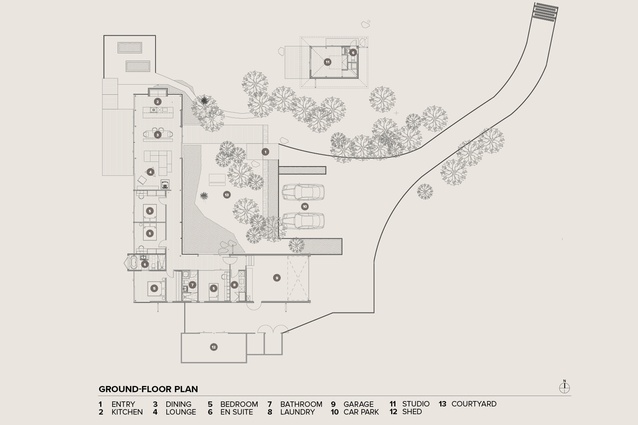
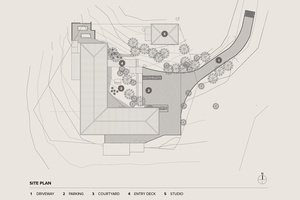
The house was completed in 2022. (Architectural projects integrated with the world of growing things generally benefit from delayed publishing gratification.) Popadich gave the house an L-shape, with the longer axis pointing north, allowing extensive, and sublime, westerly views across Cooks Bay, and the shorter arm aligned east-west. The building thus forms two sides of a courtyard, which is also framed on its east edge by a high rock wall. The sheltered courtyard is a rational stratagem on a site exposed to winds that come, prevalently but hardly exclusively, from the south-west and north-east, but it’s romantic, too, serving to lend the glazed gallery running down the house’s east side the character of a cloister. Popadich is attracted to the architecture of enclosure, with its potential reconciliation of firmitas and utilitas. (“Every now and then”, he says, he does dip into Vitruvius.) A student visit to the Alhambra in Granada was an influential experience, he says, and his job application to Pattersons was sent after he saw the Auckland practice’s Site 3 courtyard complex (2001) in Newton.
Like a good modernist, Popadich’s inclination was to design his house with a flat roof. Iteration followed iteration. “I kept doing the section but it wasn’t working.” The consequent metal-clad pitched roof, which provides volume and vertical presence, does feel right. The house is raised on piles to both minimise earthworks and achieve an effect of floating among the surrounding fast-growing native plants, the latter quality a specific request in the brief that client Abbe Popadich gave to her architect husband. The long rectangle that is the house’s stem accommodates the logical, and familiar, domestic procession of kitchen, dining and living areas, together with three of the four bedrooms. Small kitchen and bathroom extensions are the only protuberances from the rectangular form. The shorter arm of the ‘L’ contains another bedroom and the garage/workshop. A separate structure, set in bush to the north of the courtyard, was designed as a studio that can also serve as guest housing.
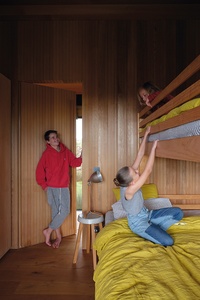
“I’ve always enjoyed working out how things are put together,” Popadich says. This is a very useful trait, he notes: “When building on a budget you can control costs better.” The house, except for three beams, one a 5.4-metre flitch beam, is built to NZS 3604, the New Zealand Standard for timber-framed buildings. The house has been designed on a 600mm module; the glazing module is 1800mm. Money was spent on materials, not excessive size or amenity. Even then, compromise was necessary. “We wanted to build in tōtara but cedar was more affordable,” Popadich says. The floor is oak, bought before the Covid price escalations; pine, stained black, has been used for structural elements. There’s underfloor heating, and a fireplace, used, Popadich says, “only on really cold days — otherwise, the house gets too hot”. The stainless-steel kitchen unit was designed by the architect; it’s as much a feature, if less of an engineering challenge, as the concrete kitchen bench Popadich inserted into the family’s former house at Narrow Neck. Metal light switches are from Abbe Popadich’s own custom range.
Rainwater is collected from the roof, filtered and stored in three 25,000-litre tanks. Waste is processed through an Ecocycle system and grey water is used for plant irrigation. The house is a low-carbon building; Popadich intends to install ground-mounted solar panels when funds allow, augmented, perhaps, by vehicle-to-home technology if it becomes more readily available and affordable. He is remarkably phlegmatic about the challenges of building in a relatively remote place. Particular restrictions — a five-metre maximum height and the use of non-reflective materials are locally mandated — were not onerous, he says. “It wasn’t that different from building on a city site.” Popadich didn’t intend his house to be especially distinctive and therein lies much of its distinction. The house is impressively resolved, elegantly sufficient and very well crafted (by builder Chris Pollock). In short, bloody good.
Learn more about the 2025 Sir Ian Athfield Award here.