Essay from Finland
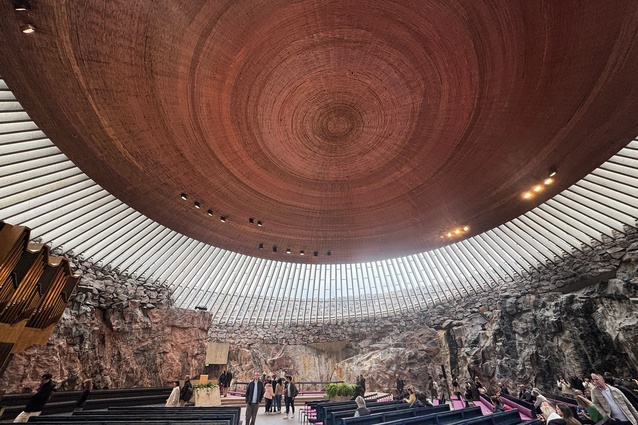
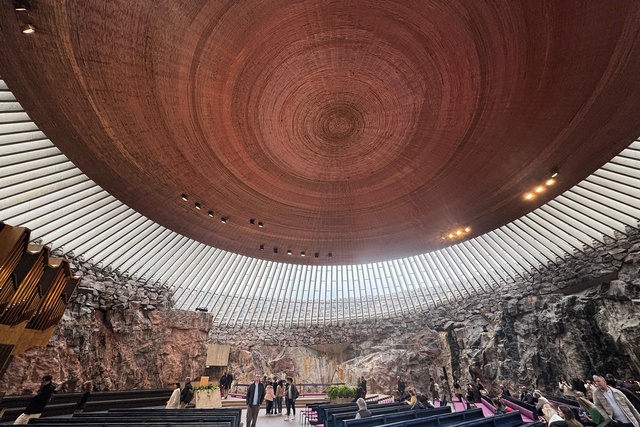
Temppeliaukio Church (1969) in Toolo, by Timo and Tuomo Suomalainen.
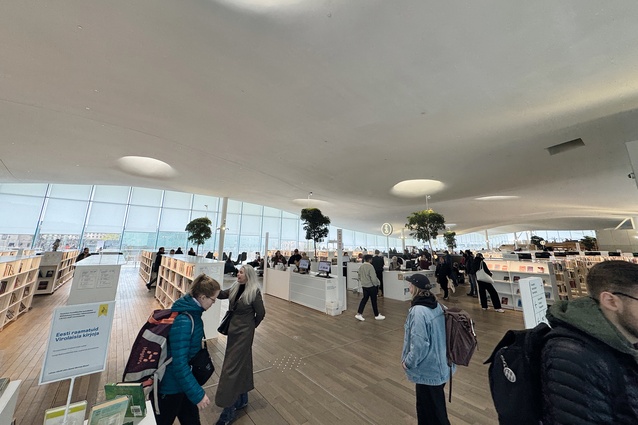
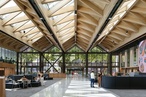
ALA’s Oodi Helsinki Central Library (2018).
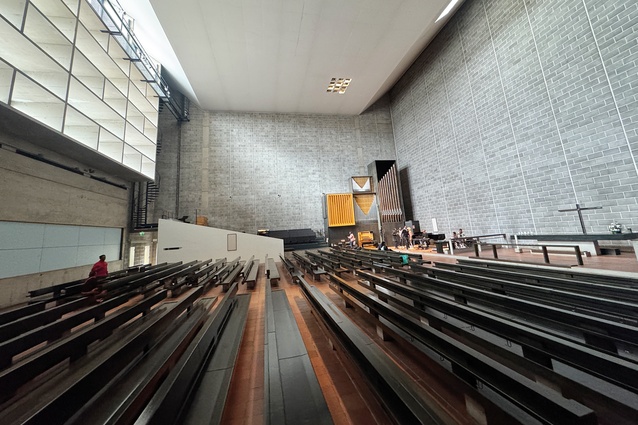
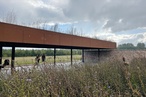
Aarno Ruusuvuori’s Tapiola Church in Espoo (1965).
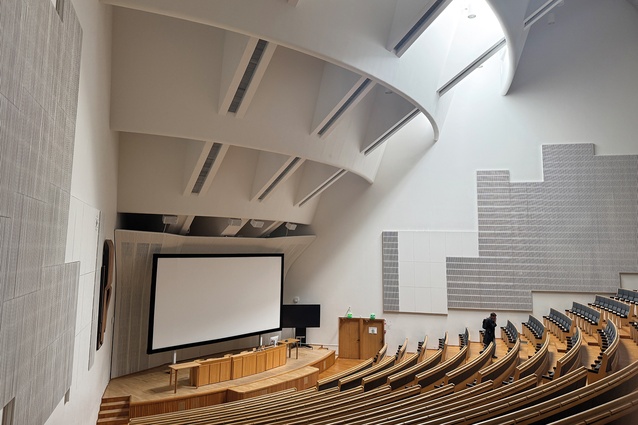
The fanlike Main Auditorium (1964–1974) of the Helsinki University of Technology, now Aalto University.
Jeremy Smith considers the Finnish liking for layering and sectioning for the light, with the underlying influence of the Aaltos evident throughout.
Arriving in Finland is all Christmas. The plane has a red nose, there’s an airport tinsel shop, and it’s arctic cold. People seem to pull out jackets from all directions. The man next to me has three. The only people not happy seem to be the baggage handlers, who are on strike, presumably from everyone oversizing their bags. Everyone simply waits, politely holding their accoutrements and, when the bags finally arrive, there’s a well-practised dressing before venturing outside. And it’s May! This is spring and not properly cold, I’m told. The water’s no longer frozen and the sun looks vaguely interested. Those winter December nights must really be long. Judging by the size and frequency of chimneys, there’s time for some serious whittling. Crafting some presents to keep everyone busy looks helpful. You might imagine the merits of a big beard and some girth.
Arriving in Finland is all Christmas. The plane has a red nose, there’s an airport tinsel shop, and it’s arctic cold. People seem to pull out jackets from all directions. The man next to me has three. The only people not happy seem to be the baggage handlers, who are on strike, presumably from everyone oversizing their bags. Everyone simply waits, politely holding their accoutrements and, when the bags finally arrive, there’s a well-practised dressing before venturing outside. And it’s May! This is spring and not properly cold, I’m told. The water’s no longer frozen and the sun looks vaguely interested. Those winter December nights must really be long. Judging by the size and frequency of chimneys, there’s time for some serious whittling. Crafting some presents to keep everyone busy looks helpful. You might imagine the merits of a big beard and some girth.
Still, to welcome you in, they raise your sugar levels with some blueberry cordial on the plane. If that doesn’t help, the salmiakki surely will, for that seems a vocation in itself. Even Moomin has branched into shot glasses. Such interior hobbies look popular. There are collections of libraries and churches, saunas, knitting shops and cafés with allocated board-game seating. Fittingly, a game of Scrabble might well compound all winter for Finnish is agglutinative. Kerrospukeutuminen reads “dressing in layers” and Finland runs this wardrobed surety. You see babies airing outside, deep under reindeer blankets, while a live screen displays the population count.
It is from these tough necessities that Finnish architects seem to converse further than just space-making. Sitting with Gunnel Nyman glass work, the optic sculptures of Maija Lavonen, Angry Birds, even Björn Weckstrom’s Star Wars jewellery are the likes of Eero Saarinen’s Tulip Chair, Eero Aarnio’s Bubble Chair and, even, Matti Suuronen’s Futuro house. But, in architecture, all things Finnish inevitably shape back to the Aaltos, and it is a 2025 invitation from Aalto University that brings me here. Big-time architects and theorists tend to share wardrobes and Kenneth Frampton describes Aalto as being “doubly fortunate… because he inherited the rich cultural tradition of Finnish national romanticism just as it was entering its decline and… because he came upon the modern movement when its pioneers had already established a zero-degree functionalism against which he could react.”1 Frampton’s not just talking about the weather. I start by going to visit the neighbours.
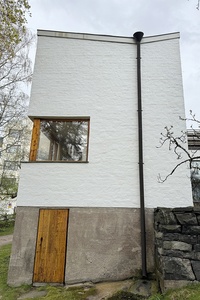
Alvar Aalto’s own home is now a museum with a booking list to get inside. Aalto lived here first with Aino and their family after they built the house in 1936, and then, after Aino’s death, with his second architect wife, Elissa. With no cover outside, I wander across the road to where a man in a large coat is exiting a rectilinear apartment building through a series of external doors. He knows all about the Aaltos, of course, with their white brick and black matchstick asymmetric façades. The Aaltos’ front door opens — only one door, I note, but there’s another one layered inside if you look. Beyond that comes the crafting of life and work practicalities that enabled the office to work out of the house until Studio Aalto was built almost 20 years later. It’s unlikely that any shouts of “Close the door, you’re letting the heat out” were aimed at Alvar, for his drawing board is surrounded by radiators and literally sits on the sauna.
The heating worked, for Frank Lloyd Wright called Aalto “a genius” on the opening of the Finnish Pavilion at the 1939 New York World’s Fair.2 Current Finnish theorist, Juhani Pallasmaa, describes Aalto’s post-war modernism avoiding “reduction and polarization” by overtly mediating “antagonistic elements”.3 It is from these disparate oppositions, be they controlling the glare of a light bulb over a hospital bed or handling entry doors with moulded brass pulls, that Pallasmaa traces Aalto’s journey from “classicist” to “functionalist” and, ultimately, the “humanizing of architecture”. Yet, it is not just Alvar inside this architecture. Aino Marsio-Aalto was an extraordinary architect in her own right. Her “harmony of purpose and form”4 is clearly evident in her Bölgeblick-ringed glassware and the custom lighting and furniture she designed for the Villa Mairea. So, too, was Elissa Aalto, who continued running the practice after Aalto’s death in 1976.
Pallasmaa records a younger generation of mid-1950s’ to early 1960s’ rationalists, who considered Aalto’s architecture “so idiosyncratic” that they “sought more objective models”.5 This is Frampton’s “zero-degree” strictness, yet, as he concludes, “whether one is following the organicist or the constructivist line in Finnish architecture, Aalto’s influence is always present.”6 Walking around Helsinki, you find a mix of older romanticism, rationalist overcoating and humanistic styling in a city with plenty of space and not many people around. Life is a bit warmer inside. A look back to the Aaltos’ neighbour shows him returning and leaning on an Aalto-looking door-push while readying to take off his jacket. He hasn’t been gone for long. Finnish architecture really only goes out to go back in.
So, we take off our coats and start staying inside, warming our way into churches and libraries. While in our more forgiving climates we might plan our elevations, these section to light. If Helsinki’s Uspenski Cathedral heads skyward in a more orthodox, romantic way, 1965’s Tapiola Church in Espoo, and its architect, Aarno Ruusuvuori, take on a constructivist “strict modernist”7 approach. Getting in takes some doing, rounding a squashcourt-like concrete exterior and then traversing the low ceilings and corridor fireplace of the parish. But there’s no missing the congregation section, with its honeycombed window aiming light firmly over the pews at the altar. Is it warm? That might depend on whether or not you’ve taken off your jacket and whether or not you are doing the talking. The Temppeliaukio Church’s welcome looks communally easier to find, despite being buried inside a rock. Clearly less objective of Aalto, this view of the sky by architect brothers Timo and Tuomo Suomalainen in 1961, wraps you with a raftered circle of light. It’s a sundial. Public buildings in Finland seem to find light as a matter of course.
ALA Architects’ 2018 Oodi Helsinki Central Library places people and books up on a third-floor undulating landscape, beneath a miraculous cloud-like ceiling, which the architects describe as “an indoor town square”.8 The stand-alone siting allows some extra sprucing to its perimeter and, through its roof-top deck and view outwards, the space sections the light horizontally rather than vertically. There’s a lot to find buried away from the light with those restaurant, movie theatre, audiovisual recording studios and maker spaces that seem, now, to hobby with books. But, up top, ALA has been on its own heater, taking light from all directions, aligning just-in-case blinds and miraculously emptying the ceiling of fittings. Look into those skylights and you find electric pendants, just as you do in the Aaltos’ work, be it the library at Aalto University, the Akateeminen Kirjakauppa academic bookshop or their own dressing room.
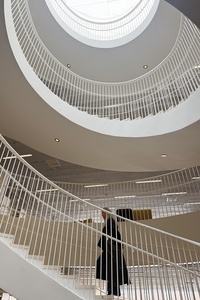
After visiting Anttinen Oiva Architects’ (AOA’s) Kaisa House at the University of Helsinki, architect and director Selina Anttinen tells me that anyone can borrow books from a Finnish university library. This explains their open tunnelling beneath a large eclipse-shaped skylight. It’s a space that is caressingly inviting, with its white grate ceilings and spiral stair, as The Architectural Review lauds in questioning at a broader scale what the teaming of institutional space with community “says about the meaning of public space in the 21st century”.9 It is a question that is simply answered by the Aaltos’ neighbour handling their entry doors with some cues from the little house across the street. All buildings deserve humanising. Kindness matters.
And, here, I have a thank-you to architect and professor Pirjo Sanaksenaho and the team at Aalto University. Christmases come all at once when walking, sitting, watching and feeling a day through an institution of Aalto buildings. You find yourself being moved with light, broadened at corners, side lit in studios, indirectly softened in reading spaces and touchingly helped up the stairs. This public prioritising of light seems Finnish, with the sections shaping outwards. So much so that I went outside before my talk to find out where the presentation light was coming from. Outside to go inside. To be given the honour of presenting in Aalto’s auditorium was, in itself, a present.
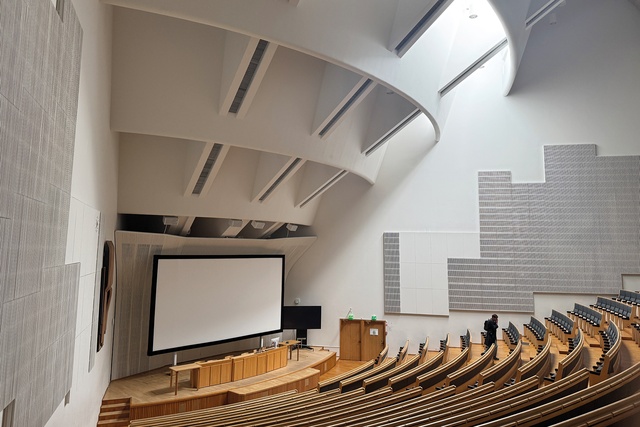
As Anttinen and Professor Anssi Lassila from OOPEAA Office for Peripheral Archiutecture join me on stage, the questions from Sanaksenaho and the Aalto school lead discussions on architecture’s role in sustainably utilising Finland’s forests. If AOA’s recent Katajanokan Laituri building, with its interior oculi and 23,000m2 of space structured from timber, and OOPEAA’s typological forest to building carbon studies at projects like Lonna Sauna are anything to go by, Timber Architecture Today10 in Finland looks to be in very good humanistic hands. As Frampton summarises of Aalto, and usefully for an increasingly fashioning Aotearoa New Zealand architectural wardrobe, “in an age in which we are overwhelmed by ephemeral images of every kind, we may justly see him as an architect whose oeuvre was totally antithetical to the reduction of building to modular spatial arrangements largely determined by proximal or productive considerations, or to provisional assemblies predominantly conceived to provide a spectacular image.” A heavy dressing to finish, perhaps, but the notion of Aalto reacting against “the cult of the ‘decorated shed’”11 suggests we, too, section further out of our own buildings and leave those simpler summer-house elevations till summer.
I bet the Aaltos did a good December ‘Ho Ho Ho!’ Their work is Christmas. The experience a gift. Whether you live at the north pole in a big red suit, or somewhere and in something a little easier to manage, architecture warms more than its wardrobe. Kiitos.
References
1. Kenneth Frampton, 2002, ‘The Legacy of Alvar Aalto: Evolution and Influence’, in Peter Reed (ed.), Alvar Aalto: Between Humanism and Materialism. New York: The Museum of Modern Art, p. 120.
2. Kristian Gullichsen, 2002, ‘Preface’, in Peter Reed (ed.), Alvar Aalto: Between Humanism and Materialism. New York: The Museum of Modern Art, p. 9.
3. Juhani Pallasmaa, ‘Toward a Synthetic Functionalism’, in Peter Reed (ed.), Alvar Aalto, Between Humanism and Materialism. New York: The Museum of Modern Art, p. 21.
4. Aalto University, 2024, ‘The story of Aino Marsio-Aalto’. aalto.fi/en/marsio/story-of-aino-marsio-aalto/ Published 18.11.2024.
5. Juhani Pallasmaa, ‘Toward a Synthetic Functionalism’, in Peter Reed (ed.), Alvar Aalto, Between Humanism and Materialism. New York: The Museum of Modern Art, p. 38.
6. Kenneth Frampton, 2002, ‘The Legacy of Alvar Aalto: Evolution and Influence’, in Peter Reed (ed.), Alvar Aalto: Between Humanism and Materialism. New York: The Museum of Modern Art, p. 126.
7. ‘Aarno Ruusuvuori’, Arkkitehtuuri museo. mfa.fi/en/architects/aarno-ruusuvuori-2/
8. Tash Reith- Banks, 2018, ‘The borrowers: why Finland’s cities are havens for library lovers’, The Guardian. theguardian.com/cities/2018/may/15/why-finlands-cities-are-havens-for-library-lovers-oodi-helsinki/
9.Tom Wilkinson, 2015, ‘Helsinki University Library in Finland by Anttinen Oiva Architects’, The Architectural Review. architectural-review.com/today/helsinki-university-library-in-finland-by-anttin-enoiva-architects/ Published 13 January 2015.
10. Aalto University, 2005, ‘Timber Architecture Now seminar’. aalto.fi/en/events/timber-architecture-now-seminar/ 05.05.2005
11. Kenneth Frampton, 2002, ‘The Legacy of Alvar Aalto: Evolution and Influence’, in Peter Reed (ed.), Alvar Aalto: Between Humanism and Materialism. New York: The Museum of Modern Art, p. 120.