From concept to construction: How architects can reduce waste now
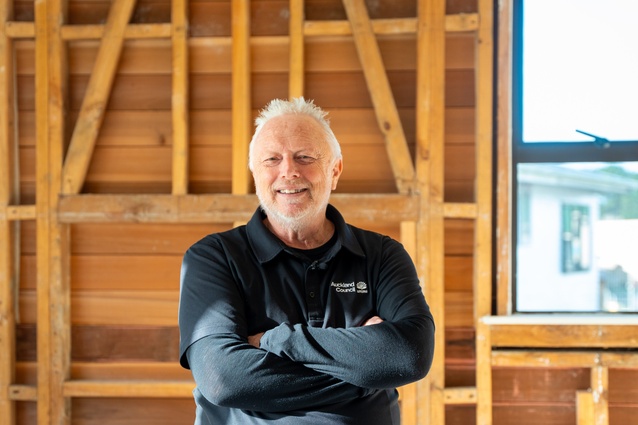
Mark Roberts, Senior Waste Advisor.
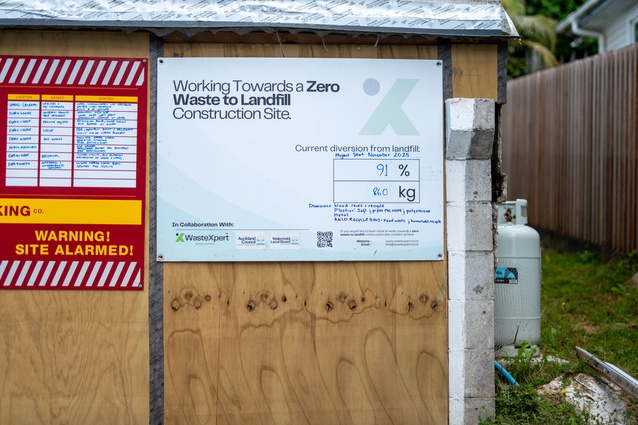
Where design intent hits the ground.
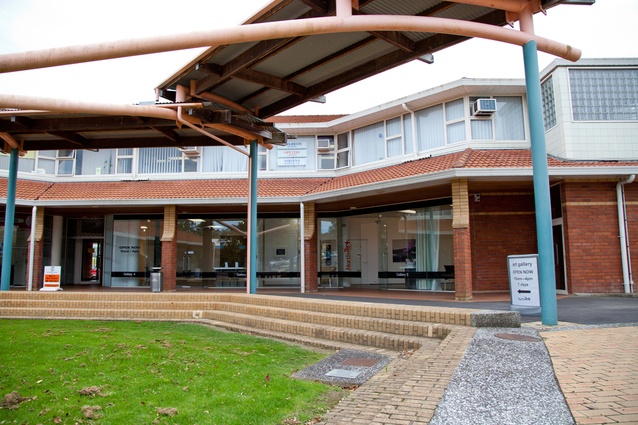
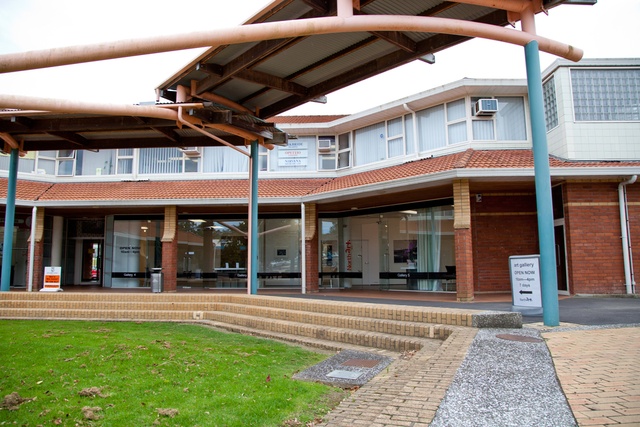
Deconstruction of this Northcote landmark reclaimed over 90% of materials.
Construction waste doesn’t start on site, it starts on the drawing board. Every decision about dimensions, materials, assemblies, and detailing shapes how much waste a project will generate, long before construction begins. Senior Waste Advisor at Auckland Council Mark Roberts says: “Every stage of design contributes to waste — often with little thought given to how material choices, dimensions, or assemblies will drive waste and cost.”
This oversight leaves contractors carrying the burden of materials that are over-ordered, over-specified, or impossible to recover. Roberts notes that plastics and composite systems, like polystyrene and products that bind plastics into concrete, have created a major challenge.
“Some buildings are effectively ‘standing landfills’ because of the volume of unrecyclable plastics locked into them.”
Designers can help by choosing material systems with recovery pathways, such as pod-type foundation systems or low waste structural solutions.
A clear example comes from the Sustainable Business Network. Through early collaboration with Twin Solutions, Construkt Architects significantly reduced waste on an Opito Bay bach project. Switching from a slab-on-grade to a RibRaft and ClevaPod foundation avoided 15m³ of imported hardfill and 24m³ of polystyrene. Replacing doubled 90mm studs with single 140mm studs reduced timber use and thermal bridging. Early coordination meant materials and methods were optimised before construction, proving that preventing waste is more effective than managing it later.
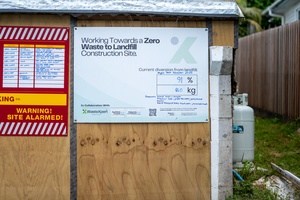
Procurement is another area where waste hides in plain sight. Recent Auckland projects show how overordering, especially of plasterboard, creates unnecessary disposal costs and material loss. More interiors contractors now rely on cut-to-order services and precise quantity planning to minimise offcuts.
Waste continues throughout a building’s life. In response, Pavilion Architecture’s Long Term Manufacturer Involvement model designs for long service lives, straightforward maintenance, and component recovery. Materials are selected so components can be reused, recycled or returned through buyback schemes turning potential waste into future value.
More companies, including Naylor Love, are selecting materials for overall lifecycle impact — not just immediate performance — leading to more durable, lower waste buildings.
Circular strategies are scaling in multi-unit housing too. At 26 Aroha Avenue, shared roofs, gardens, and social spaces reduce material use per household while improving resident wellbeing.
Regeneration projects take this further by making deconstruction standard. The Auckland Urban Development Office now requires deconstruction methods for building removal, ensuring materials are preserved rather than landfilled. Architects can strengthen this by designing deconstruction-ready assemblies, like bolted connections, layered construction, and separable systems that enable high value recovery. Financial analysis from Auckland Council’s Research and Evaluation Unit shows deconstruction can break even with demolition once salvage value and avoided landfill costs are factored in.
Across these examples, the innovations are practical and repeatable:
• Standardised deconstruction methods
• Material salvage and resale models
• Onsite reuse strategies
• Cost neutral deconstruction pathways
• Business case driven sustainability decisions
• Circular material flows that reduce emissions and resource use
Waste is a design problem, and architects are uniquely placed to solve it. By questioning default materials, designing for recovery and longevity, and collaborating early with contractors and manufacturers, the profession can dramatically reduce construction waste while improving performance and longterm value. As Roberts reminds us, “waste is not inevitable — it’s designed in, and it can be designed out.”
For more information, visit aucklandcouncil.govt.nz or call 09 301 0101.