Itinerary: Kiwi high Tech
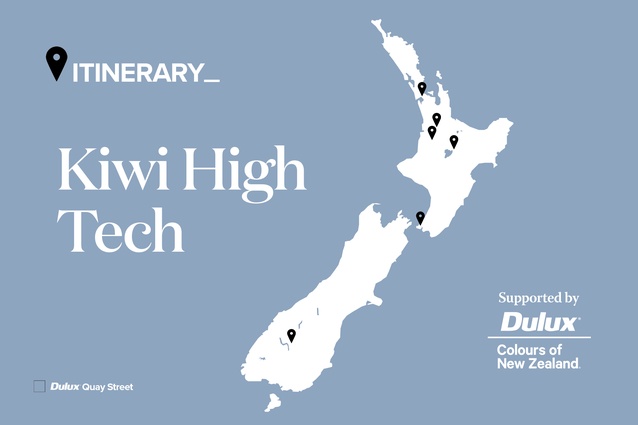
Itinerary: Kiwi High Tech. Featured is Dulux Quay Street, Dulux Colours of New Zealand.
In this Itinerary, supported by Dulux Colours of New Zealand, Andrew Barrie visits 14 innovative High Tech projects from across New Zealand.
The 1970s saw a cadre of leading New Zealand designers – Roger Walker, Ian Athfield and Claude Megson, as well as the older figures such as Miles Warren and Peter Beaven — competing in the creation of highly original work. In the early 1980s, however, many architects’ eyes turned again to the horizon, adapting ideas from abroad rather than developing unique personal languages. One of the most intriguing new directions, particularly for those who still held some faith with modernist values, was indicated by Piano and Rogers’ Centre Pompidou in Paris, completed in 1977.
The machine had long been a defining image of modernism. Le Corbusier’s “engineers’ aesthetic” favoured the streamlined forms of the aeroplane and the ocean liner. The Centre Pompidou crystallised a new image of the machine in which the elements of the mechanism were expressed and even celebrated: exposed structure and exaggerated joints, plug-in services and flexible plans. The result: an architecture of ‘parts’. The approach lent itself to large spans and tall towers. Both internationally and locally, the icons of High Tech were, for the most part, commercial and civic architecture — office buildings, high-end laboratories and factories, airports and sports halls.
High Tech architecture, though, developed some local nuances. In Europe, the progenitors of High Tech were young radicals; Renzo Piano was just 39 years old when the Pompidou was completed. While the approach drew more from industrial technology than from architectural tradition, it retained modernism’s elevation of functional and structural logic as a primary driver for design. Here in New Zealand, this seemed to make it more palatable to the older designers who led our established commercial firms. But there were other attractions for the establishment. Complexity and innovation are usually expensive and, globally, the style has held particular appeal for wealthy clients, such as insurance companies and banks.
(Norman Foster’s Hong Kong and Shanghai Bank, 1985, was, at the time, the most expensive building in the world.) Unsurprisingly, that has also been the case in Aotearoa. Of course, corporate buildings here are created for regional rather than global entities, and the step down in fiscal firepower means that Kiwi High Tech is characterised by more modest means — off-the-shelf elements mixed in with the highly bespoke construction systems that characterise overseas work.
If the High Tech innovators — Piano, Rogers and Foster — updated Corbusier’s 1920s’ “engineers’ aesthetic” to a more explicitly mechanistic imagery aligned to the technology of the 1970s and 1980s, by the new millennium, architects were following the cues of the era’s much less expressive technological objects. Our technological icons became the 3D printer and, released in 2007, the iPhone — a seamless rectangle of satin steel, plastic and black glass. Now, two decades further on again, the rise of the digital world means that technological advances have further receded from the physical realm. Artificial intelligence is unlikely to help — its physical expression is a few blinking pixels and a shorter ‘to do’ list. As architectural inspiration, Cybertrucks and delivery drones are of limited utility, and the zeitgeist is likely pushing us away from such explicitly consumerist reference points.
In any event, the necessary substitution of concrete and steel with mass timber means our technologically advanced buildings now resemble huge machines less than they do vast cabinetry. Despite this material shift, we may eventually understand the stream of Kiwi High Tech to have flowed through to Irving Smith Architects and RTA Studio’s outrageously slender timber diagrid at Scion (2020) or to the green systems and jaunty solar panels of Tennent Brown’s new Ngā Mokopuna. Corbusier’s century-old words are still relevant: “Our own epoch is determining, day by day, its own style. Our eyes, unhappily, are unable yet to discern it.”
THE ITINERARY
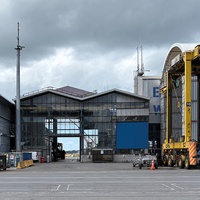
1. 1979 – Mobile Plant Workshop
Quay Street, Auckland
KRTA
After emerging in the 1950s with a genteel modernism, through the 1960s and ’70s, Kingston, Reynolds, Thom and Allardice championed progressively bolder approaches, with High Tech entering the mix in the late 1970s. David Mitchell wrote of this building that its architect had “made a mechanism from the workshop for straddle cranes that lift containers on the wharf. He designed an industrial jewel box that displays its insides to the waterfront drivers. In many ways it is a simple wharf shed, but this architect too knows the poetry of engineering. The straddle crane building is high drama passed off as simple practicality.”
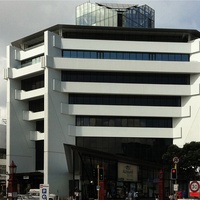
2. 1983 –Auckland Harbour Board Building
139 Quay Street, Auckland
Dodd Paterson Newman Pearce Architects Collaborative
This building is the closest New Zealand came to Japanese Metabolism — a delayed arrival of ideas, typical before the advent of the internet. It had all the elements of a 1960s’ ‘city in the air’: a daring megastructure that suggests extend-ability, a central service core and public space beneath the elevated building. The building now contains commercial office space, and the undercroft has been filled in with shops and bars, demonstrating just the kind of flexibility that was the goal of Metabolism but, ironically, making the building less interesting and obscuring the explicitly High Tech elements. See Home & Building Aug/Sept 1983 and Aug/Sept 1986.
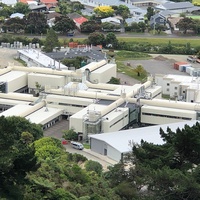
3. 1983 – Physics and Engineering Laboratory
69 Gracefield Road, Lower Hutt
Structon Group
Originally designed for the Department of Scientific and Industrial Research, then the government’s primary means of supporting technological innovation, this complex of workshops and laboratories was one of the nation’s most thoroughgoing expressions of the High Tech approach. The laboratory’s key need was for flexibility, which was provided by a moon-base-like arrangement of ‘loose fit’ structures, nodes and courtyards. The composition was completed by a network of externally exposed services, originally bright red. The project has received numerous NZIA awards, including an Enduring Architecture Award in 2008. Refer NZIA Journal June 1977 and NZ Architect 1, 1983.
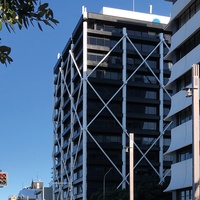
4. 1984 – Union Building
2 Commerce Street, Auckland
Warren and Mahoney
Between the brutalism of the 1970s and the postmodern classicism of the mid-1980s, Warren and Mahoney briefly explored a High Tech-inflected approach, characterised by structural expression and angular geometries. This tower’s prominent location means it’s the best known but the period produced many gems; seek out the former Waitematā City Council Offices (6 Waipareira Avenue, Henderson; 1981–84). The Union Building’s external pre-cast concrete bracing to absorb earthquake loads was a first for high-rise buildings in New Zealand, and a cunning piles-in-tubes base-isolation system was a world first. See Home & Building Dec/Jan 1984/85 and NZ Concrete Construction May 1984.
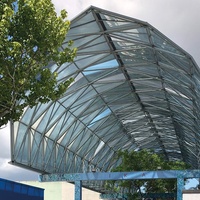
5. 1987 – Ōtara Town Centre Canopies
East Tāmaki Road, Ōtara
Rewi Thompson
The reception of this project tends to focus on its cultural and contextual qualities: the symbolism of its fish imagery, and its location at a key centre for Auckland’s Māori and Pasifika communities. But it’s worth remembering that Thompson emerged in the early 1980s from Structon Group’s hothouse of modernism, and this project is undergirded by bravura structural design — the glazed canopies are supported by three different types of steel frame, elevated on elegant concrete portals. Unbuilt projects by Thompson recently brought to light show extravagant structures were, at least for a time, a key strand of his thinking. See Architecture NZ Sept/Oct 1993.
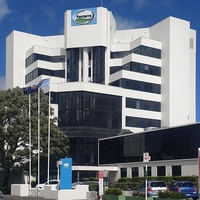
6. 1987 – Anchor House
70 London Street, Hamilton
Stephenson & Turner
Unusually for an office building, this tower was developed and owned by its occupier — the huge dairy company that evolved into what is now Fonterra. The exterior of the building (which absorbed two existing structures on the site) is a sculptural composition in the high modernism for which its designers were widely celebrated, but stepping inside reveals a five-storey atrium animated by all the elements typical of High Tech: expressed lattice structure, glass skin, free-standing lifts, and exposed and brightly coloured air ducts. This grand space was described by a reviewer as “a visual and spatial delight”. See Architecture NZ Nov/Dec 1987.
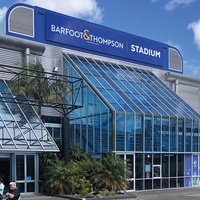
7. 1987 – Chase Stadium
203 Kohimārama Road, Kohimārama
Dodd Paterson Architects
Sharing an architect with the Auckland Harbour Board Building (listing 02) and now named Barfoot & Thompson Stadium, this project was built on the grounds of Selwyn College. It was initially intended to be a relatively modest school gymnasium, expanding to become the venue for gymnastics during the 1990 Commonwealth Games. For critic Paul Walker, this underlying modesty undermined its credibility: “Though it is not a high-tech building insofar as this would imply overly precious means of construction and an intensely serviced interior environment, the sleek, colourful finishes of Chase Stadium do give it a high-tech look.” See Architecture NZ Mar/Apr 1988.
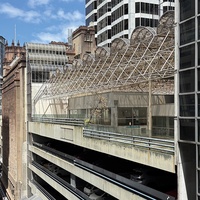
8. 1988 – Chase Plaza
72 Albert Street, Auckland
Walker Co-Partnership
Property developers Chase Corporation were behind many of the 1980s’ most high-profile — and most heavily critiqued — commercial projects. Subject to a string of modifications, this project’s most memorable original feature was its space-framed roof canopy, assembled from vaulted Plexiglass specially imported from Germany. Following the Stock Market Crash of 1987, the name was changed to Finance Plaza after Chase Corporation went into decline at the end of the decade. The Plaza, which occupies a rooftop that formed a podium to several office towers, is now being gradually occupied by sports facilities. See Architecture NZ July/Aug 1988.
9. 1991 – Auckland Trotting Club Stables Complex
400 Manukau Road, Auckland
Adams Langley Architects
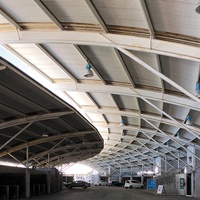
As with many of the firms in this itinerary, Adams Langley Architects had a company lineage that had produced some of the country’s most adventurous modernist buildings. This elegant project is, in many ways, very simple and unassuming: two open-ended sheds that follow the curve of the immediately adjacent racetrack. Seeming to effortlessly combine expressive cantilevered structure, crisp detailing and graceful geometry, the project won an NZIA Resene National Award in 1991, the jury noting how the “robust and functional complex has used inexpensive and unadorned building materials to create a light and airy environment”. See Architecture NZ Mar/Apr and May/June 1991.
10. 1998 – Taupō Events Centre
26 AC Baths Avenue, Taupō
Creative Spaces
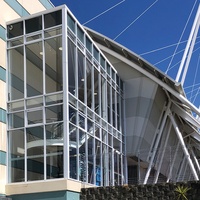
Fusing High Tech and PoMo elements, this well-used sports and recreation centre is organised around a huge sports hall. The hall’s roof structure was designed by Ove Arup & Partners, the international engineering firm behind High Tech icons such as the Centre Pompidou (1977), Rogers’ Lloyd’s of London (1984) and Foster’s Hong Kong and Shanghai Bank (1985). The roof is a thin arc that combines steel trusses and laminated timber beams, all supported by tension cables and rows of slender masts that run down the building’s long façades.Refer Architecture NZ May/June 1998 and Sept/Oct 1999.
11. 2003 – Peregrine Winery
2127 Gibbston Highway, Gibbston
Architecture Workshop
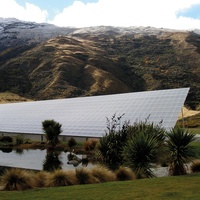
Christopher Kelly brought serious High Tech bona fides, honed on high-profile projects at Renzo Piano Building Workshop, including the Kansai International Airport near Osaka (1994) and the Aurora Place Tower in Sydney (2000). This wildly photogenic project is keyed to the scale and drama of its alpine setting. A vast translucent canopy twists gently over enclosures for the making, storage and selling of wine that are embedded in the ground below. The covered space generated between the two is for hosting events. The construction is technologically expressive but economically savvy, skilfully combining custom-made elements with off-the-shelf systems. See Monument 68 (Aug/Sept) 2005
12. 2008 – Waitomo Caves Visitor Centre
21 Waitomo Village Road, Waitomo
Architecture Workshop
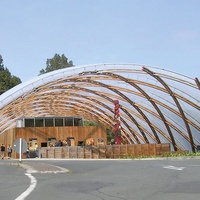
This groundbreaking project follows a similar parti to that of Peregrine — a light roof floating over embedded functional spaces — but dissimilar geometries, materials and context conjure a distinctly different result. It presents a version of High Tech that feels more locally grounded, with most of the building, including the spectacular lightweight grid-shell frame for the canopy, being made from timber and incorporating subtle references to a variety of local built and crafted forms. It won the NZIA Architecture Medal in 2011: see Architecture NZ Jan/Feb 2011. Architecture Workshop’s The Lindis (1490 Birchwood Road, Ahuriri Valley; 2014) completed a trilogy of remarkable canopy-ground projects.
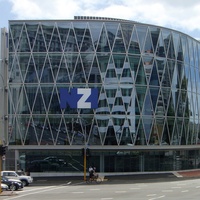
13. 2009 – NZI Centre
1 Fanshawe Street, Auckland
Jasmax
This building’s diagrid glazing made it one of Auckland’s most striking new commercial buildings but, as with other projects of the era, the technological expression is, in many ways, subsumed within simple forms. In plan, the stack of office floor plates peels back from the diagrid façade to create a dramatic five-storey atrium, a calm material palette animated by floating floor slabs, flying stairs and projecting meeting rooms. On the rear, a smooth plane of sun louvres masks service ducts, which snake, Pompidou-like, over the exterior. The building received an NZIA National Architecture Award in 2010. See Architecture NZ Sept/Oct 2009.
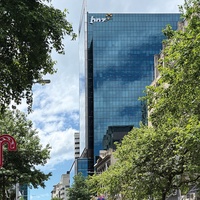
14. 2010 – Deloitte Centre
80 Queen Street, Auckland
Warren and Mahoney with Woods Bagot
As noted earlier, the advent of objects such as the iPhone generated a new image of the ways in which our increasingly digital technological environment was expressed in physical form. Our most advanced machines now didn’t express their parts and controls but were seamless and inscrutable. This aesthetic calming was absorbed by architects, and, in a review of this building, Bill McKay picked out the connection: “There’s a real iPhone chic to the Queen Street front, with the sheen of black glass in two vast planes that hover like a couple of really, really big flat screen TVs.” See Architecture NZ Jan/Feb 2010.
OTHER ADDRESSES
Given the association of High Tech with commercial buildings, and the risks created by exposing services and structure to the weather, many projects have been demolished or altered beyond recognition, including Mason & Wales’ Harbour Board Building (1980) at Port Chalmers and John Blair’s O’Connell’s Pavilion in Queenstown (1988). Much was also lost in the Canterbury earthquakes.
Colonial Mutual Life Building (1980, 1984)
117 Customhouse Quay, Wellington
Structon Group
Mid City (1981)
239 Queen Street, Auckland
Sinclair Group
The Oaks (1981)
73 Cuba Mall, Wellington
Warren and Mahoney
Gas House (1982)
426 Palmerston Road, Gisborne
Roger Walker
McLean Park Grandstand (1984)
Latham Street, Napier
Hoogerbrug, Magdalinos and Williams
National Bank Centre (1987)
Queen Street, Auckland
Glossop Chan Partnership
Montgomery House (1990)
190 Trafalgar Street, Nelson
Ian Jack & Associates T
The Pinnacle (1991)
406 Remuera Road, Auckland
Dr Robert Donald
21 Queen Street (2009)
21 Queen Street, Auckland
Peddle Thorp Architects An award-winning renovation and enlargement of an existing office tower.
William James Building (2010)
275 Leith Walk, Dunedin
Architectural Ecology
Eden Park South Stand (2011)
Reimers Avenue, Auckland
Jasmax and Populous
SOURCES
An excellent, if Eurocentric, general resource on this moment in global architectural history is Colin Davies’ High Tech Architecture (London: Thames & Hudson, 1991). More locally — and released in the mid-1980s when much of this local work was emerging – David Mitchell and Gillian Chaplin’s The Elegant Shed: New Zealand Architecture since 1945 (Auckland: Oxford University Press, 1984) comments on several of the buildings in this itinerary; intriguingly, its fascinating final chapter on the new ideas then emerging doesn’t point to technology as a key driver of change. Two of our landmark general architectural histories touch on some of the key High Tech buildings: Peter Shaw’s New Zealand Architecture (Auckland: Hodder & Stoughton, 1991) and Terence Hodgson’s Looking at the Architecture of New Zealand (Wellington: Grantham House Publishing, 1990). Rewi Thompson fans should seek out Jeremy Hansen and Jade Kake’s Rewi: Āta haere, kia tere (Auckland: Massey University Press, 2023). Also useful is John Balasoglou’s Stephenson & Turner (Auckland: Balasoglou Books, 2006). Gerald Melling’s The Mid-City Crisis and Other Stories (Wellington: Thumbprint Press, 1989) presents a stinging critique of both the forces at work in the 1980s and the results they produced.
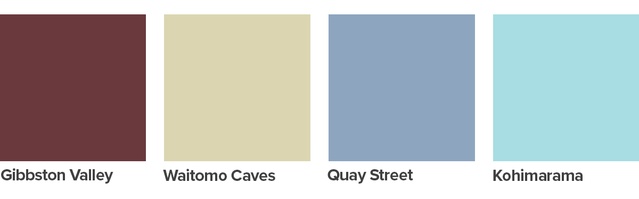
The Itinerary series is supported by Dulux Colours of New Zealand. Dulux Colour Specialist Davina Harper has selected a Colours of New Zealand palette based on this itinerary. See the full range and order colour samples here.