Making shadows
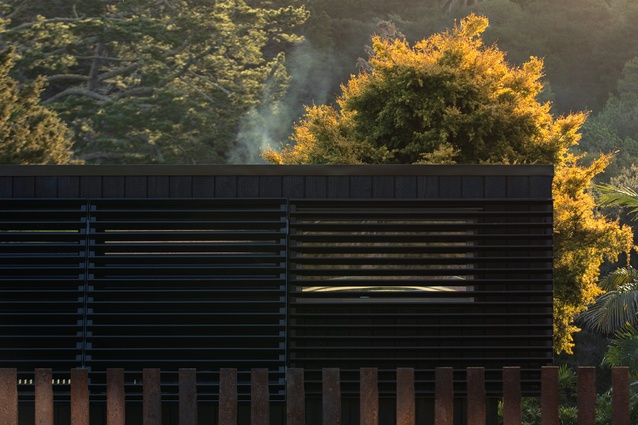
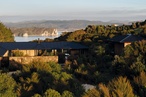
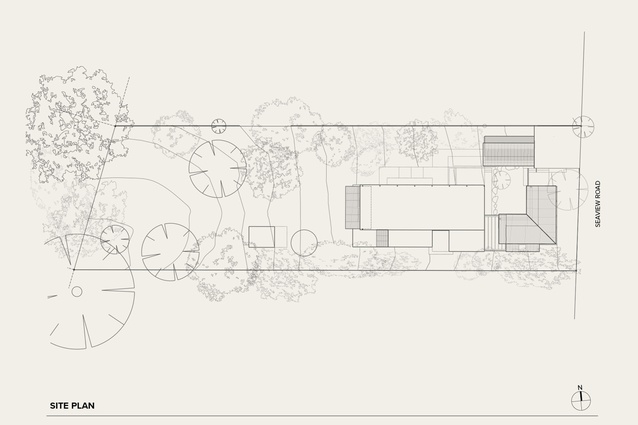
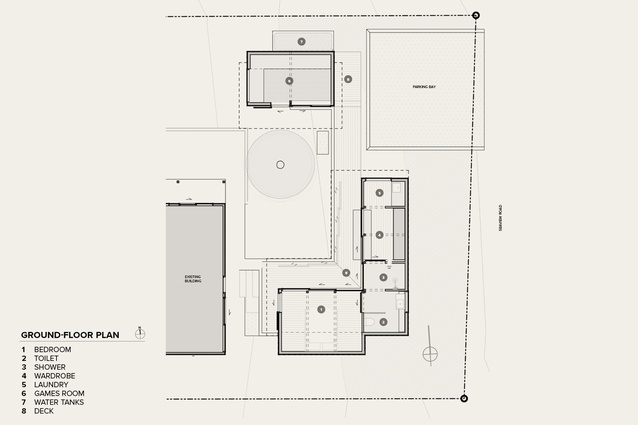
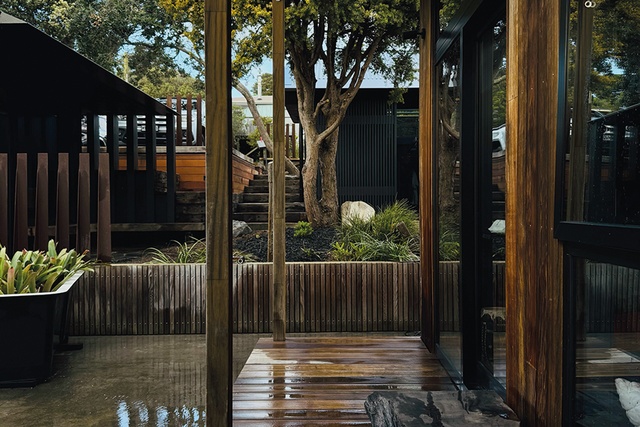
The new pavilions have been built around a large golden tōtara.
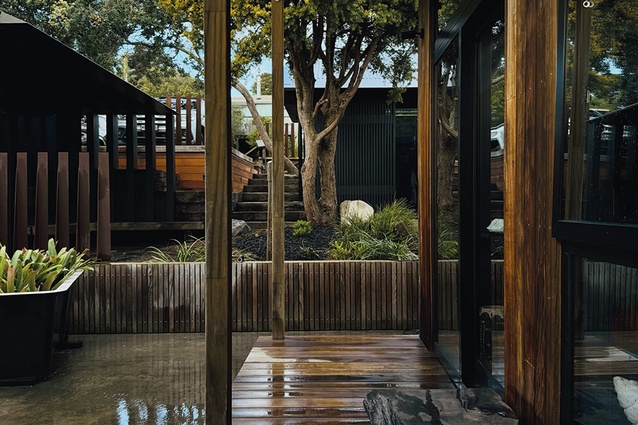
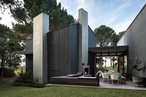
Connections to the new shadow pavilions from the existing house.
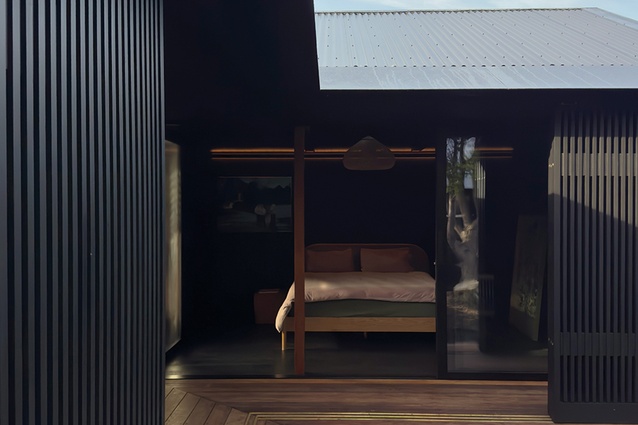
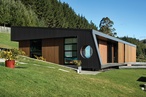
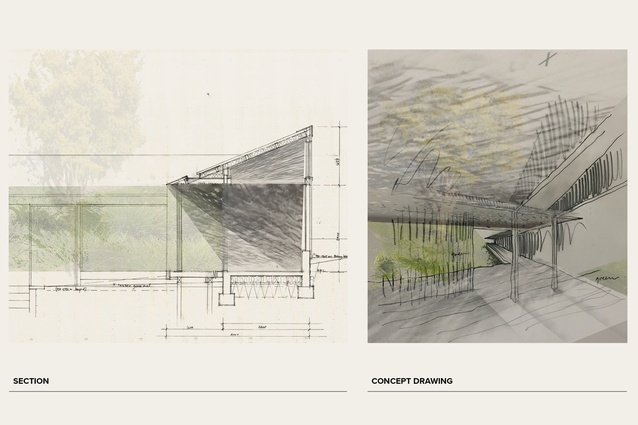
Shadowing beneath the razor-thin eave.
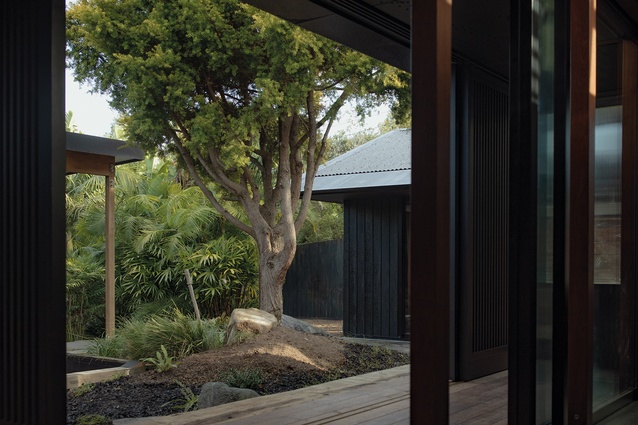
Contrasting materials to the central space: sharp to thick, smooth to uneven.
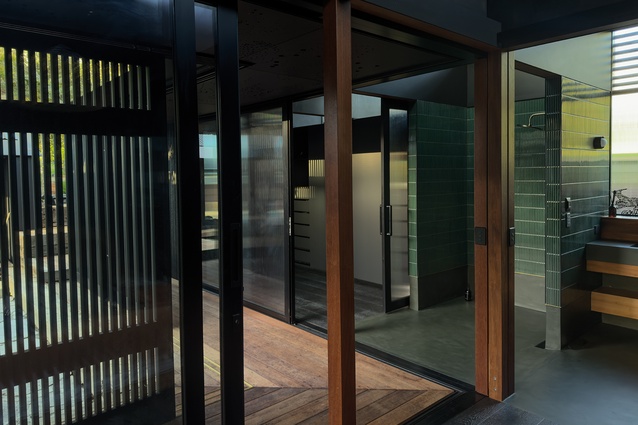
Layering from inside to out.
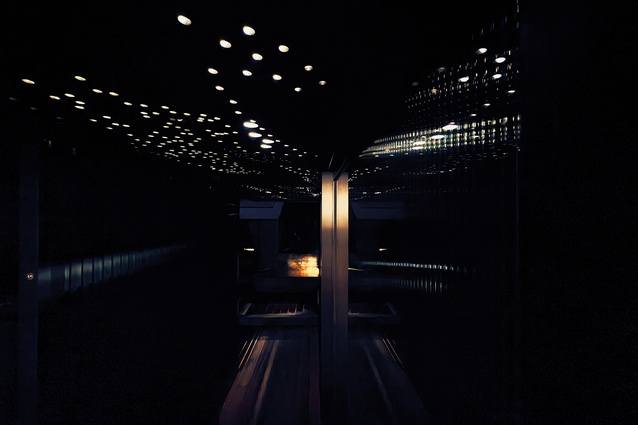
Madalena Refiti’s soffit patterning reflects in the glass sliding doors at night.
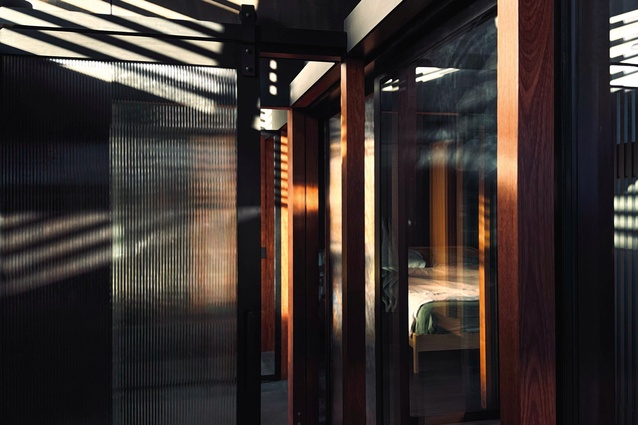
Layering from inside to out.
Slow needn’t be a bad word in architecture. Sure, finding enough coffee and pencils to make a start can stay progress but, even once under way, response times, typing speeds and hand-overs all readily jam.
The how, the where and, importantly, the when of architecture practice can’t all be cornered at juggernaut speed. With so much going on, why not jaunt your way to an architecture as if on a Sunday drive and save all that fast and furious wheel spinning.
Enter Lynda Simmons, the self-proclaimed “slowest architect in Aotearoa”. Her title may be readily contested but one project every four or five years certainly dragways her to the start line, if only occasionally. Holding on to that handbrake, though, doesn’t mean she’s not living and breathing architecture as are the rest of us. In what some might schedule as spare time, others as their family time, Simmons works a balance where she “allows time for architecture”. When the time arrives, she is also writing and teaching architecture and being instrumental in Architecture + Women’s journey. Her mantra to “choose how you practise and be conscious of it” may not yet be found in many professional practice notes but her work demonstrates that establishing time for everything else is not paradoxical to good architecture. This go-slow looks like a way of working that is well worth travelling. To get there, we commute some well-timed realities to life and architecture through a current project on Waiheke Island that isn’t just architect slow but slowed architecturally.
There’s some gold card envy on the ferry, which arrives with an on-the-hour, every hour, scheduling that alarms even the most easy-flowing. I know because in a past, and month-short, island life, I was precisely an hour late for work, often. Forgetting these past urgencies, I follow Simmons onto a bus and we talk our way to Onetangi, arriving some 20 minutes later to a house addition she continues to work on with photographers and cinematographers Tammy Williams and Martyn Williams. Tammy has successfully timed her way to work in the city today but Martyn is here and, like Simmons, is suitably dressed in all black. With the house gently lowering down the site and presenting a similar shadowy attire, on looking away, I promptly lose them in our national colour camouflaging. We are, with our north-south orientation and mountainous terrain, “the land of the long black shadow”1 as Colin McCahon described.
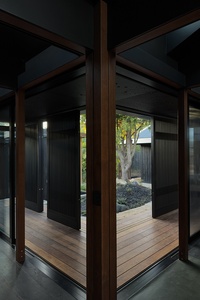
With pupils wide open, I locate them standing under a razor-thin eave. They are discussing a slow-to-arrive detail to the two little additions that now, with the existing house by architect Dave Melling, scale around a tōtara-centred courtyard. Thinking they’ve perhaps lost the fascia, I sample a conversation that might well run between Ansel Adams and namesake Wednesday. In fact, it is hard to tell which of these lines shadows from Tim Burton.
“The tunnel at the end of my light.”
“There’s shadow in the ceiling.”
“Texture is the key, for it holds the darkness.”
Take a moment and consider great American landscape photographer Adams developing an exposure technique early last century that added deep tones to black-and-white photography. Imagine the relief that was found in the darkness. Adams, with just the one ‘d’, famously described: “You don’t take a photograph, you make it.”2 It’s the same thinking here, just perhaps more Addams with two ‘d’s-esque: “You don’t find shadows, you make them.”
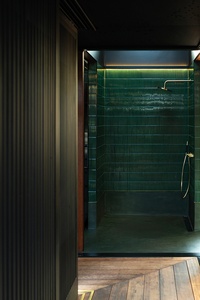
That conventional metreage brief was sooner (or later) left behind, as the trio started exploring photographic stills of the tonal gradations in the surrounding bush. From there, the process started wearing sunglasses at night and quickly established a dislike of supermarket lights, and prioritised spatial sketching, and ferrying and busing endless prospective materials to site for testing. If the pigment finishing schedule makes for some heavy reading — burned cedar, blackened steel, and onsite and factory blackenings — it is in recognition that each material textures and absorbs light differently. But it’s not quite all back in black, there’s a release in a de-hued green microcement and a browning to post and beam facings as they articulate the ins and the outs. Throw in an open-aired wardrobe that, interestingly, isn’t all Johnny Cash — at least not yet — and the lush greens of the surrounding bush, and it’s an opening in the veiling that enables a kind of de-punked and free-living Waiheke gothic. A bit like the ferry timetabling, there’s some freedom to be found between the scheduling.
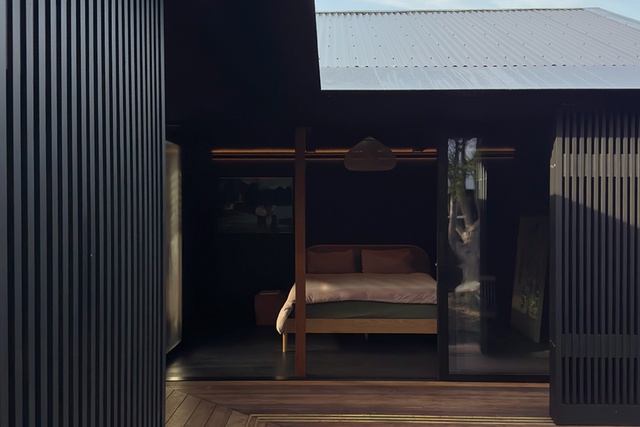
It turns out that Simmons and Williams are shadow-boxing a different but no less Burton-esque conversation through a faceted glass sample. Simmons’ “I’m leaning towards the Georgian glass” looks soon to be embedded into further drawings and detail for a late southern screen. Simmons here is quick to praise Nick Sayes and the team at Sayes Jackson Architects who undertook the documentation with their customary finesse. But, notable to the process is that, following regular visits into the detailing, Simmons subs back in for the contractual and onsite administration to weight the materials and sample a way to the finish. There’s a sense of old-time process in this caressing of the design on site that Simmons draws back to being “taught by an old timer”: her father, architect Neil Simmons. The lessons keep running, with daughter Madalena Refiti, a recent master’s degree recipient in Spatial Design from AUT, designing the soffit patterning and learning the process. But the sensibilities equally run to the detail.
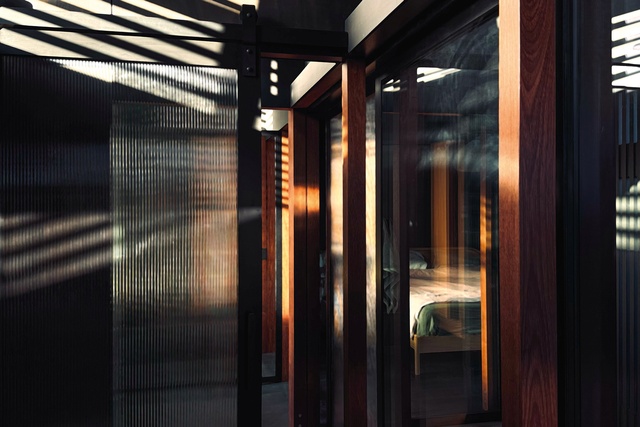
Waiheke’s need for water collection means that those blade-thin eaves hide internal gutters, with an external overflow and downpipe cleverly hidden around the corner and outside the weather line. Those lined baffles simply truss outwards to free up the inner glazed and outer ventilating sliders. That perforated soffit draws to breathe out the heat passively. Yet, if there’s some well-costumed smoke and mirrors in the detailing, the planning simply works like an onion to layer more out than in. Inside is so small they haven’t even added up an area. Nor do all the spaces yet have functions.
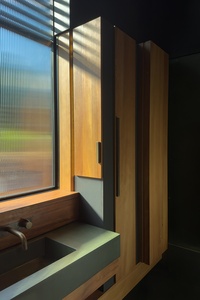
The main addition is clearly a bedroom cornering with a bathroom to a wardrobe, but the smaller rectilinear addition’s use is more ambiguous. Be it for teenager, guest, games or studio, it, too, has an eave sharpened like an Amy Winehouse fingernail and edges out over sleeper-sized and roughly finished timber steps. This cornering and layering from out to in, from sharp to thick, from smooth to uneven, works to slow the central space and allow those verandah-ing back under the eave to recess truly into the shadows. In all this go-slow, it is interesting that the work establishes spatial opportunities around a tree, with some similarities to architect Gordon Smith’s former home on Waiheke Island. Simmons’ is certainly more deeply toned and more present in its planning but, ironically, and to challenge her title, she’s been driving her process here only since 2021. Simmons isn’t near Smith’s 30-plus-year effort.3 There’s time yet, I suggest, to really settle in to re-read some courtyard origins with Charles Correa’s A Place in the Shade.4 Time to actually stain that bark if it fades, or piece some moments together, photographic style.
Simmons’ 1986 architecture school thesis was titled ‘Shadow is Defined: the architecture of the box’ so, in context and typology, she might not have gone far. Slow? Certainly. But Lynda Simmons Architect, “the slowest architect in Aotearoa”, takes some keeping up with. What’s next? Please don’t rush a response. Stay in your lane. Start a convoy. We can all wait. Good space takes time and scheduling.
References
1. Craig Potton, 2002, Colin McCahon: A Question of Faith. Amsterdam: Stedelijk Museum; Nelson, NZ: Craig Potton Publishing, p. 48.
2. The Ansel Adams Gallery, articles.anseladams.com/ansel-adams-quotes. Accessed 9.9.2025.
3. Jane Binsley, 2005, ‘Matter of Principle’, New Zealand Home and Entertaining, Apr/May: 48–49. 4 Charles Correa, 2010, A Place in the Shade: The New Landscape & Other Essays. Penguin India.