Of quadrangles, cloisters and corbels
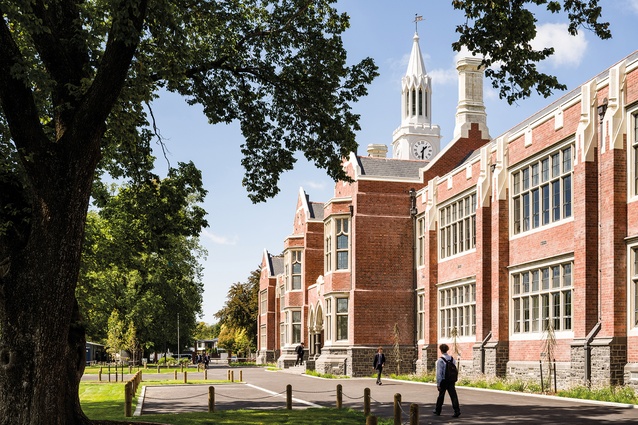
The principal façade of Christchurch Boys’ High School’s Main Block, looking eastward towards the entrance to the school grounds. Note the stone column of the entrance porch, one of a pair relocated from the school’s original 1881 building, adjacent to Canterbury College.
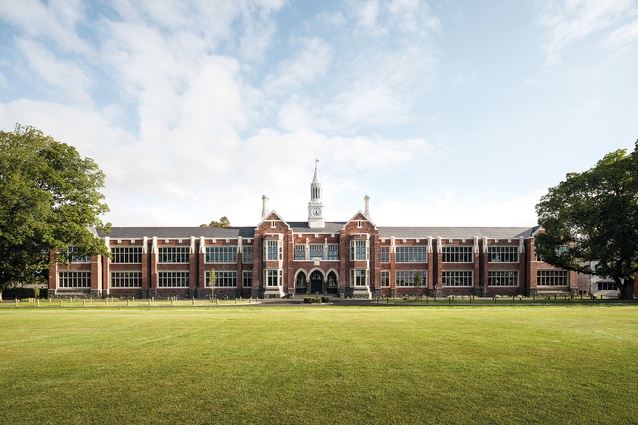
The Main Block viewed from the north; the school’s World War I memorial shrine, dedicated four months before the school opened on its new site, is aligned across playing fields with the building’s central axis.
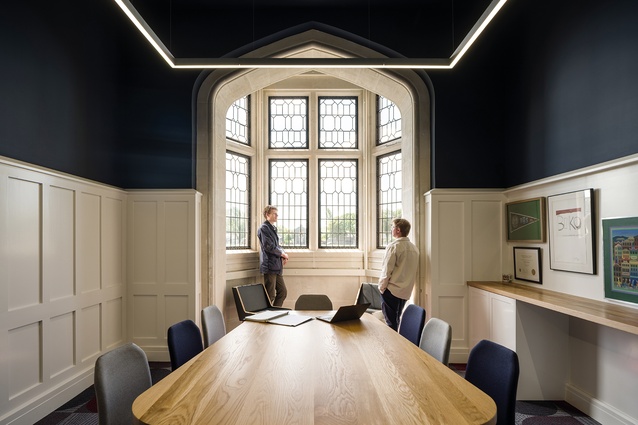
The office of the headmaster occupies the projecting bay with oriel window to the east of the main entrance.
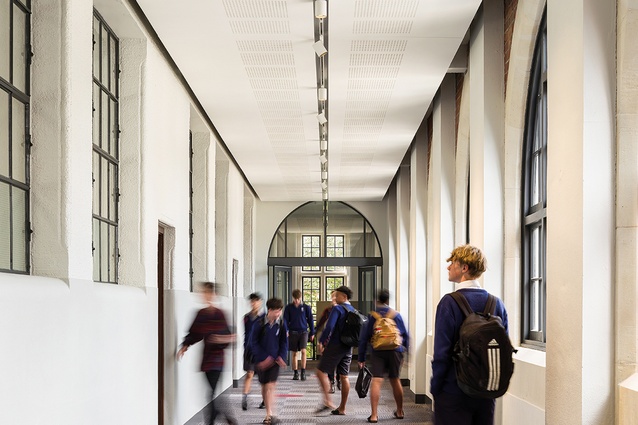
Corridors, originally open cloisters, link the linear sequence of classrooms and function as efficient, light-filled circulation spaces.
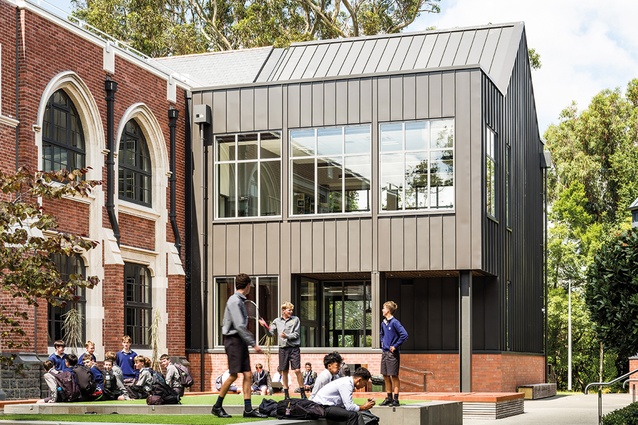
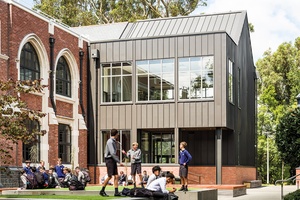
The eastern quad is viewed from the north. Although the addition’s materials and fenestration pattern are contemporary, its form and massing respect that of the earlier building.
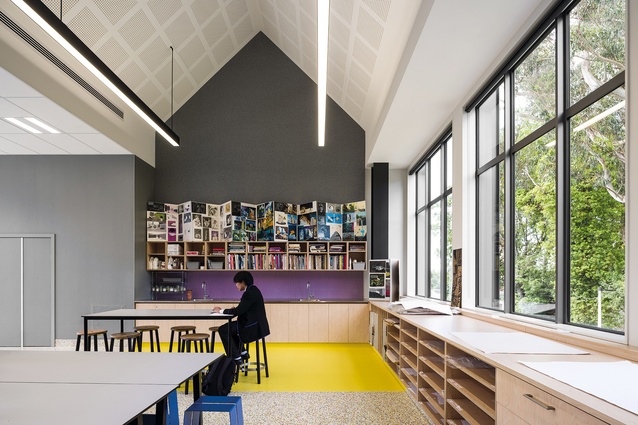
The spacious feel of the art studio is enhanced by the high ceiling, which rises into the roof gable, while its south-facing windows provide generous natural light.
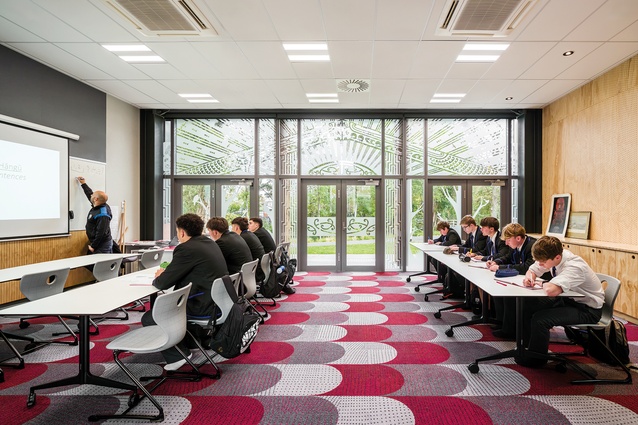
A dedicated Te Reo classroom opens to the newly landscaped river frontage. The patterns on the glass incorporate the traditional maihi form.
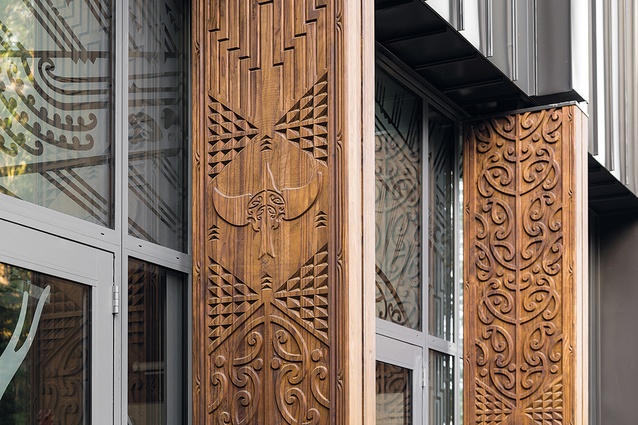
The ceremonial riverside entrance to the Te Reo space is signalled by carved wooden panels framing the doors.
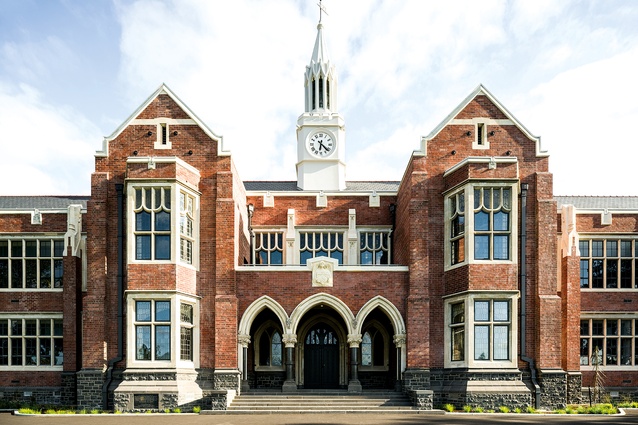
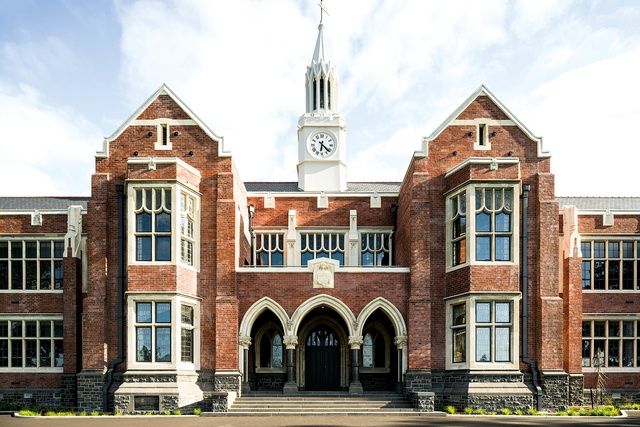
Christchurch Boys’ High School’s Main Block.
When Christchurch Boy’s High School moved from the building it had occupied since it opened in 1881, adjacent to Canterbury College in Worcester Street, to its new site on the former Deans farm at Riccarton, it was determined to retain a link with its origins.
The main entrance of the new building, designed by Guthrie Brothers, was given a porch screened by three Gothic arches, a direct quotation from W. B Armson’s original Boys’ High School. Such was the concern for the perpetuation of school traditions, however, that the granite columns supporting the central arch were removed from the Armson building and incorporated into the porch of the new school on Straven Road. Sceptics may regard this as myth-making, but Armson’s drawings and early photographs show the columns with their distinctive decorative bands while, today, the entrance of what is now known as ‘Old Boys’ High’ at the Arts Centre of Christchurch possesses a pair of plain columns.
Maurice Guthrie, who joined his elder brother John as a partner in 1919, was an old boy of the school and had trained in the office of Collins and Harman, the practice Armson founded in Christchurch in 1870. The incorporation of these columns into the new building would thus have had personal significance as well. An underlying consciousness of history and tradition is, in fact, a pervading characteristic of Boys’ High’s Main Block.
It is hardly surprising, therefore, that when, in the 1980s, it was proposed to demolish the Straven Road building because it was designated an earthquake risk, the school’s old boys rallied in its support. Seismic strengthening carried out by the Ministry of Works saved the building from demolition and ensured its survival during the 2010 and 2011 Canterbury earthquakes. So effective was this strengthening that it continued to be in use until the commencement of Athfield Architects’ current strengthening, conservation and refurbishment programme.
As completed in 1926, Christchurch Boys’ High consisted of the main range of a larger design that envisaged flanking wings linked by cloisters. A hall, positioned on the axis of the main entrance, divided the space formed by the cloisters into two quadrangles. Yet, as is so often the case in New Zealand architecture, future development occurred in piecemeal fashion. The south-eastern corner block of the original plan was added in 1927, but this was not connected to the main building until 1955, when a flat-roofed link building was inserted, although its elevations continued the brick-and-stone vocabulary of the earlier sections. The double-level open cloisters proved impractical and were enclosed during the 1930s. Apart from this and the 1980s strengthening work, the building had changed little since its opening, although incremental alterations to meet changing needs had compromised the clarity of the Guthries’ original design and deferred maintenance, especially since the earthquakes, had created a legacy of leaks and deteriorating masonry.
Viewed across expansive playing fields and framed by mature trees, the façade of Christchurch Boys’ High School is an impressive sight, anchored at the centre by the entrance block surmounted by its clock tower and flanked by double-height oriel windows. To either side are symmetrical, double-storey ranges of classrooms, divided into bays by paired buttresses and terminating at either end in projecting corner pavilions. Such rigorous symmetry would have been anathema to Victorian Gothic Revivalists but, by the 1920s, especially in the United States, the Collegiate Gothic style had been merged with Beaux-Arts principles, blending rational planning with traditional stylistic references. At Boys’ High, the decision to arrange classrooms in a linear fashion ensured good ventilation and was a direct response to the public health crises of the period. The provision of extensive north-facing windows meant that classrooms were well lit but recognition of the health benefits of sunlight, a feature more usually associated with early Modernism, almost certainly influenced this decision. Apart from the direct quotation of the main entrance, the Guthries’ handling of Gothic details is also of its time, especially noticeable in the geometric abstraction of the buttresses with their strangely sunken pinnacles.
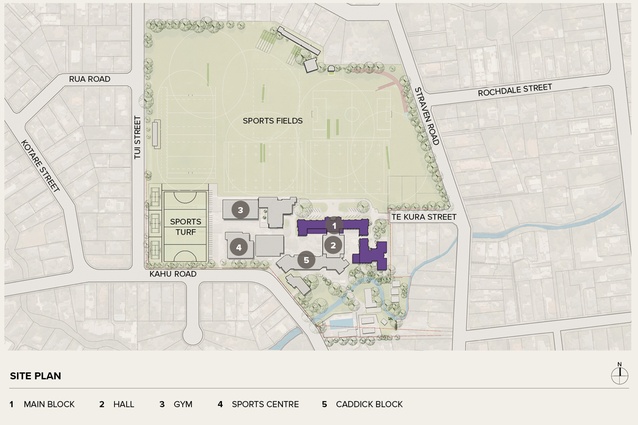
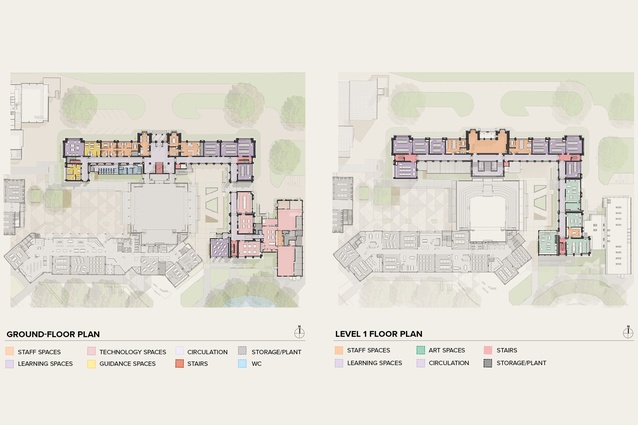
Although the most publicly visible building on the site, the Main Block was, by 2017, only one of a much larger collection of school buildings and part of the architects’ challenge was to integrate it into this larger context while retaining its important symbolic identity. Their task was further complicated by the fact that they were dealing with a building that was almost a century old, suffering from earthquake damage and decades of deferred maintenance. An additional constraint was the Main Block’s Heritage New Zealand Category 1 listing and Group 1 listing in the Christchurch City Council’s District Plan Schedule of Historic Heritage.
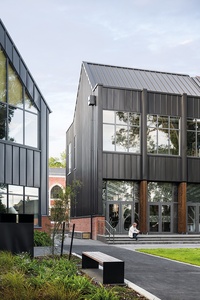
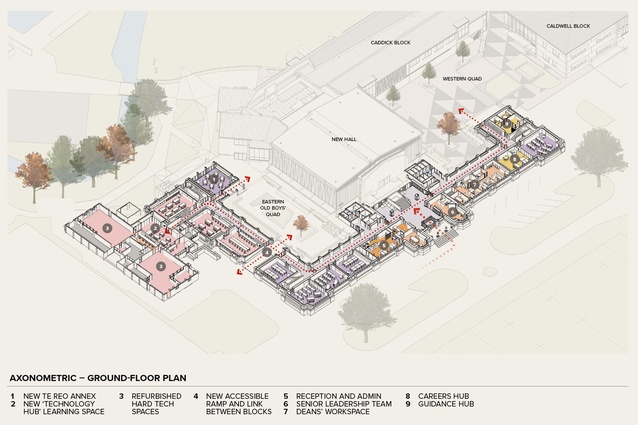
Perhaps the most remarkable feature of Athfield Architects’ interventions at Boys’ High is how little they show. At first glance, the exterior seems unchanged, until you notice the renewed slate roof, the cleaned and repaired stonework and rose washers on the gable ends, where seismic strengthening has been inserted into the roof space. The only addition has been at the south-eastern corner, where the 1927 block has been extended to the west to create a classroom dedicated to the teaching of Te Reo on the ground floor, with doors opening directly to the newly landscaped riverside, and a new art studio on the upper floor, with large, south-facing windows and a high ceiling rising into the gabled roof. The addition’s standing seam steel cladding links it to the adjacent Caddick Block, completed to Athfields’ design in 2021, but its form is dictated by the ridge height and massing of the existing structure. The ceremonial riverside entrance to the Te Reo space is signalled by carved wooden panels framing the doors and patterns on the surrounding glass representing maihi, designed by Ariki Creative and rendered in cut vinyl frosting. While clearly new, this addition blends with the old and recognises the transition to the contemporary architectural vocabulary of the neighbouring block.
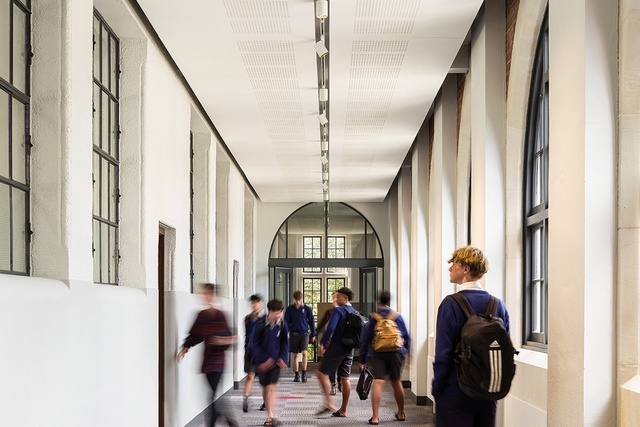
On the interior, similar restraint is everywhere in evidence. The main entrance lobby has hardly changed except that the wooden panelling has a freshly burnished look and the entries to the main reception on the left and the office of the senior leadership team to the right have been subtly widened and made transparent. The school’s administrative hub now clusters around the main entrance but, beyond this, the classrooms largely follow their original configuration. Services in both the cloisters and the classrooms have disappeared behind lowered ceilings, while acoustic panels and carpets absorb sound and create an atmosphere of ordered calm, even when thronged with boys during the changeover between classes. The clarity of planning originally envisaged by the Guthries, and now realised through Athfield Architects’ interventions, reveal that the more-than-one-thousand-year-old device of cloister and quadrangle still has relevance in 21st-century New Zealand.
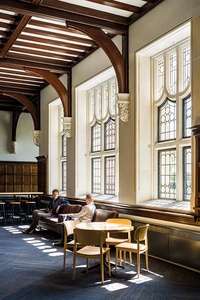
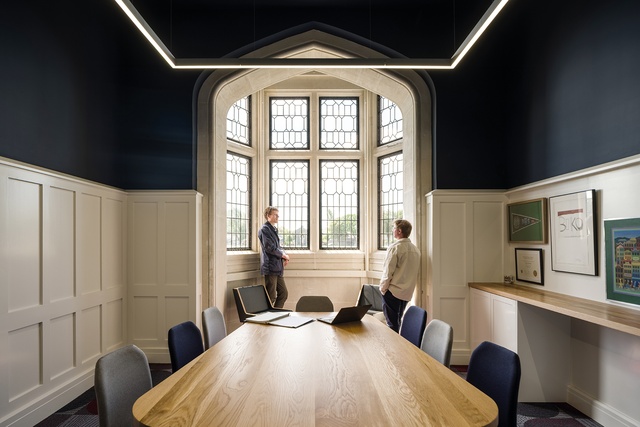
If the original stairs at either end of the Main Block seem slightly narrow by modern standards, there was a noticeable lack of jostling as boys found their way to classrooms on the upper floor. This is, perhaps, a reflection of an unconscious recognition that they are fortunate to occupy a building that is steeped in history yet meets the standards expected of a modern school. The staffroom, occupying the space of the original library overlooking the main entry, has decoratively carved stone corbels, glowing timber beams and panelling, more akin to an exclusive club than to a workaday school environment.
From the threshold of the main entrance, the view to the north extends across playing fields to the school’s World War One memorial shrine, also by the Guthries, unveiled in January 1926, four months before the school itself opened on its new site. Turning through 180 degrees, the other component of this memorial axis is revealed: the World War Two Roll of Honour that frames the entrance to the hall at the top of the first flight of the main stair. Such a powerful conjunction of architecture and landscape is unusual in New Zealand but it highlights the value of heritage retained and celebrated. By following the well-established conservation principle of doing ‘as little as possible and as much as necessary’, Athfield Architects has given new life to a building that has nurtured generations of students, among them, Sir Ian Athfield himself.