On storage and stuff
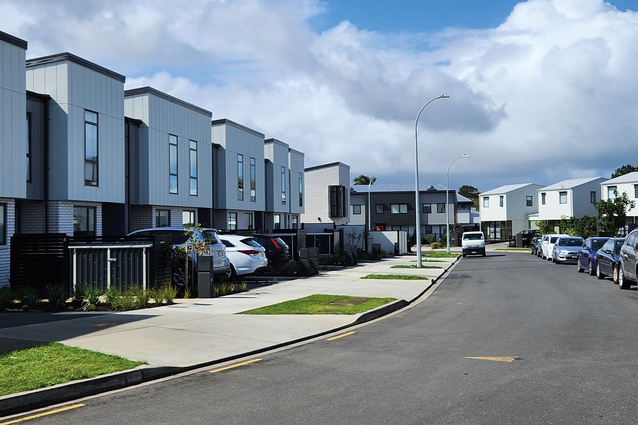
Mediumdensity housing in Auckland’s Māngere.
Anthony Vile discusses spatial minimums, consumerism and life in medium-density housing.
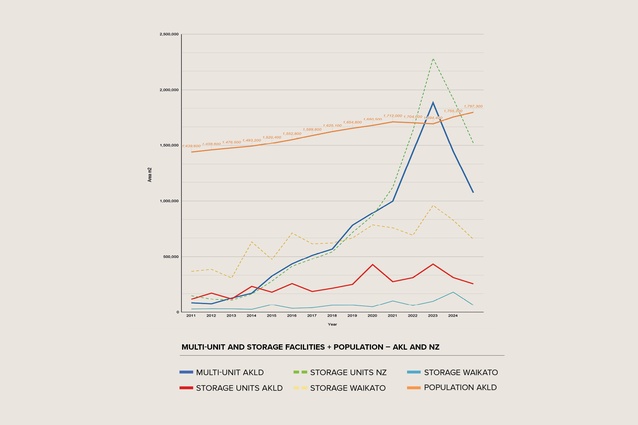
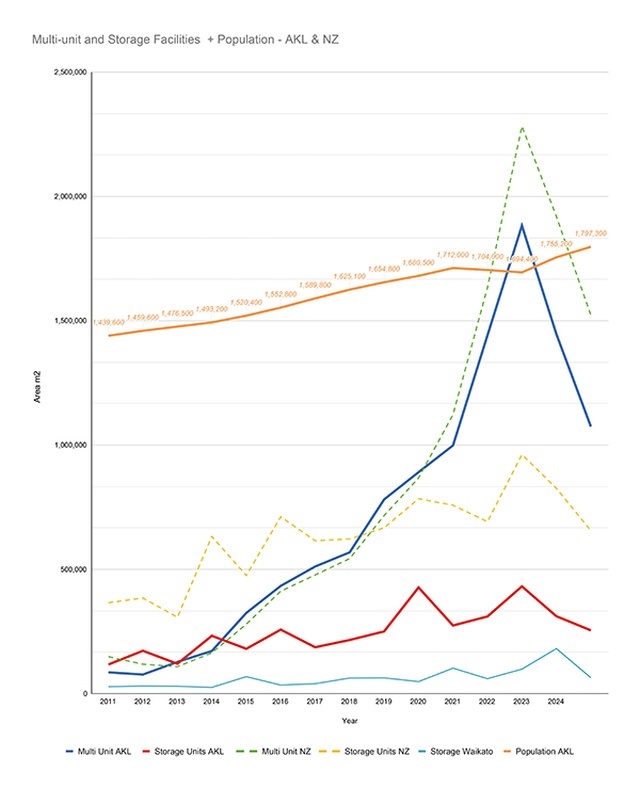
The push for yield maximisation and ‘efficiency’ of design in medium-density housing (MDH) is eroding functional elements historically associated with the family home. Where design minimums are not legislated, utility spaces like storage are targeted as non-critical, running the risk of being reduced in scale or even eliminated. Storage space has become a casualty of austerity and, ironically, a symbol of a successful free market in action. Population growth coincident with the reduction of domestic storage in MDH is driving the rising demand for offsite storage facilities as necessary urban infrastructure. The private sector has embraced self-storage as a profitable asset class — cheap to build, low risk and offering stable, long-term revenue, thanks to persistent demand. Unitary Plan intensification in Auckland has driven the evolution of a new, highly rationalised building type: the multistorey storage facility.
This architecture is based purely on clear dollar-percubic- metre returns — the poetics of space reduced to an algorithm — making it the ‘bean counter’s dream’. In Auckland alone, the four largest operators – Kennards, National Mini Storage, National Storage and Storage King — collectively hold approximately 330,000m2 of storage space, an estimated volume of 792,000m3. Investor confidence is underscored by recent acquisitions; National Mini Storage was purchased by Kennards for AU$4 billion, equating to AU$50,000 per m2. Storage, it seems, has become a high-value and high-volume business, with rents generally in the NZ$300–$360/m2 per annum range.
LIFE IN MEDIUM-DENSITY HOUSING
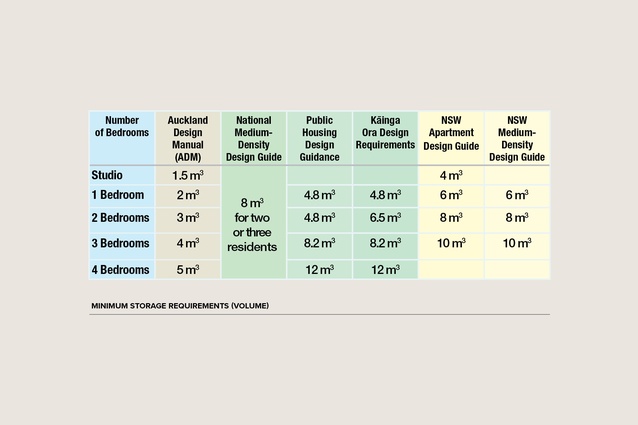
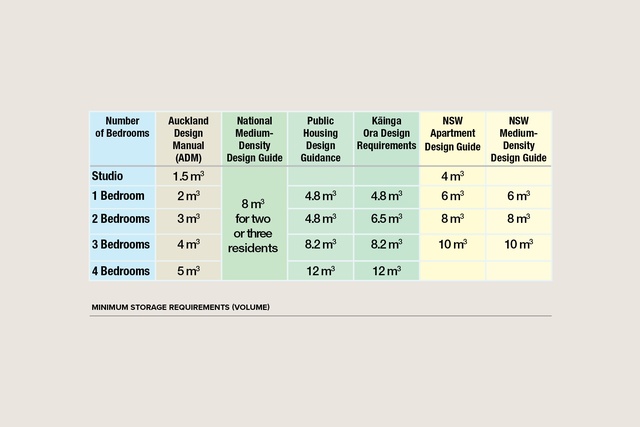
The rise of the self-storage industry clearly demonstrates the market’s response to a deficit of domestic provision in MDH. But what are residents’ actual experiences? A recent Auckland Council study sheds light on this. In 2023, Auckland Council’s Economic and Social Research and Evaluation team and Tāmaki Makaurau Design Ope (TMDO) completed the Life in Medium Density Housing in Tāmaki Makaurau study. This research investigated how Aucklanders are experiencing life in recently built MDH, providing analysis of 57 design attributes based on online surveys completed by 1243 households. The findings painted an objective picture of six years of intensification. Feedback regarding the human need for storage was clear: “Storage is inadequate for many households. Over half of all the participants reported that they had insufficient storage for general household items (e.g. vacuum cleaner), linen, kitchen equipment and food, and occasional items (e.g. suitcases).” “For those households with a garage and at least one car, half used it for purposes other than parking their car, including storage, exercise, as a study and for other living activities.” Notably, the draft Unitary Plan originally included minimum standards for storage provision, with the purpose to “ensure dwellings have sufficient space for the storage of everyday household items and bulky items, such as bicycles”, but these were removed in the operative plan. The reason — whether developer lobbying or otherwise — is unclear but the effect is the creation of a clear deficit. Despite this, bestpractice guidance does remain for minimums, as summarised in the table opposite. Global ergonomics and housing research generally suggests that the average human adult generates 1–1.5m3 of long-term storage need (seasonal clothing, sports gear, archives, tools, etc.) in addition to daily cabinetry. This is roughly equivalent to the storage volume of our top-selling family wagon, the Toyota RAV4, which provides 1.6m3 of storage with the seats down.
THE ILLUSION OF MINIMALISM AND THE REALITY OF CONSUMPTION
The minimalist houses featured so often in glossy design publications exist largely through the practical application of expensive, hidden storage strategies. Though photographed without the clutter of daily life, these houses are built to be lived in, and even minimalists have a significant volume of objects — practical and symbolic — to be curated, filed and hidden with the help of German-engineered hinges and expensive cabinetry. In a society obsessed with growth and consumption, the lack of accessible, affordable domestic storage only intensifies the problem. Alternatively, as useful social policy, rather than encouraging consumption, we could enforce the reading of The Gentle Art of Swedish Death Cleaning: How to free yourself and your family from a lifetime of clutter and stop buying so much stuff we don’t really need. “Simplify your life by surrounding yourself only with things that bring you joy.” Even the recent IKEA Life at Home Report New Zealand 2024, based on 500 home visits across the country, confirmed that widespread dissatisfaction with storage indicates a key domestic need for Kiwis. The report noted: “Kiwis are seeking to maximise functionality and storage to accommodate a growing number of activities across different multifunctional rooms in the home.”
Though not a human right, the provision of a basic level of storage is assumed as a human need, when considering homes are “to be designed to meet day-to-day needs of residents”
OUR APPETITE FOR STUFF
The deficit of household storage highlights not just a design flaw but a broader cultural tendency: our massive appetite for stuff. Stuff is manufactured to address utilitarian and emotional needs, as well as to generate a dopamine hit at the checkout. Stuff comes from somewhere, needs to be stored somewhere and needs to be disposed of somewhere. “It’s said that almost 90 per cent of everything we consume is shipped in a container.” Auckland and Tauranga ports annually handle a staggering volume of imports. If you were to stack the combined number of TEUs (20-foot equivalent units) processed annually onto a one-hectare site, the stack would reach approximately 3172m into the sky. That is a mountain of stuff — 85 per cent of the height of Mount Cook — that annually needs to be distributed, sold, organised, stored and, ultimately, disposed of. While the deficit of storage in our developer-delivered MDH stock is an evident problem, it runs in parallel with our need to reflect on and refine our appetite for buying stuff generally.
ESSENTIAL SAFEGUARDS FOR LIVEABILITY
The future house is fluid, flexible and distributed. The trend of distributing elements of the house into the urban fabric is visible in many cities. The laundry is relocated to the laundromat, the backyard to the local park, the dining room to the local bistro, the lounge to the local cafe or bar, storage to the storage unit. The city is the new house. However, in the wave of neo-liberalism pushing the free market as our saviour, the deletion of design minimums needs to be cautioned. Best-practice guidance on minimums to support healthy and culturally supportive living environments is required. The outcome of research is clear. Some things in design, despite the naysayers, are not subjective, and need to be approached with an engineer’s pragmatism. Humans require minimums for survival — oxygen, food, water, sunlight, weather tightness and, critically, storage. The evolution of MDH in Auckland reveals both the strengths and shortcomings of our planning framework. Intensification has delivered more housing but, often, at the expense of liveability. Storage, though rarely glamorous, remains fundamental to domestic life. Without it, residents turn to offsite facilities, fuelling a profitable and growing industry with the burden of additional costs transferred to individuals. MDH reveals a critical lesson for architects and planners. Design minimums aren’t bureaucratic constraints; they’re essential safeguards for liveability and an opportunity to deliver genuine long-term value to our communities. Now, where the hell did I put those golf clubs? Thankfully, they’re only 3km away in my storage unit: just a quick dash in my RAV4.