Pip Cheshire 2013 Gold Medal interview
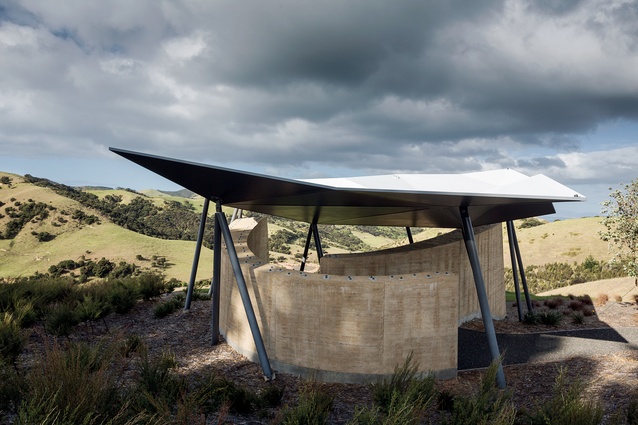
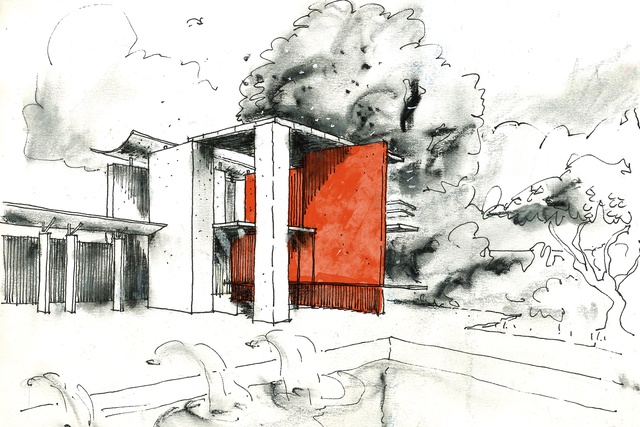
Rore Kāhu’s walls are constructed of rammed earth, the same technique used in Russell’s Pompallier Mission of 1842
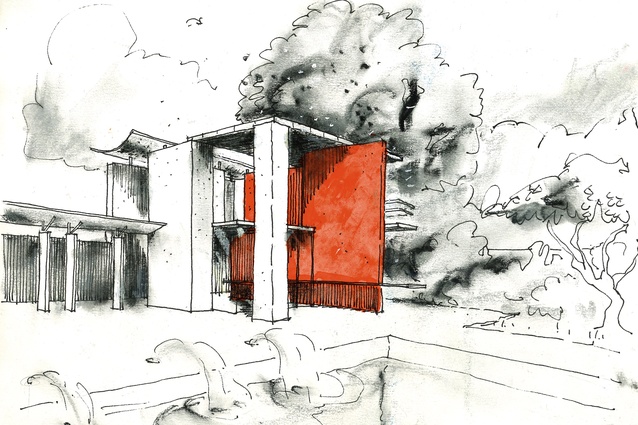
The pool house at the Congreve House – the house writ small.
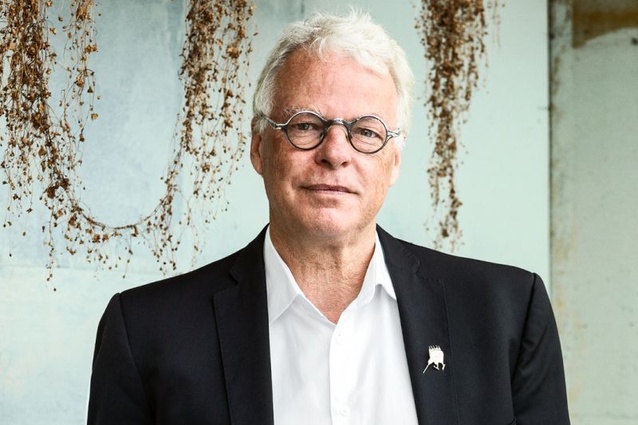
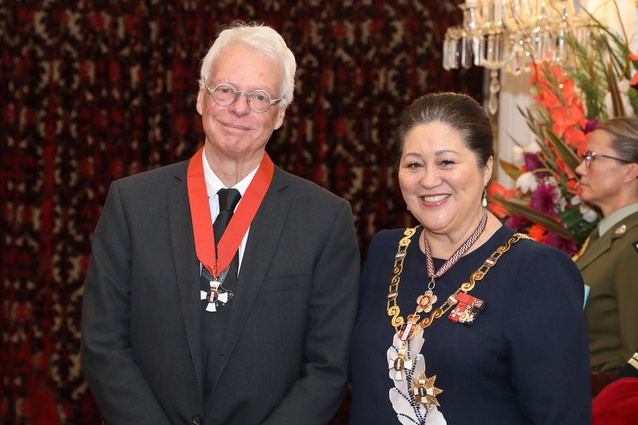
In 2013, Pip Cheshire was awarded the NZIA Gold Medal, he sat down with the then editor of Architecture NZ magazine, Justine Harvey in a wide ranging interview.
Justine Harvey (JH): Shall we talk about where you came from and the early influences that led you along the architectural path?
Pip Cheshire: I was born in 1950 in the beach suburb of Sumner in Christchurch. My parents were very friendly with Paul Pascoe, and Peter Beaven lived down the road when I was about nine or 10.
JH: Did you know Peter Beaven then?
My father did. Peter was a bit younger than my dad and was involved in establishing the Akaroa Heritage Trust, an organisation to protect the character of Akaroa; we had a house there, so my father got caught up in that. My father commissioned Peter to make a building in Sumner that gave rise to a public protest meeting which vilified both Peter and my father.
JH: So it wasn’t built?
No. It was a high-rise, about four stories in the middle of Sumner, and it wasn’t built, largely due to the outcry.
Back then, I didn’t know much about architecture at all. I went to high school in the city and had to commute there from Sumner. Christ’s College was probably my first engagement with architecture; it’s so full of very serious buildings, including Cecil Woods, early Warren and Mahoney, Speechly, Pascoe and others. Then, I went over the road to the Arts Centre, which used to be the town site of Canterbury University with its very strong buildings by Mountfort and others, and studied political science. I had long hair, played in a band, worked on the student newspaper, surfed and spent a lot of time chasing girls. I also worked part time labouring in a plastics factory, so I scrambled out of university with a very poor Bachelor’s degree. It was the ’60s and it felt like I was there forever.
JH: Did you have an interest in making things at that time?
I was more politicised than anything because I’d been involved in various groups at the university. During one of the proposed All Black tours to South Africa, around 1971, I invited HART people to speak to the factory, so the management shifted me into a tiny little perspex factory to get me out of the way. I was floundering around anyway so I left. I finally graduated and my father had a factory making industrial safety equipment and I worked there. But I couldn’t work for him because we had argued all the way through the Vietnam War, so I set up a little fibreglass factory of my own with about 10 or 12 people working for me and supplying him with components.
JH: You would have been quite young.
I was probably 24. One day, I was playing chess with someone I flatted with and we saw a television news report about a building that had received a national award for architecture. My friend taught in the building and told me he thought it was a terrible building. I said, “Well, that’s ridiculous; we should be able to do better buildings than that,” and he replied, “Well, why don’t you go to architecture school?” Pretty much the next day, I flew up to Auckland and met the dean at architecture school. I sold up the factory, got married, drove north, stopped on the Canterbury Plains, wiped the dust off my hands, shook my fist at Christchurch and said, “I’m not going back there”. It seemed too small. I was going to a new life, it was like being reborn.
My first year at architecture school was in 1976. I cross-credited some papers, so I didn’t have to do an intermediate year, and I had a great reference from Paul Pascoe that said, “I’ve known Pip since he was born; he should be allowed to do anything he wants to do”. That was it.
JH: Do you still have the letter?
No I haven’t, I gave it to the school in the days before copiers and I didn’t really know how special that letter was.
When I went back to Christchurch to see my grandmother, she hauled out a newspaper interview with me from when I was 15: a brave one-legged-surfer kind of story. It said that when I left school I wanted to be an architect.
JH: You didn’t remember the interview?
Well, not the statement; it took me 12 years to realise the intention.
JH: Did the journey between those points help you?
It just made me impatient. I felt I had to catch up and I was terribly excited and eager. I turned up at university on the first day and the students had called a strike. I thought, “This is great”, because Canterbury was really exciting like that for a while. We’d had a clandestine printing press and, in the middle of the night, we’d churn out mimeograph documents. At the student paper, you could get on the phone at night and ring up Muldoon and say, “Look, Canta the student paper here, what do you think is happening about so and so?” Everything was really tense; I remember interviewing the head of police down there and he looked at me and said, “Cheshire, you’re studying political science, sociology and economics”, and I said, “How do you know that?” He took me into a room and showed me a wall full of photographs with names that had been taken from an upstairs room looking over at the hotel we used to drink at.
JH: Was he trying to spook you?
Yeah, I guess so; it was that time towards the end of the Vietnam War when the anti-apartheid movement was strong.
JH: So, being at architecture school, what inspired you? Did your thinking change?
Well, I was an older student which made a difference but I think it was a very indifferent time at the school while I was there. It was not very academic. I was impatient and wanted to get working. So, during my last year at school, I designed a restaurant in the city and it took up a lot of my time. I probably shouldn’t have done that because it was at the sacrifice of doing a good final year.
JH: But, you probably learnt more from doing the restaurant.
Yeah, but not intellectually. Universities offer the pursuit of architecture as an intellectual discipline and that is the single most important thing. It’s not a craft or trade skill. Walking the colonnades and discussing the meaning of life and architecture is a fine thing to do for four or five years. It’s a fine preparation for a profession. Anyway, I didn’t do that. Instead I designed a restaurant called The Melba in Courthouse Lane, which was very fashionable. It opened about the time that Metro magazine started and it was always in the gossip columns. It was called the ‘grey watering hole’ and was one of the first bars in Auckland. The licensing laws were such that you still had to serve food but it had a huge, great bar running through it and the food was a secondary thing. It was always the scene of extraordinary things, like somebody riding a horse into the bar with a sword and lopping the top off a bottle of champagne. The country was awash with cheap champagne at that stage around 1981/’82.
When I left architecture school, I handed in my thesis and an hour later I’d moved into a tin shed on Jervois Road in Ponsonby that students had set up as a studio. By then, it was just Amanda Reynolds, Mal Bartleet and then me; then Pete Bossley arrived three months later. He was an escapee from the Ministry of Works and operated under the nom de plume of Roy L Dalton. So that lasted for a year or two, then Bossley and I got together and formed a practice. A couple of years later, some guys from JASMaD rang up and said, “How about we get together?” and, after about a year of talking, we formed JASMAX and I was there for 15 years.
JH: And how was that time?
It was alright. It was interesting because it drew on my management experience as much as anything. I went from fibreglassing to, eventually, in the last couple of years at JASMAX, running a practice of 150 or so very skilled people and I had never done an apprenticeship in architecture.
JH: Obviously you must have people and leadership skills to naturally manage people.
Well, I don’t know. I often think that I have an ego bigger than my ability.
JH: Architects have to have an ego though. You wouldn’t survive otherwise.
I guess that’s right. I think that I promote people a lot, take young graduates, or anybody really, and support them, push them and give them opportunities. A cynic would say that I have gained success on the coat-tails of very able people around me. I say: surround yourself with people who are better at doing things than you are and empower them.
JH: So, at what point did you decide to go out on your own?
Well, I was managing JASMAX and finding it increasingly challenging, I suppose. It was a big, flat structure that had grown quickly and required complex management that took up too much of my architecting time.
JH: It’s a big responsibility.
Oh yeah, I enjoyed all of that but I felt I should be committing more to the intellectual art of architecture. When Britomart came along, I introduced Peter Cooper, whom I’d designed houses for, to Greg Boyden, who’d done the underground rail station, and the City put the above-ground element out to bid. Cooper said, “Look, you’re my architect”, pointing to me. I was happy be his architect, because Cooper and I had become quite close, but the City said, “You are nominated project architect for Britomart but you’re also managing director of JASMAX and an adjunct professor at the architecture school; you can’t do all those things, so we’ll be back in half an hour to find out what you’re going to do about it.” I thought, “Oh, that’s pretty interesting.” But everything just fell into place after that. I said to Peter, “Well, I’ll resign from the practice but, if I do that, will you commission me to design the masterplan if the bid is successful?” He said, “Yeah.” So I resigned and that actually all happened within 10 minutes or so.
JH: A life-changing decision in half an hour.
Yes, a bit like going to architecture school, sometimes the stars align and you have to be ready to seize the day.
I thought that I would sit in a room, with an old table and a leather chair, with my feet on the desk doing the masterplanning of Britomart and others would make the buildings. But the first client I told said, “You’re leaving? I’ll carry your bags, I’m coming with you”. And I thought, that means I’m starting a new practice. It was good and bad, but it wasn’t what I planned at all. So I had to form a practice and then I was inundated with people wanting work.
JH: They must have enjoyed working with you.
I think that, for better or worse, I represented a commitment to architecture, rather than the business of architecture. I’ve always said, “If you are concerned about money then you can’t be taken seriously because, if money is your prime motivation and you chose architecture, your decision-making is deeply suspect from day one.”
So, the contract was won by Cooper and Co and they said, “You can occupy any building you like in Britomart”. I was given a big bundle of keys and I went around all the buildings and found the beautiful Maritime Building on Quay Street, where Cooper & Co is now. It had power and phone but I didn’t know where they came from. We squatted there for a year or so. Then we flashed the neighbourhood up too much and Cooper & Co started getting serious about rents. I was able to buy this office on Hobson Street for the same cost as the rent. I was pleased with the shift because when we came here people realised that we were serious about the practice.
JH: So what are the key projects that have meant a lot to you?
Well, the first project was The Melba restaurant and the next one would be Congreve House. That’s a big leap; there’s a whole bunch of projects in between which are close to the heart, but those are ones which probably made the greatest leap for me.
I designed some townhouses in Arthur Street, which are full-tilt, postmodern – little white boxes with Corbusian references on the inside and, on the outside, they have an overlay of pipes, tubes, tiles, colours and wonky shapes. I was thinking about a discourse, a sense of the European heritage and an engagement in Maori and Pacific heritage. Colliding things offered the opportunity of bringing ideas together and somehow you might get an architecture that was an Auckland one – whimsical, as you might say Ath and Walker’s more flamboyant buildings were. Although, in a way, it was a really trivial way of handling things: it was all to do with pattern and colour. You see that in every bloody competition scheme that’s done; people make a paving pattern saying, “Oh, the paving pattern is reflective of the tukutuku panels” – spare me.
JH: It becomes cheesy, as opposed to a concept being intrinsic to a scheme – a surface element rather than an intellectual element.
Yes, I think the elements which can be drawn from Pacific architecture are actually spatial organisations and sequencing: so the way in which a marae is very informal, all very relaxed with balls being kicked about then, all of a sudden, someone will straighten their tie, clear their throat and instantly it becomes a highly formalised space. I think it’s very interesting the way a ‘welcome’ is dealt with spatially and the Maori protocol is supported by or facilitated by certain arrangements of people and space. The entry is not immediate; you don’t just charge up to the front door, so there’s a reticence about approaching space until you’re invited on, or called on, if it’s a marae. That’s not just a Maori but a Pacific phenomenon. I think our culture is slowly absorbing that. It’s a slow process of osmosis but there is an opportunity to bring together cultures and the architectural implications of those cultures are somewhat more profound than the pattern-making on which much of it relies at the moment.
JH: So you worked on Te Papa?
While at JASMAX, I was on the periphery of Te Papa; I helped win the competition, did some midnight hours and made the final presentations to the judges.
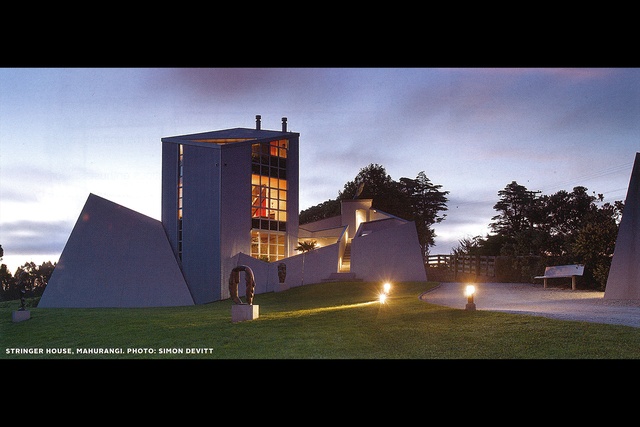
The Congreve House was built then, it was designed at Bossley Cheshire but documented and built while I was at JASMAX. I also designed the Bruce Mason Theatre and the JASMAX building at the top of Upper Queen Street. That was a semi-deconstructed postmodern thing I really liked and I designed Peter Cooper’s house at Clifton Road, which is a really good house. I designed houses for Stephen Bambury and Terry Stringer while at JASMAX too.
JH: And there were some projects in Antarctica as well, but that was later wasn’t it?
It started about 2002 or 2003. It is the conservation of Scott’s and Shackelton’s huts. It’s an ongoing project I’m still involved in.
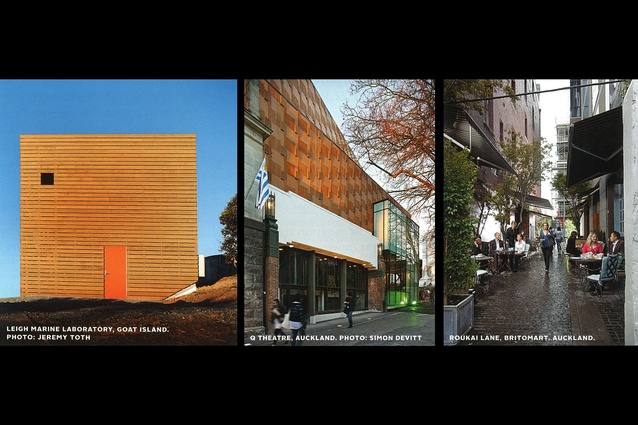
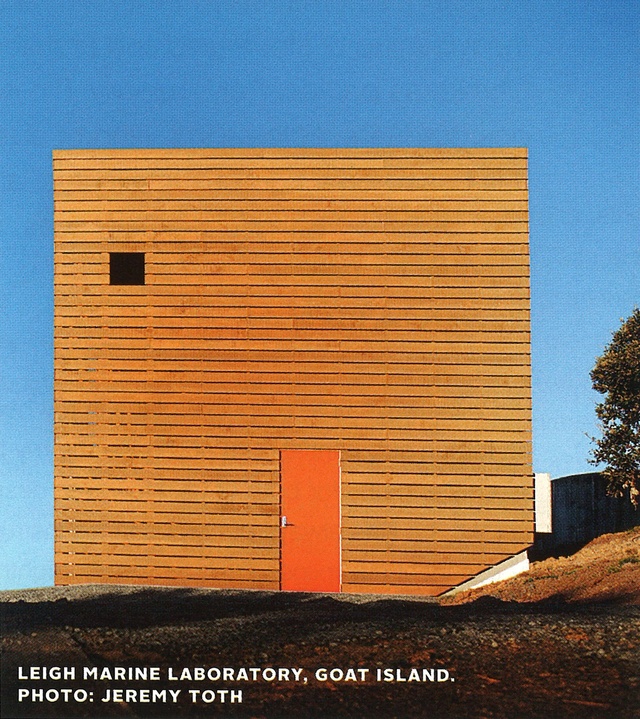
After leaving JASMAX, I immediately started work on Q theatre and the Goat Island Marine Centre at Leigh. They were really good jobs because they were bigger and more complicated and it took a fair bit of blood on the floor to get them done. Neither are big-budget jobs and there was a commitment on our part to doing them well, but most projects have that level of sacrifice. Q’s interesting because it opened at almost exactly the same time as the Auckland Art Gallery and, whereas the Art Gallery is very beautiful, highly crafted architecture at a decorative level, Q is much more robust and raw. Q looks like it’s a hard-working place – people bang into it, screw things into it – and I think it’s a really lovely difference really. There’s been an easy acceptance by the theatre community which has made it a source of satisfaction for the whole team.
JH: What is it like working with your son Nat?
It’s not uncommon in architecture but it’s a unique relationship. He’s very able and has revved up the practice a great deal. He always gets involved, contributes and is engaged. Yeah he’s ambitious, he’s on fire. It’s lovely. He very graciously accommodates me and I very graciously accommodate him. I have a remarkable family: three very close sons and their extraordinary mother.
JH: She obviously trained them well.
Yes, she has had a big influence.
JH: What projects are on the boards at the moment?
Well I’m doing some work on the St James – trying to unravel that. I’ve just completed a very big house up north; Mountain Landing is a farm that we’ve done a number of projects on and this house is the most recent one. I’m also working on buildings associated with a golf course in Te Arai. And we are working on the City Works Depot. That’s pretty exciting. There are a lot of houses too. Nat’s driving a whole raft of projects: three storeys of fit-outs for Genesis’ headquarters and there are the beautiful bars and cafés down at Britomart.
JH: How would you like to see things develop in Auckland, having worked in the city for how many years?
Thirty years. Auckland feels pretty good at the moment, like it’s got a head of steam. But I am bothered by the way that the city procures things. There’s a record of competitions like Queens Wharf which are awful and…
JH: I have this conversation, virtually, every day. I bet you do.
But I want to hear what you think. We stretch a dollar really thin, here in New Zealand. We’re in a hurry. Sometimes I wish that we would think more and do less. It is incredibly easy to make a building here compared with Britain, for example, and we’ve got quite a small gene pool so we need to think very carefully before we build. How would I like it to be? I’d like better public transport. I’d like more trees – that must be the easiest and cheapest way of transforming a city. And there are streets like Customs Street which I think are really crucial. That is a moat with mechanical alligators at present…
JH: And Quay Street? Yeah, although I must admit that I don’t feel quite the same desperate need to cross Quay Street as Customs.
No, because there’s not much to cross for. Not at the moment. There will be eventually. I suppose, because I’ve done all that work in Britomart, the intention has been to try and spread the density of the High Street/Lorne Street experience down to the water’s edge. Britomart has done that really well but it is ring-fenced by some pretty tough roads and Customs Street is the one that shuts it from the rest of the city. At the very least, I just think they’ve got to put a great row of trees down the middle of Customs and I know that the traffic engineers are a bit…
JH: Well they need to slow things down. Council probably needs to be quite radical. They need to put more public transport in, bring in congestion charging if people then won’t get out of their cars, and encourage people to be more active. It’s not just about traffic; it’s about the social exercise of engaging with the city when you bike and walk. We become part of the city and not just part of a machine. Also, what would that mean for the health of the population because most people sit in front of computers all day and then the rest of their time is spent in the car and in front of the TV.
Yeah, all good reasons.
JH: Talking about the Auckland waterfront. Where is the stunning architecture that is emblematic of Auckland, that draws people into a bigger story about what Auckland represents? Someone from overseas might ask, what is Auckland in terms of its architecture? The Sky Tower? Auckland is an international city but it needs to have defining moments in terms of the development of New Zealand architecture as a discourse.
I think we’re very strong at designing houses but I don’t think we design enough larger buildings. There are very few big buildings and most of them are designed by Australians, often very derivative or not their best work. The ASB is, most of Queen Street is, the Art Gallery was, so Kiwis don’t get much practice at it. There is also very little discourse about city buildings. The popular press doesn’t engage itself in that. There are also people making big buildings who shouldn’t be. I see it in the Urban Design Panel: buildings that are just terrible. So you can get as far as saying, “I think we’ve got the wrong architect here; you need to re-think the project” because they’re essentially trying to make a silk purse out of a sow’s ear and, sometimes, at a bureaucratic level, the mechanisms aren’t strong enough to say, “This building should not go ahead as it is”. Buildings are invariably driven by next year’s balance sheet. In the past, you would have companies that would make a building with their name on it and the quality of the architecture said something about the company.
JH: It’s disturbing that so few grasp that.
We have a whole economy which is built upon dollar efficiency and you have our great helmsman saying he’s quite relaxed about everything. So I have a very uncomfortable feeling about…
JH: Yet politicians are often made ‘great’ through the legacy of improved built environments. Or through some kind of social change.
Yeah, well, what is this government going to bequeath the country? We have a whole cadre of property managers and developers who manage projects, not just at a bricks-and-mortar level but at the conceptual level, that are very concerned with the first cost of the building or next year’s balance sheet. It’s very rare that buildings are built by ‘patient capital’, those who will take a 100-year-long view of it. If you look at the Royal Guardian Assurance building: when they built that, they would have been thinking, “We want this building to stand firm and very clearly say something about the robustness of the company”. That’s absolutely not the case now.
JH: Do you think that can change?
I imagine that buildings will inevitably follow the Christchurch model, where buildings are de-risked as much as possible. They will become tilt-slabbed concrete with big overhanging roofs made out of metal because the technology is totally known. There are no risks associated with that.
The decorated shed intellectually facilitates that progression. I don’t think that’s what David Mitchell anticipated when he talked about ‘the elegant shed’ but I sense that the lesser project managers will inevitably veer projects towards that. They step into the middle and separate out the component parts: the architect from the engineer, and from the cost planner and everybody else, so only the managers speak to everybody. They’re the holders of the budget and the vision which is driven by maximising short-term profit. It’s not a great recipe for making a building.
You can say that architects have a terrible reputation around dollars but I don’t think that’s particularly fair or accurate. What architects are bringing to a project is invariably a wider sense of responsibility, to those people who pass by, to those who use it, those who aren’t at the decision-making table. The demise of the architect’s role impoverishes society considerably and Christchurch is just positive proof of that because architects have been taken out of play down there.
I fear we are going to end up with a tilt-slab kind of town. I was down there during the first of the earthquakes and I have a sense of unfinished business because I’m not doing anything down there but I am reluctant to be a carpetbagger and would rather support the locals if required.
So you asked me about my architecture, what is it driven by? How could Auckland be better? Simple answer: more trees; a more complex answer: I think it will inevitably get better, though perhaps not as a singular coherent bit of design. We live in a large pluralist city and it will inevitably reflect that diversity and ambiguity. Cities reach a critical mass and I believe that Auckland has reached that trigger of population numbers, it’s now a self-sustaining economy.
JH: Do we need a city architect or a city architectural team?
Yeah, well certainly a city architect. There used to be one and they did some fine buildings. I don’t think that a city architecture team is necessary but I do think a city architect and a government architect are absolutely critical. The challenge is whether architects are seen to be capable of doing that anymore.
JH: There seems to be a separation between architects and urban designers.
I don’t think that’s true in private practice but it’s certainly true in the city because there are no architects employed by the city. I think the ease with which architects were swept aside in Christchurch was a rather sobering moment and I think the same thing is happening up here.
JH: So do you think architects need to be more politicised and to push themselves out there?
Oh, definitely. I think it’s surprising that architects haven’t; if you’re really serious about manipulating a city you need to be involved in politics. If you’re serious about transforming the city, you inevitably enter the political realm because so many of the decisions are made at that level. In many ways architecture is becoming increasingly disempowered so, yes, I would say politicking is very important. Politicking, writing, having more public debate. And popularising architecture and making it more intelligible, because architects do speak in tongues. At various times I have gone and harassed the editor of The Herald saying, “You know you’ve got to talk about architecture, all the great newspapers in the world have architecture critics or columnists”.
JH: Occasionally, a piece stands up but to find architecture on The Herald website, I think you go into the ‘Life & Style’ section, under ‘Design & Garden’, or somewhere in ‘Property’, and then you’ll be lucky if you find something. I suppose that navigation pretty much sums up the general understanding of architecture.
Often buildings are mentioned but not the architect and yet the good should be recognised, the poor should be damned and the work examined and critiqued; that’s how cities are made. I think the popular press has a responsibility to do this. I think the great trick is to make complex ideas clearly intelligible; architectural writing employs a great deal of jargon and shorthand to compensate for not-too-thorough thinking.
JH: I agree. Since we’re on the subject of writing, the BLOCK publication for the NZIA Auckland Branch has been your baby for a long time.
Yes, though it’s a collaboration with Nat, Sean Flanagan, Andrew Barrie and Ian Scott. Before that I used to do a newsletter by myself, which was much more strident and noisy and I used to be harassed by the Institute because I was a bit fast and loose with who said what. I’ve always enjoyed writing.
JH: And what about your plans for the future?
Well, I’ve got a lovely range of projects, from domestic to really complex urban projects. So it feels pretty good at the moment.
This interview was first published in Architecture NZ issue 3, 2013.