Politics of place in an election year
Reader, I’ve spent many columns thinking through the ways buildings and cities become repositories for our hopes and anxieties: how spatial forms are always already political, and how architecture ought to reckon with histories of displacement, inequity, care and resistance. But, this month, I find myself inhabiting a different kind of spatiality: the interior worlds of loss and love, of ending and beginning.
In the last few months, I have experienced the very highs and lows that life affords us and, in the wake of those events, been invited to engage with government on the thorny topic of granny-flat exemptions here in Aotearoa. I am in the strange and dizzying interstice between mourning and possibility: the personal collapsing into the political and back again.
These events, intimate and institutional, have made me acutely aware of the ways in which we navigate worlds that are both fragile and fiercely contested.
Reader, I often think of you, and wonder how you are making sense of things. I imagine you, like me, negotiating the familial: from the small — the back and forth of the family WhatsApp — to the large, like an aunt’s cancer diagnosis. I imagine you sitting in traffic, listening to the radio, while also thinking about what you’ll do for dinner.
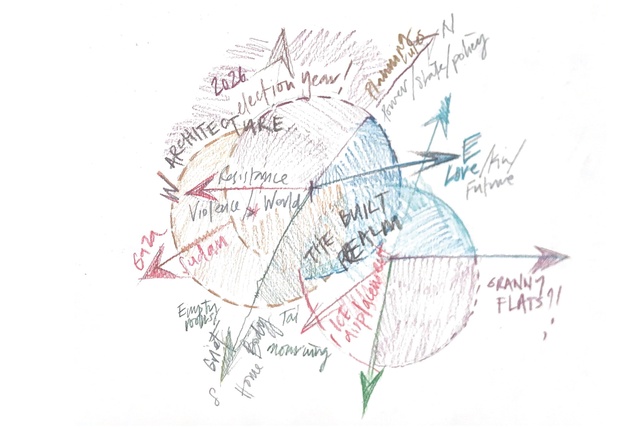
This year, of course, is an election year. So, let me start with a question that feels both pedestrian and urgent. What should our communities, and we as individuals, make of politics now — and what does that mean for the built realm? If politics is about the allocation of power and care, then architecture is among its most tactile outcomes: who gets housing, whose voices shape neighbourhoods, how public spaces acknowledge or erase histories. In this moment, those questions are not abstract. They are visceral — as visceral as heartache.
Elsewhere, the confrontation over borders, policing and movement keeps erupting into public space: protests, cordons, streets made impassable, bodies made vulnerable by the state and by the crowd. In places such as Gaza and Sudan, the scale of suffering is difficult to comprehend and yet it is also deeply spatial: displacement, encampment, destroyed infrastructure, blocked routes, the deliberate thinning of everyday life.
These are not distant abstractions; they are ideas made real. These incidents are not isolated. They are spatial stories: of streets, neighbourhoods, police perimeters, borders and collective grief. They remind us that space is one of power’s first languages. How then, do we speak it?
Still, my diary this week is also local and profane: the conversation around housing supply, grannyflat exemptions and densification — daily bread for architects and urbanists. In the immediacy of local planning, it can be tempting to forget that housing is also profoundly about belonging and dignity. It’s about whether our policies and physical forms reflect a public ethic of care, or the integers of market value.
The idea of granny flats — accessory dwelling units — can feel modest, even technocratic. But, at its heart, it holds a fascinating potential: to unsettle exclusionary zoning, to densify in ways that open housing options across life stages, to weave multigenerational living into our urban fabric. The politics of housing are spatial politics: who gets to live where and how proximity can mitigate or amplify inequality. Here, too, architecture isn’t neutral. I hope this conversation becomes a question of care and room-making — not only a neighbourhood argument about windows, fences, property speculation and who is looking at whom.
So, how do we, as a community, parse these intersecting pressures — local housing policy, global struggles against state violence, personal grief and the everyday work of practice — in an election year? I return to something I still believe about space; it’s never neutral. The shapes we build and the rules that govern them tell a story about what and who we value. What is life, after all, but competing moral compasses in real time?
In my own life, recently, the everyday has been a negotiation between loss and care. Mourning and celebration feel like overlapping spatial states — an empty room of loss blurs into the threshold of love and partnership, the uncharted territory of what comes next. Architecture, after all, not only frames the way we move through cities but also the way we move through time, memory and community. I think we all come to love this about it.
When I think of politics and space, I think of the ways in which our built forms can either flatten or amplify difference: how they can entrench exclusion or enable connection. I think of how, when the state tightens its grip in one place, people still rise to defend the life of place — because space is always bound up with belonging. I think of how housing policy here can either open doors or inscribe new barriers. I think of how every election, every debate, is ultimately about the kinds of world we want to inhabit together.
In an election year, it’s easy to retreat into polarising binaries — left versus right, protest versus order, local versus global. But our spatial lives defy such tidy polarities. They are messy, layered and shared. Our cities and neighbourhoods are communities in waiting, shaped by policy, economy, care and the everyday acts of inhabitation. So, perhaps the task before us — as designers, citizens, families and communities — is to keep insisting that the politics of space be grounded in dignity, equity and shared humanity.
In Pacific cultures, we talk about vā, the relational space between people and places. It reminds us that space isn’t only physical, but relational and ethical. As we navigate this election year, may our conversations about housing, public space and policy recognise that politics and place are inseparable — and may we design worlds that reflect not only what we fear but what we hope for.