Protecting Canterbury’s taonga
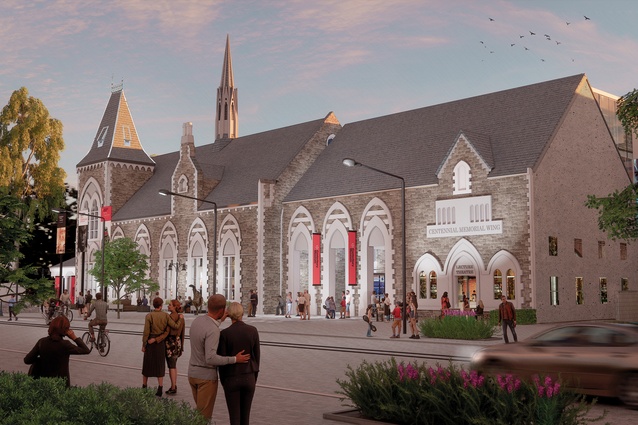
Render of the redeveloped Museum.
A cornerstone of the Ōtautahi Christchurch cultural precinct and wider Canterbury region, and home to more than 2.3 million items of local heritage, Canterbury Museum houses 25 per cent of Aotearoa’s taonga, with an estimated value in excess of $1 billion.
In the seismic era, the Museum’s guardians identified the imperative to save and protect the Museum’s heritage buildings and treat them, in effect, as the first artefacts in the collection. “Canterbury Museum has been on its current site since 1870, when the first Benjamin Mountfort building opened to the public,” explains Museum Director Anthony Wright. “The Museum is actually seven separate buildings, built between 1870 and 1995, that cover more than 90 per cent of the site. The Mountfort-designed heritage buildings, mirroring the Christ Church Cathedral at the other end of Worcester Boulevard, are our greatest treasures.”
Athfield Architects’ involvement with the Canterbury Museum dates back to the late 1990s, when discussions began for upgrading the Museum’s collection of buildings and additions built over 150 years, including six Category 1 heritage buildings and the adjacent Robert McDougall Gallery, which was the previous city art gallery.
The current version of the redevelopment project began in 2012, post the Canterbury earthquakes. “While the Museum was one of the few undamaged neo-Gothic buildings in the city, the result of the 2011 earthquakes increased the importance of seismic strengthening issues in relation to these buildings and the importance of the protection of its collections in an active seismic zone,” says Athfields’ project architect Trevor Watt.
While seismic strengthening to the Museum and Robert McDougall buildings is a significant part of the redevelopment project, this has been undertaken while also addressing other key brief requirements, including respecting heritage, integrating Ngāi Tahu and Ngāi Tūāhuriri cultural narrative, achieving additional space on the current site, protecting people, collections and buildings, expanding within planning and legislative requirements, storing collections properly, particularly providing appropriate environmental control, and future flexibility.
“This project creates a new public experience and exhibition spaces for a modern museum, integrating mana whenua cultural narrative, tikanga and stories to its heart,” says Watt. “It reveals, celebrates and strengthens a series of heritage buildings and creates a world-class environment to store, research and conserve the Museum’s collection — all on the restricted central-city site.”
Stage construction commenced on site in late 2022 and the seven-metre-deep, base-isolated basement is currently under construction. “The façades of the existing buildings all form an edge and will be exposed internally within the new atrium — the heart of the redeveloped Museum,” explains Watt. It is here that the treasured 26.5m Ōkārito Blue Whale skeleton, the world’s largest, will be on display.
The Museum is expected to open in 2029.