Unveiling the accretions of time
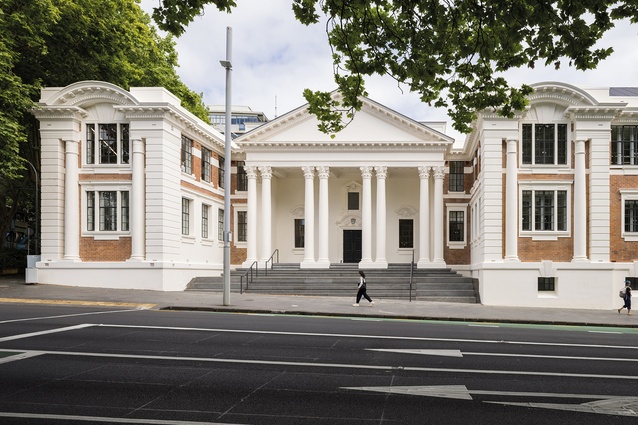
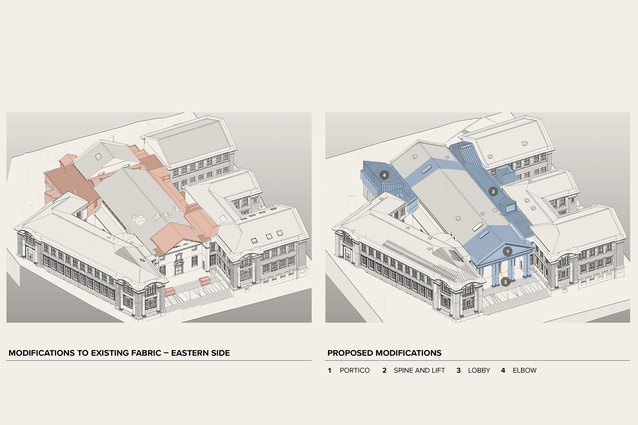
The reconstructed external portico on Symonds Street was based on old photographs of Old Choral Hall, remaining evidence at the site and the detailing of the columns and pediment at the Auckland Baptist Tabernacle.
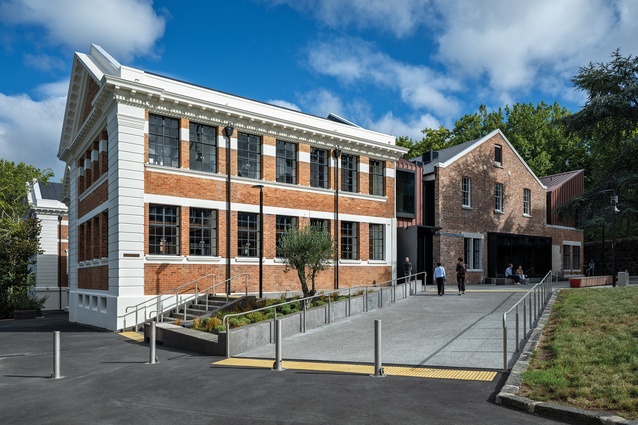
The exterior of the refurbished Old Choral Hall complex, looking from the Barracks Lawn. The four key construction phases, including the new additions, are clearly evident from this approach.
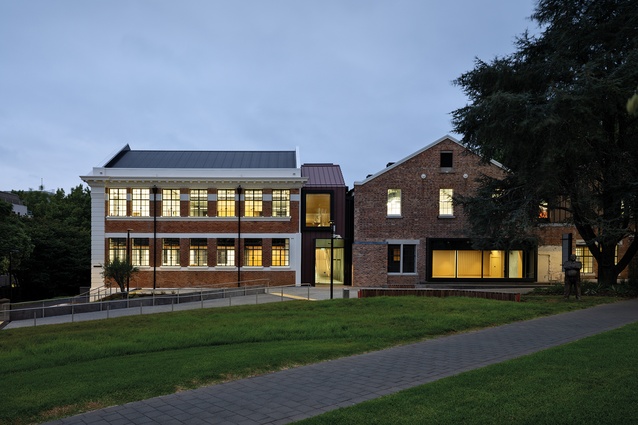
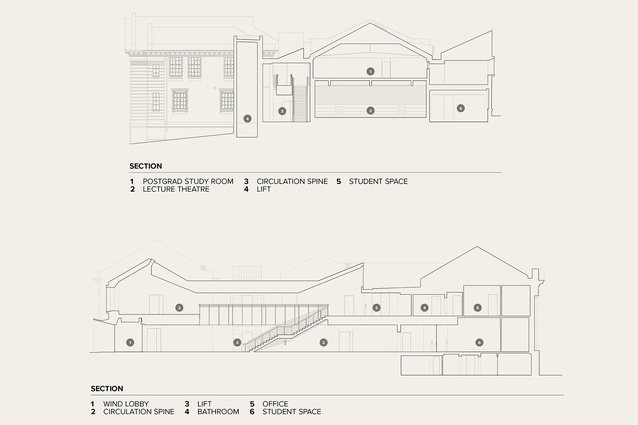
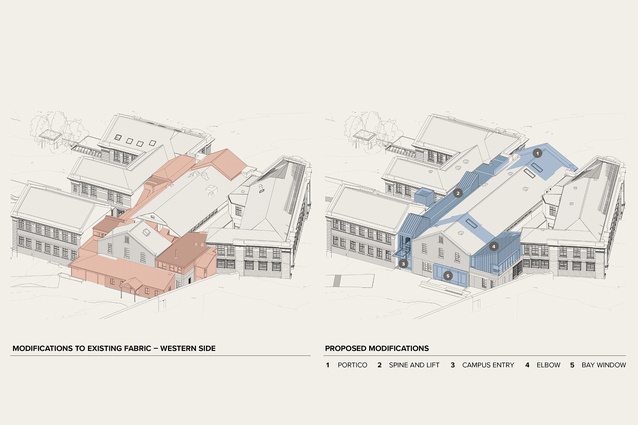
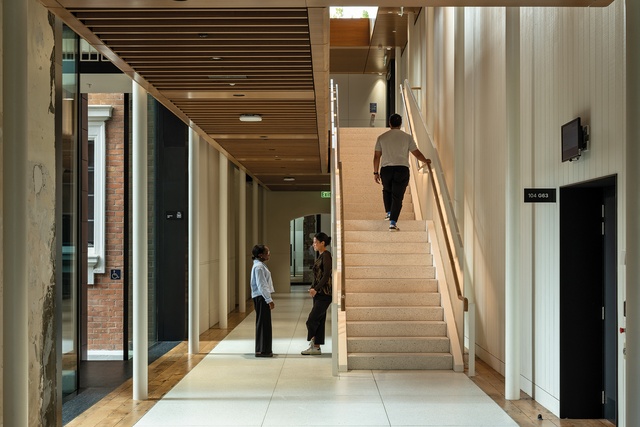
The back of the original Choral Hall is now visible, after unsightly additions have been removed, and the new circulation ‘spine’ (to the left) connects the Hall wing and the Lippincott wing.
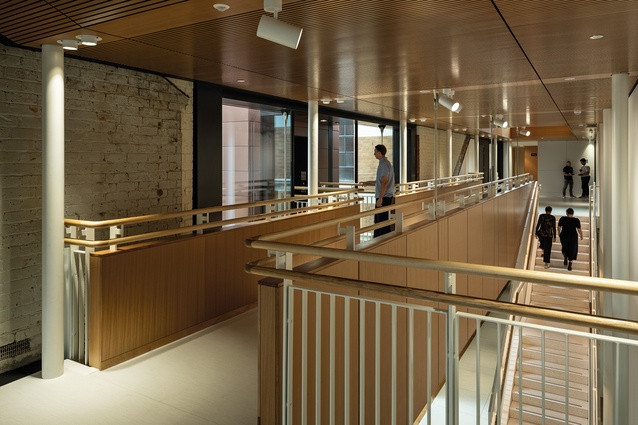
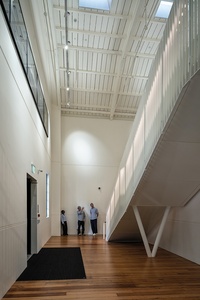
The upper level of the circulation spine.
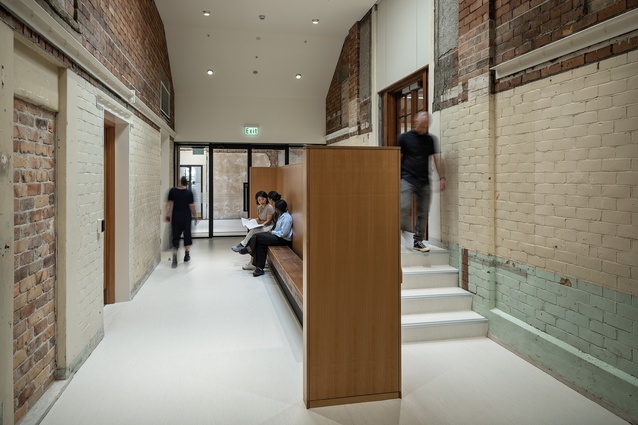
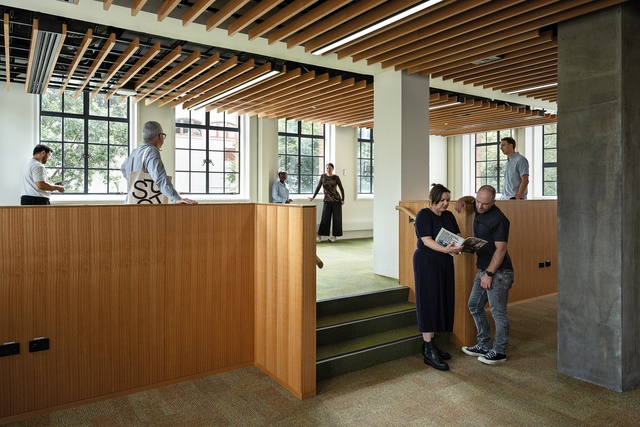
The accretions of time are evident with a layering of materials and finishes.
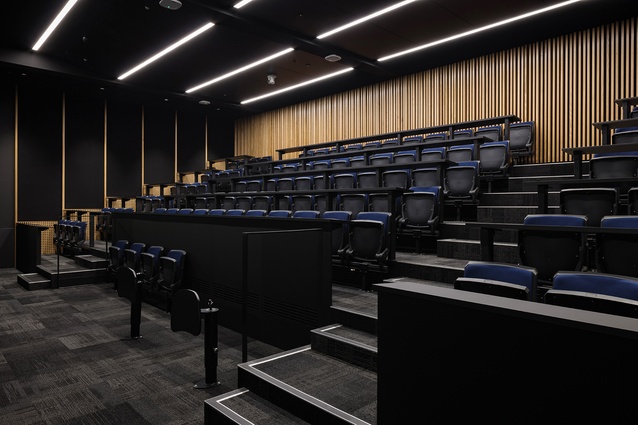
One of the two 100-seat lecture theatres.
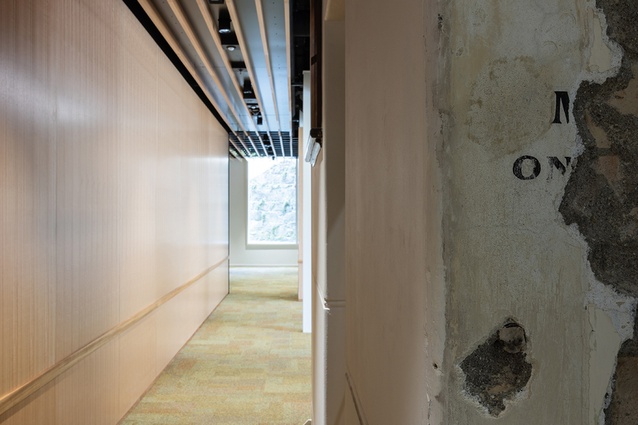
New and existing materials sit comfortably alongside one another.
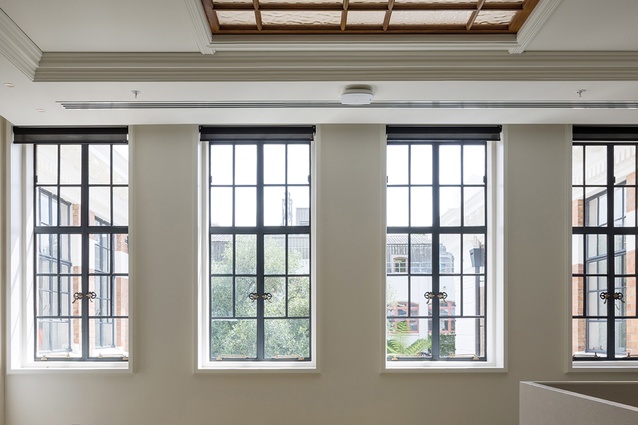
All of the steel windows were painstakingly refurbished, in situ. Additional light is brought in via new and original skylights throughout.
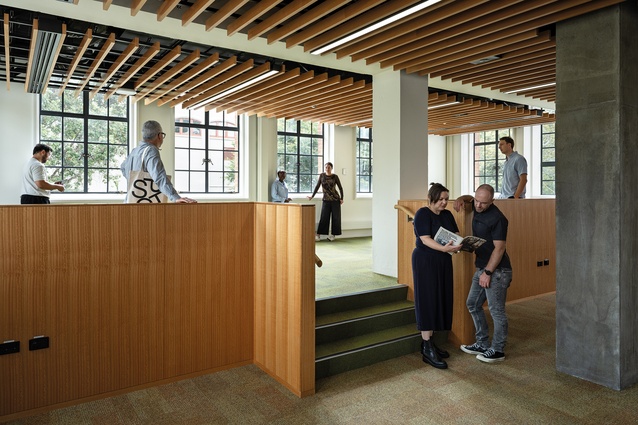
Colour-coded flooring identifies the complex’s different zones
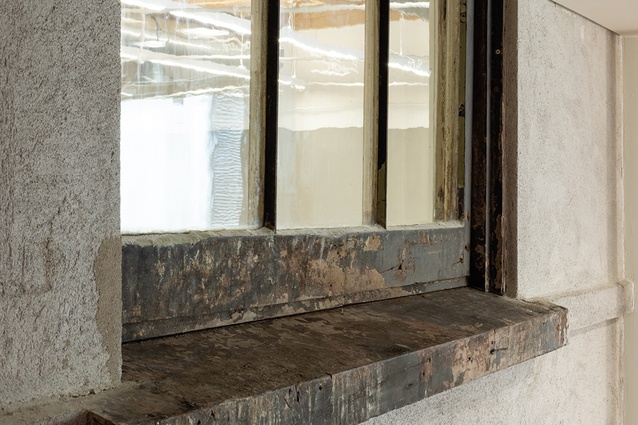
One of the original clerestory windows is presented raw, as found, with no attempt to smarten it up and return it to a former, pristine state.
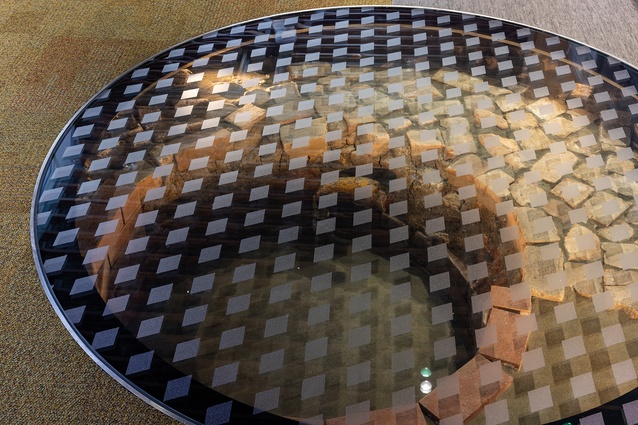
The discovered well is thought to predate Choral Hall.
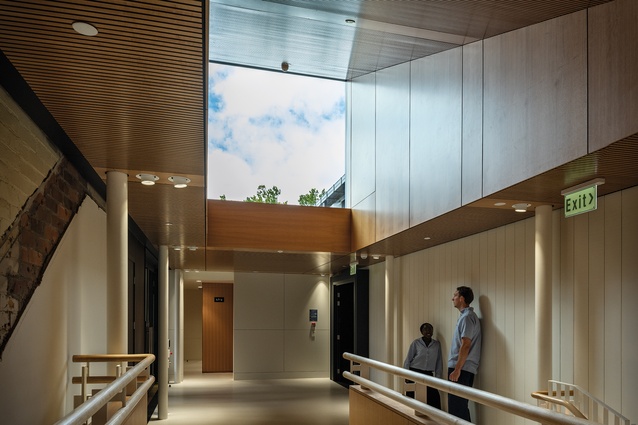
The circulation spine has helped to rationalise what was previously described as a “rabbit warren” of spaces.
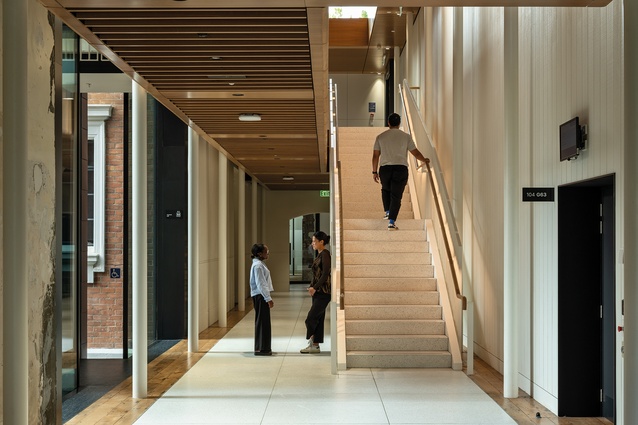
The circulation spine has helped to rationalise what was previously described as a “rabbit warren” of spaces.
Joanna Theodore examines the meticulous peeling back of layers and reconstruction by Architectus in its careful refurbishment of Waipapa Taumata Rau University of Auckland’s Old Choral Hall.
The cost of strengthening and refurbishing heritage buildings is a challenge that many building owners will relate to so, when I asked about the costs for the Old Choral Hall project, the height of the raised eyebrows said it all, though the final figure has yet to be disclosed. As such, Waipapa Taumata Rau University of Auckland’s commitment to this demanding project is commendable and, in turn, the outcome is a triumph.
The refurbished complex contains 4000m2 of floor space. There are two 100-seat lecture theatres, various meeting spaces, as well as offices for students and staff. Circulation throughout has been substantially rationalised, addressing what many in the project team described as a “rabbit warren” of spaces — the result of nearly 150 years of changing uses and adaptation.
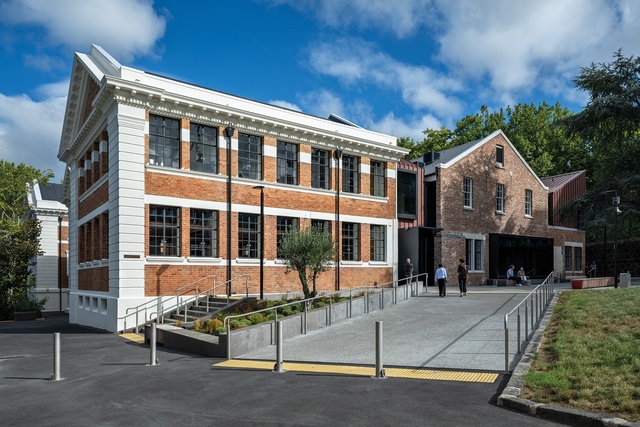
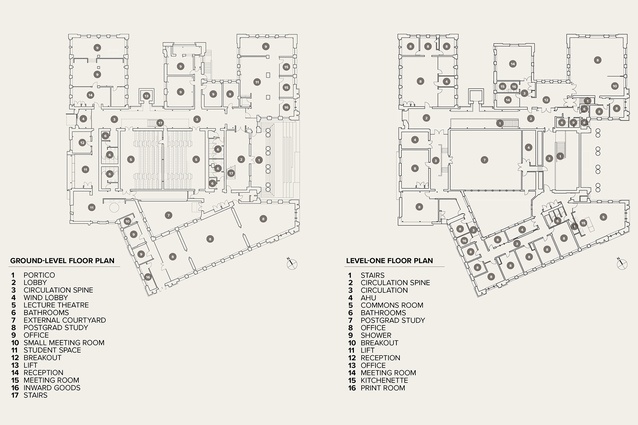
Four key periods of construction, including the new additions, make up the complex.
The original building, at the heart of the complex — the Choral Hall — was designed in a classical revival style by Edward Mahoney for the Auckland Choral Society and opened in 1872. It was substantial, with seating for 1100 people. The University had strong associations with the building even before they bought it, just prior to WWI. For example, the graduation of Kate Edger — the first woman to gain a Bachelor of Arts degree in the British Empire — was held at the Hall in 1877 and, from 1888 onwards, it was used for teaching.
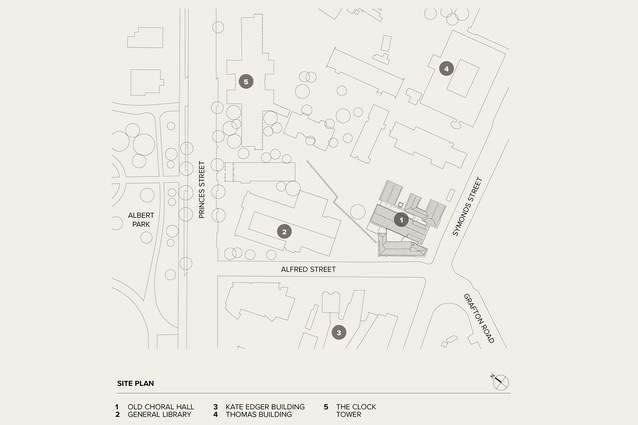
Subsequently, a further wing was added on each side of Choral Hall, to house the science department. One wing was added in 1919, along the south-western elevation of Choral Hall, facing Alfred Street, and another was added, towards the north-east, in 1925. The 1925 wing was designed by American architect Roy Lippincott, who also designed the University’s iconic Clock Tower.
Over time, various unsympathetic additions and alterations took place, resulting in a less cohesive building. Project architect Architectus explained that many of the changes were additions rather than deletions so, by removing these, most of the significant heritage fabric could be uncovered and was still intact. Unveiling and responding was a core part of the project process, with many surprises along the way.
One of the significant discoveries included an old well, which is believed to predate Choral Hall itself. It now sits proudly displayed below a glass floor. A less pleasant discovery was the fact that the Lippincott wing didn’t have any foundations! I was told that “the client was very patient”, despite the unpredictable nature of this discovery process. The process was made even more challenging by the Covid-19 pandemic disrupting the project, which had started in 2019.
A gratifying honesty flows through the interior spaces, honouring the principles set out in Section 5 of the ICOMOS New Zealand Charter 2010 — New Zealand’s key guiding conservation document — which advises that conservation should recognise “the evidence of time and the contributions of all periods”.
The accretions of time are evident, with each period’s time stamp identifiable, and even the evidence of the unsympathetic, removed elements has been captured — they are all part of the building’s history, after all. Many building features are presented raw, as found, with no attempt to smarten them up and return them to a former, pristine state.
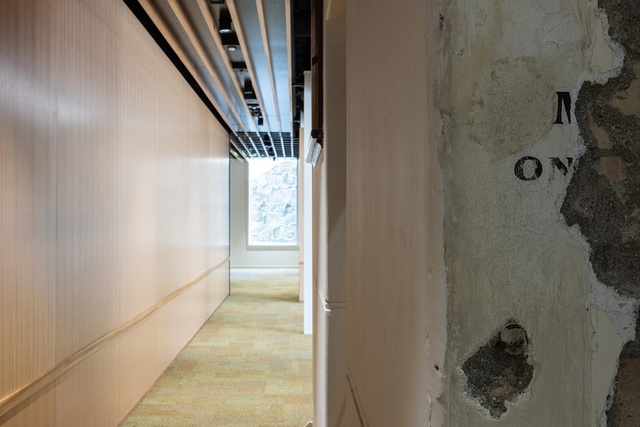
This principle of raw honesty also extends to new elements, such as the shotcrete shear walls, which were originally going to be over-clad but, upon seeing them in place, the team decided to leave them exposed — this way their rich materiality, function and story is evident at a glance.
Only a few concrete shear walls had to be inserted, and some steel columns and beams also remain from earlier strengthening projects, but most of the seismic strengthening action is undertaken by timber strongbacks. These essentially form a new ‘skeleton’ on the interior of the building, supporting it from within. It is more sustainable to use timber strong-backs than it is to use concrete or steel; the strong-backs also have the benefit of being virtually fully reversible. Reversibility is an important conservation principle — not because earthquakes might cease to occur in the future but because an improved solution (or a new use) may be developed at a later stage, thus allowing the building to be returned to its previous state and the new solution to be implemented.
The exception to the internal strengthening is the reconstructed portico, which has been added externally along the Symonds Street frontage. Concealed within the hollow, lightweight concrete colonnade and pediment are steel columns and beams, which support the front façade. The original portico was removed as a precaution following the Napier earthquake in 1931 and, for nearly 100 years, the building sat strangely maimed, as though it were missing a vital body part.
Returning the dignity and cohesion of this frontage was an important objective of the reconstruction project, explains Robin Byron, who was the Heritage New Zealand Pouhere Taonga representative working alongside the project team for its duration. She advocated for the reconstruction of the portico from the outset; however, as a costly undertaking for the aesthetic benefit alone, it wasn’t until Beca, the structural engineer, identified the need to strengthen the front façade that the two objectives were aligned and the reconstruction became a reality.
Under the guidance of conservation architect Archifact, the portico was reconstructed, based on old photographs of Choral Hall, remaining evidence at the site, as well as the detailing of the columns and pediment at the Auckland Baptist Tabernacle, which were believed to be similar. Unfortunately, no drawings of the portico survive.
Reconstruction is perhaps the most challenging of all conservation processes and a term heritage professionals often approach with scepticism. It is defined in the ICOMOS Charter as building “again as closely as possible to a documented earlier form, using new materials”. It should not be, but often is, confused with restoration, which involves reassembly and reinstatement using existing materials, such as fallen masonry or removed joinery that has been in storage, for example.
Reconstruction goes hand in hand with loss — it generally follows wars or natural disasters. In New Zealand, our heritage is no stranger to loss, thanks to our high seismicity. Elements such as parapets, pediments and finials have often been removed as a precaution or damaged as a result of earthquakes. Like the portico at Old Choral Hall, their loss often dramatically alters the proportions and reading of the building and, hence, reconstruction of these elements can, with strong evidence, be supported.
However, reconstruction also presents an interesting conundrum. While a vital part is reattached, returning the proportion and coherence of the original, the materials are new — in the case of the Old Choral Hall portico, even part of the function is new. I reflected on the project with Byron for the purposes of this article and we wondered if, in hindsight, and without disrupting the coherence of the reconstruction, more of a tangible clue could have been provided about the portico’s dual function. Seismic strengthening is our heritage — it is a vital part of our New Zealand story and, amidst all of the honesty that flows through the rest of the project, both externally and internally, evidence of this part of the story would have been a welcome final touch.
Overall, it is great to see this Category 1 Historic Place so successfully revitalised and the next chapter of its story begin to unfold. I can’t help wondering how it will be used, and by whom, in another 154 years — in the year 2180.