Urban Art Village 2025: Building a City of Ideas
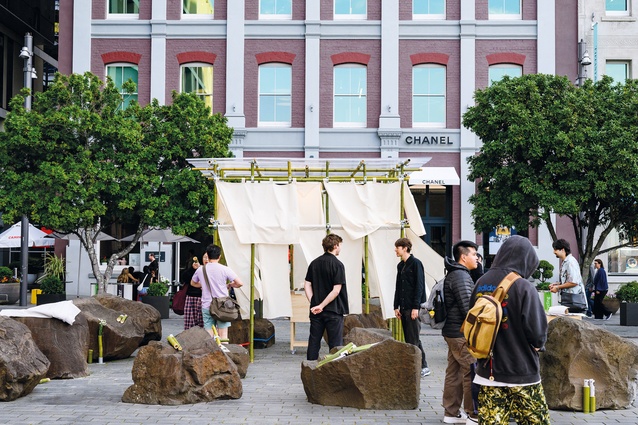
Bypass Journal’s A Failed Roof forms a city reading room from leftover materials, recomposed into a gathering space to reflect on the past and future of shelter.
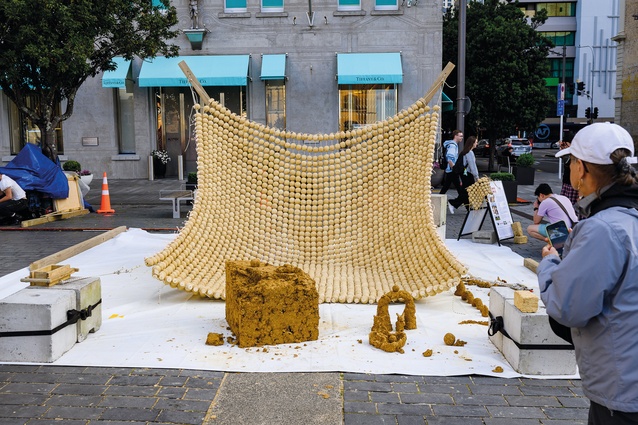
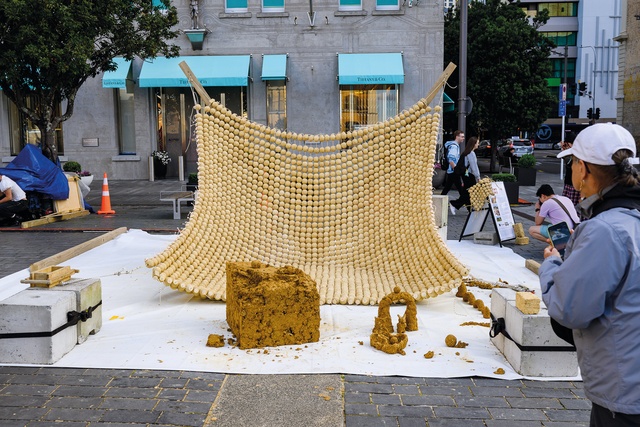
pre:fab platform’s Calycore Canopy brings natural materials into the concrete city with a biodegradable installation as an overhead net and sculptable earth inviting public interaction.
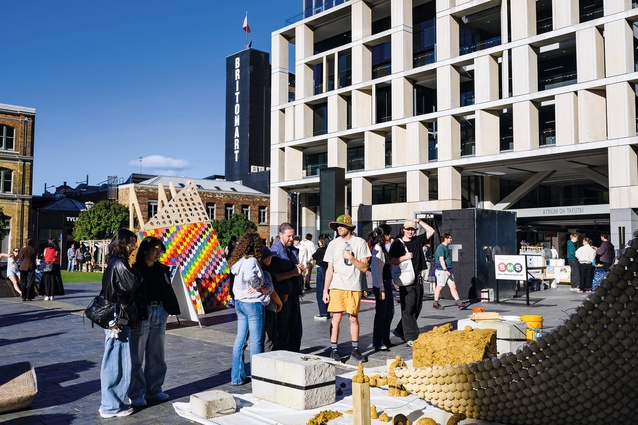
Unitec’s Mawhitiwhiti: Jumping from Feathers to Leaves is a 3D-printed leaf cloak on a tree-house roof, casting light and wonder.
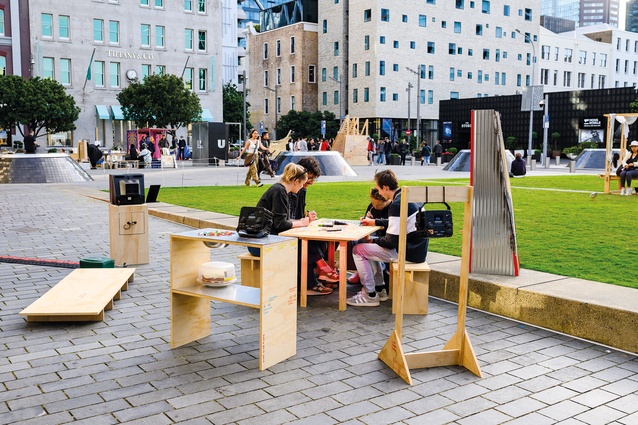
James Holyoake’s More Than a Roof Over Your Head explores back-country hut life through portable furniture that can be carried, assembled and used to shape encounters between people and place.
Gina Hochstein and Yusef Patel experienced the irrepressible Matt Liggin’s Urban Art Village, which ran 30-31 October 2025 in Takutai Square in Britomart.
Matt Liggin’s Urban Art Village (formerly Urban Art Week) returned to Auckland in late October — this time in a new setting. Relocating from its previous home on O’Connell Street, the event inhabited the city’s Takutai Square in Britomart, transforming the Square into a lively pop-up village of architectural imagination.
For two days, the square was activated with conversation, creativity and construction, as students and recent graduates from architecture schools in the North Island came together to explore the intersection of art, architecture and urban life. Ten experimental installations animated the square from morning until late evening, inviting the public to explore, play and participate.
The move to Britomart signalled both growth and renewal. Organisers described this as the first iteration in its new setting, made possible through the support of Heart of the City and Britomart’s Jeremy Hansen. The expanded, pedestrian-friendly site eliminated the need for road closures, opening the event to a wider public audience. What was once a temporary street activation evolved into a small but compelling urban festival — a chance for the public to see architecture, not as a finished product but as a process.
This year’s edition brought together groups from four major institutions: the University of Auckland, Unitec, AUT and Victoria University of Wellington. The collaboration was both intentional and symbolic — a commitment to the educational community over competition. The organisers hope to expand in future years, inviting participants from Otago Polytechnic and Ara Institute, in order to create a truly national platform for architectural experimentation. “It’s about breaking down silos and stopping the gatekeeper,” stated Liggins. “We want a space where everyone can learn from one another, celebrate ideas and simply enjoy making.” That emphasis on learning through making is at the heart of Urban Art Village. Participants designed and built one-to-one structures that test ideas about materiality, scale, light and human interaction. Each installation was fabricated with a limited budget, encouraging resourcefulness and hands-on engagement. “When you work at full scale, you learn what gravity feels like,” Liggins reflects. “You discover fabrication limits, material strength and the realities of construction that a drawing alone can’t teach.”
The pedagogical benefits extend beyond the workshop. Students also pitched their ideas to the organisers, simulating a real-world client process. They presented concepts, received critique, iterated on their proposals and refined them — an invaluable rehearsal for professional practice. “It’s not about winning,” says Liggins. “It’s about clarity — learning to communicate ideas and respond to feedback. That’s how architectural thinking grows.”
But Urban Art Village is not just a student exercise — it’s a public event: one that draws many visitors each year. Passers-by stop to watch, touch, sit, draw and talk. Children climb through structures; office workers pause to take in the sight of students assembling on site. The installations transformed Takutai Square into what could be considered a living laboratory — a space where making became both spectacle and dialogue.
In this sense, the event tested the boundaries between education, exhibition and urban intervention. Each structure becomes a prompt; how do we build together and what kinds of social interaction can architecture create? The collective outcome is less about form and more about atmosphere: a village of ideas that breathes with curiosity and generosity.
The organisers described this year as a celebration of collaboration and civic generosity. It brings visibility to the creative process, reframing design as an act of participation. “It’s not about objects,” one says. “It’s about conversations — between universities, between disciplines, and between the public and the built environment.
Ten years on, Urban Art Village has evolved, but its core ethos remains constant: architecture as a shared experiment. Its success lies in its humility and immediacy. Rather than polished renderings or distant master plans, it offers real materials, real weather and real people. The event collapses the traditional divide between architect and audience, reminding both that the city itself is a space of ongoing invention
This year, in its new home at Britomart, Urban Art Village invited the public to see design not as a remote discipline but as a living conversation. For two days, Takutai Square served as a testing ground for the next generation of architects, offering a glimpse of what our cities could be when imagination is given space to flourish.