Itinerary: Building with mass timber
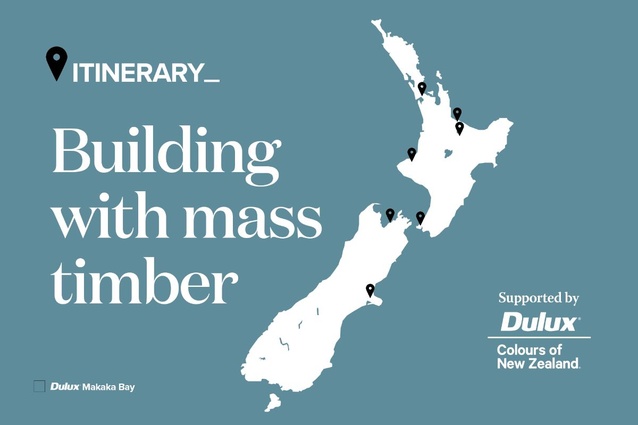
Itinerary: Building with mass timber. Featured is Dulux Makaka Bay, Dulux Colours of New Zealand.
This Itinerary, supported by Dulux Colours of New Zealand, Andrew Barrie highlights 14 mass timber architecture projects in New Zealand.
The argument for timber is simple: we grow it here — quickly and sustainably — and it sequesters CO2 from the atmosphere, contributing to our collective effort to blunt the effects of our rapidly worsening climate crisis.
Even those without a particular historical bent will have gained a sense of the rise of mass timber architecture in New Zealand in recent years. The volume of such work — at least with the kind of buildings we see in architecture magazines such as this one — has risen from one building every year or two in the 2000s, to it becoming a constant presence on these pages. Around half of the large new buildings in last year’s NZIA National Awards list employed mass timber.
Scanning through the buildings in this itinerary, we are presented with an array of timber configurations — glue-laminated timber (glulam), laminated veneer lumber (LVL) and cross-laminated timber (CLT). There is also a wide range of structural technologies, particularly when multiple storeys or large size magnify seismic loads — rocking walls, shear walls, box beams, dampers, composite floor cassettes and all the rest. For architects, venturing into unfamiliar territory, especially as regards costs and the amount of effort required to maintain quality standards, can whiten the knuckles. Unsurprisingly, our high-profile timber designs have been produced by a fairly small circle of firms; several firms appear more than once in these listings. Likewise, few engineers have developed significant expertise with mass timber. More than half the projects in this itinerary were engineered by one firm — Dunning Thornton — whose timber specialist Alistair Cattanach has accumulated a significant record of innovation. With both architects and engineers, the circle is thankfully widening, and there have been attempts to generate repeatable, cost-effective solutions, most notably the Pres- Lam systems developed by the Structural Timber Innovation Company, based on research carried out at the University of Canterbury. But the technology remains slow to filter down, largely remaining confined to high-profile buildings with ambitious designers and adventurous clients.
The folk at Irving Smith Architects, New Zealand’s most consistent innovators with mass timber, have described the challenge of mass timber architecture as being one of “T-shirts vs ball gowns”. They point out that most examples of our timber architecture to date have been civic, institutional and corporate buildings, in which architects and engineers have been given the budget and design freedom to do something special — ball gowns. Their argument is that we need to develop systems and methods that will allow mass timber to be used in the ordinary commercial and residential buildings that make up the everyday bulk of our towns and cities – T-shirts. “The challenge,” Jeremy Smith says, “is to get more timber into more buildings, not more timber into selected buildings.”
We are seeing such T-shirt buildings appear. Irving Smith’s own WallÉ (2022) presents an approach to small commercial buildings that addresses the issues that usually make such projects so dire — fire, daylight and ventilation. RTA Studio’s Living House (2025) prototype in Rotorua deploys CLT slabs to increase construction speed and reduce costs. Studio Pacific Architecture’s Hangar 4 (2025) for Air New Zealand in Auckland is hardly a T-shirt but hopefully it signals the expansion of mass timber in infrastructural projects that are currently the exclusive preserve of steel and concrete.
Daring designers with wellresourced clients are likely to continue to lead the way. The challenge for the wider profession is to follow close behind, repeating and rationalising systems to enable their use in everyday buildings to the extent that they can be adopted as industry standard. In doing so, we can all contribute to the necessary evolution of the way we build.
THE ITINERARY
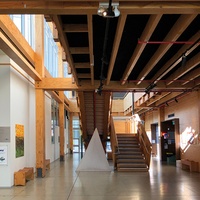
1. 2009 – NMIT Arts & Media Building
61 Nile Street, Nelson
Irving Smith Jack Architects
This project was the winning entry in a government-sponsored competition to encourage the use of structural timber in multi-storey construction. The design incorporated University of Canterbury research that led to the world’s first use of seismic, post-tensioned timber shear walls. However, the building itself serves as an educational tool, establishing a precedent for environmentally sensitive timber construction. The project attracted a stack of national and international awards, including for its timber and engineering innovations. Refer Architecture NZ May/June 2011.
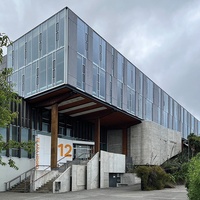
2. 2012 – Te Ara Hihiko, Massey University
Wallace Street, Wellington
Athfield Architects
Built for the College of Creative Arts, this project employed the world’s first multistorey, post-tensioned timber frame. This allows the structure to rock in an earthquake but return to position with minimal damage. The LVL frame and the steel mechanics of the posttensioned system are exposed on the interior and, unusually, on the exterior. Placed on a complex landform and providing a cross-campus circulation route, the structure as a whole is a hybrid — the timber frame rests on an embedded concrete plinth. The project received numerous awards, including an NZIA National Award in 2014. Refer Architecture NZ Aug/Sept 2012.
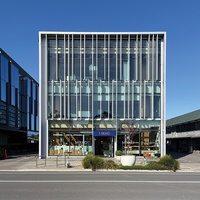
3. 2014 – Merritt Building
134 Victoria Street, Christchurch
Sheppard & Rout
As with NMIT and Te Ara Hihiko, this project employed structural technology developed at Canterbury University (UC). Intended to act as an efficient, reproducible timber structural system, equivalent to concrete or steel in cost and suitable for everyday commercial buildings, the technology was developed by UC’s Structural Timber Innovation Company. The system employed cables within the timber beams and energy-dissipating steel fittings to minimise damage and allow rapid reoccupation after seismic events. This three-storey building houses retail spaces and professional offices and was the winner of an NZIA Local Award in 2015. See Progressive Building August 2015.
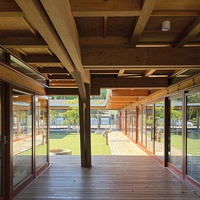
4. 2016 – Cathedral Grammar Junior School
2 Chester Street West, Christchurch
Andrew Barrie Lab and Tezuka Architects
Large timber structures typically rely on extensive use of steel to transmit loads through joints, where stresses are at their maximum. To reduce costs and complexity, this project made use of timber-to-timber joints. These old-school partial lap joints needed to fit very tightly to achieve the required structural stiffness and so required a very high level of accuracy from the timber milling process: ±0.5mm on elements up to 12m long at a time when ±5mm was typical. The project accumulated design and engineering awards, including the NZIA Ted McCoy Award for Education in 2018. See Architecture NZ Sept/Oct 2016.
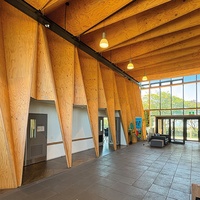
5. 2016 – Mount Pleasant Community Centre
3 McCormacks Bay Road, Christchurch
Chris Moller Architecture + Urbanism
Built to replace a community centre lost in the 2010–2011 earthquakes, this project employs LVL in a unique way — as thin sheets to generate an origami-like pleated structure. Such forms were a favourite of the modernists — pleats make thin planes rigid — but this structure required the use of very 21st-century digital design and fabrication techniques to create the steel and timber joints. The geometry sits over a tripartite planning arrangement — a large ‘atrium’ with a double-height multi-purpose space to one side and a stack of support spaces, including a café, to the other. See Architecture NZ March/April 2018.
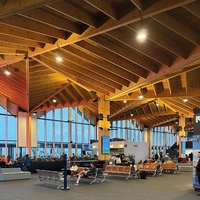
6. 2019 – Nelson Airport Terminal
Trent Drive, Nelson
Studio Pacific Architecture
Given the surrounding commercial forests and the presence in town of CLT and LVL fabricators, it is not surprising Nelson has become a centre for innovation in mass timber. Prefabricated in a nearby aircraft hangar, the building received numerous awards, including the NZIA’s Sir Miles Warren Award for Commercial Architecture in 2020. The awards jury stated: “As one enters the terminal, tall, bare timber columns draw the gaze up towards the faceted, triangulated timber ceiling and underside of the roofscape: a composition that showcases local expertise in timber fabrication.” See Architecture NZ March/April 2020.
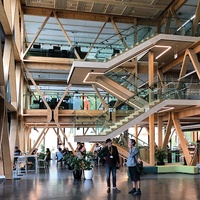
7. 2020 – Te Whare Nui o Tuteata
Longmile Road, Rotorua
RTA Studio and Irving Smith Architects
Built for the national research institute that provides scientific support to our forestry industry, the Scion Timber Innovation Hub was another project explicitly intended to showcase the potential of timber. Office, exhibition and hospitality spaces are wrapped around a triple-height atrium. The implausibly slender LVL diagrid vertical structure was made possible by the development of all-timber joints which align stresses with timber grain, maximising the timber’s strength. Small replaceable steel ‘fuses’ at the connections absorb stresses generated by severe earthquakes. See Architecture NZ March/April 2021.
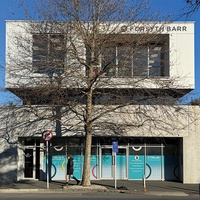
8. 2022 – WallÉ 96
Collingwood Street, Nelson
Irving Smith Architects
Part of a long-running series of ISA projects that employ mass timber structures in ‘everyday’ commercial buildings, WallÉ deals cleverly with the design constraints typical of central city commercial buildings — particularly design-deadening fire regulations. The building occupies the full site, and the lower half of the three-storey building — up to balustrade level of the middle floor — is pre-cast concrete, providing complete fire protection. Above, a mass timber structure meets regulations, provides amenity for occupants and ensures future development on adjacent sites won’t ruin things. See Architecture NZ Sept/Oct 2022.
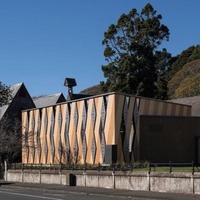
9. 2023 – Te Whare Hononga
39 Vivian Street, New Plymouth
Tennent Brown Architects
Built beside our oldest stone church, this project takes on the ambitious challenge of both accommodating and representing the reconciliation between mana whenua and the church. It employs a structurally ambitious but poetically resonant reciprocal roof structure — no individual member extends across the space, smaller members combining to achieve the long spans. Bestowing an NZIA Western Award in 2024, the jury stated: “Stylistically and technically successful, the true success of this project’s intention will only be known with years of hui, wānanga and kōrero. But for now, perhaps it succeeds simply by starting the dialogue.” See Architecture NZ Nov/Dec 2024.
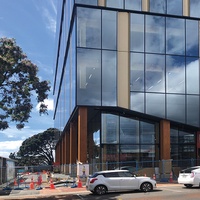
10. 2024 – 90 Devonport
90 Devonport Road, Tauranga
Warren and Mahoney
Leased as the new headquarters for Tauranga City Council, this eightstorey building was, at completion, the nation’s largest mass timber office building. A 6 Star Green Star design, the project is an example of an increasingly favoured approach which doesn’t seek an entirely timber structure but hybridises structural materials, each doing what it is good at — timber columns, beams and floors dealing with gravity, and steel braces resisting seismic loads. This allows for a simpler, more elegant and more efficient structure: one that the architect intended to become a repeatable commercial typology. See Architecture NZ Sept/Oct 2022.
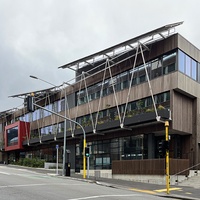
11. 2024 Ngā Mokopuna
42–50 Kelburn Parade, Wellington
Tennent Brown Architects
Formerly known as the ‘Living Pā’, this project is the largest New Zealand project to date to take on the Living Building Challenge. Built for a large institution accommodating Māori facilities on a tight urban site, it seems to realise the suite of ambitions currently facing New Zealand architecture. It includes a full array of sustainable systems, significant carbon reduction and cultural integration. At the project’s core is an LVL and CLT structure, notable for the sturdiness required for a multistorey building to meet the seismic loads generated by a fault line located just a stone’s throw away. See Architecture NZ Jan/Feb 2024
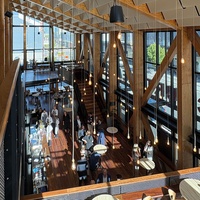
12. 2025 – The Court Theatre
129 Gloucester Street, Christchurch
Haworth Tompkins and Athfield Architects
Home to the last surviving home-based professional theatre – that is, having all production facilities in one building – this project is a collaboration between London-based theatre specialists Haworth Tompkins and locals Athfield Architects. Housing two auditoria and administration, production and support spaces, this building is a structural hybrid, combining steel, concrete and timber structural systems to address complex spatial, acoustic and technical requirements. Its mass timber structure is boldly expressed in the dynamic triple-height foyer – described by Dorita Hannah as “not unlike a local pub”. See Architecture NZ Sept/Oct 2025.
13. 2025 – Hangar 4
14 Laurence Stevens Drive, Auckland
Studio Pacific Architecture
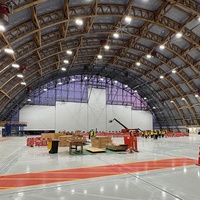
This project is a groundbreaking example of mass timber being employed beyond the bounds of commercial and institutional buildings. The building follows a structurally efficient geometry, and self-supporting ETFE pillow roofing further reduced the physical structure required. The huge trusses, which combine elements of LVL and CLT, were factory assembled in sections, joined together flat on the ground, and then rotated up into place by New Zealand’s largest crawler crane. Despite being constructed from mass timber rather than from spidery steelwork, the finished building is incredibly elegant. See Architecture NZ Jan/Feb 2026.
14. 2026 – Fisher & Paykel Global HQ
830 Great South Road, Auckland
RTA Studio
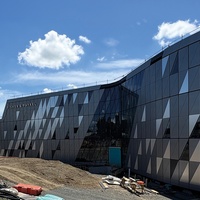
Still under construction, this campus will include facilities for parking and appliance prototyping labs, but it is the flagship ‘home’ building, which will house administration, research and design functions, that will no doubt be the focus of attention. Extending the approach taken with Scion’s timber diagrid system, the building’s curving exterior walls are made up of a diagrid with a simplified web joint, with the floors and roof made up of CLT slabs. Fun fact: it will take the New Zealand forestry industry only three hours to grow the wood used in the building. See Architecture NZ May/June 2023.
Other addresses
2012 – Carterton Events Centre
50 Holloway Street, Carterton
WSP Architecture
2014 – Te Kura Whare
12 Tuhoe Street, Taneatua
Jasmax
2017 – He Tohu
70 Molesworth Street, Wellington
Studio Pacific Architecture
2021 – Ōpuke Thermal Pools & Spa
35 Mount Hutt Station Road, Methven
Sheppard and Rout
2021 – Brandon House
149 Featherston Street, Wellington
Studio Pacific Architecture
2022 – HomeGround
Hobson Street, Auckland
Stevens Lawson
2023 – Tuhiraki – AgResearch Lincoln Facility
21 Ellesmere Junction Road, Lincoln
Architectus
2023 – Green School New Zealand – Kina
406 Koru Road, Koru
Boon
2024 – AUT Tukutuku
90 Akoranga Drive, Northcote, Auckland
Jasmax
See Architecture NZ Jan/Feb 2025
2024 – Te Whare Whakatere Ashburton Library and Civic Centre
221 Baring Square East, Ashburton
Athfield Architects
See Architecture NZ July/August 2025
Sources
The projects in this itinerary have all received significant coverage in our local architectural press, but most are new enough that few have received coverage in book form. Aaron Betsky’s Unfinished & Far Far Away: The Architecture of Irving Smith Architects (Barcelona: Altrim, 2023) gives in-depth coverage of ISA’s innovation in mass timber, locating the practice in its Nelson context. The Christchurch buildings are all included in Freerange Press’ Shifting Foundations: Post-quake Architecture of Ōtautahi Christchurch (Christchurch: Freerange Press, 2023). Amelia Melbourne-Hayward’s article entitled ‘Shiver me timbers’, published on ArchitectureNow in 2015, gives a succinct account of the state of play at that time, including the structural innovations emerging from the University of Canterbury. Fans of our mass timber buildings would do well to study our long history of timber buildings, particularly timber gothic churches and elaborate meeting houses. Both types are well covered, along with many others, in Historic Buildings of New Zealand: North Island (Auckland: Cassell, 1979).
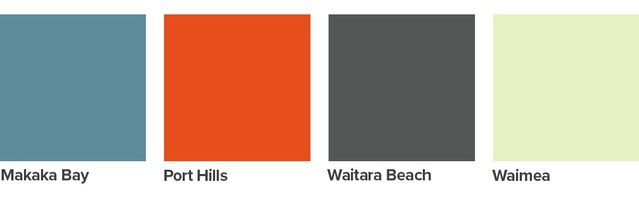
The Itinerary series is supported by Dulux Colours of New Zealand. Dulux Colour Specialist Davina Harper has selected a Colours of New Zealand palette based on this itinerary. See the full range and order colour samples here.