Book: Health design in New Zealand
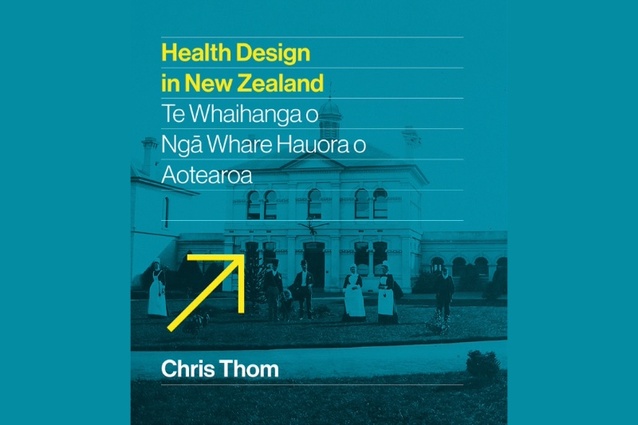
Health Design in New Zealand by Chris Thom Massey University Press, 2025.
Dorita Hannah discusses the book Health design in New Zealand by Chris Thom which tackles the specific typological development while opening up the classification beyond hospital architecture.
New Zealand is slowly amassing literature on its architectural history and contemporary spatial practices. Documenting the legacy of our constructed environment allows us to move forward and recognise unique contributions — already made and yet to be envisaged — within and beyond our shores.
It is, therefore, a landmark occasion to have a book published on health design in New Zealand, tackling its specific typological development while opening up the classification beyond hospital architecture. Chris Thom has thoroughly researched the history of hospitals, psychiatric institutions, clinics and even medical schools: facilities designed to train carers and tend to our nation’s sick, elderly, mothers and children. Historically, these included ‘fallen soldiers’, the ‘insane’ and the ‘incurable’. Adopting a generally chronological structure, punctuated by thematic sections, he incorporates a comprehensive catalogue of images to chronicle our health architecture since colonisation.
While the first chapter is dedicated to pre-settler ‘Hauora Māori’, two pages don’t begin to do justice to spatialities of a rich pre-settler culture around indigenous rongoā practices. However, Thom’s mention of Sir Mason Durie’s Te Whare Tapa Whā of 1984 signals an oft-cited health model that likens four aspects of well-being – spiritual, mental/emotional, physical and familial/social — to the walls of a wharenui rooted in whenua. This symbiotic architectural analogy has rich potential to resonate globally as — faced with existential challenges inherited from imperialism, capitalism and colonisation — we turn to solutions emerging from indigenous epistemologies.
In Architectures of Care, Brittany Utting writes that healthcare typologies tend to reinforce specific “roles, bodily norms, and behavioural forms”. Such regularisation is evident in Thom’s exhaustive compilation of projects from the first rudimentary facilities established by missionaries in the 1830s to more inventive amenities incorporating inclusive and inventive contemporary models. It is interesting to learn of planning innovations: from Florence Nightingale’s 19th-century ‘pavilion principle’, mitigating the spread of disease by maximising sunlight and ventilation; to more recent ‘salutogenic design’, returning to an emphasis on nature, fresh air and daylight. Coming full circle, these advances were inherited from England and Europe, and, later, North America and Australia, begging the question: what reforms emerged from within Aotearoa and its particular cultural make-up?
The most localised and culturally apposite innovation comes from Princess Te Puea Hērangi, who desired more healthy environments for her people at Ngāruawāhia after the 1918 pandemic. She conceived Māhinārangi (1928) — a wharenui at Tūrangawaewae — as a hospital staffed by Māori professionals with its familiar structure and carved environment designed to appeal to all iwi. This involved removing internal ridge poles to create a central aisle with side windows providing ventilation. Unfortunately, Te Puea’s idea was rejected by health authorities, signalling an ongoing colonisation of the state’s imagination.
Are more recent governments doing enough to address inequities in our built environment, extending beyond buildings as objects to include siting and landscaping? We know that what works for our most vulnerable can serve all citizens. Although Thom presents critical heritage buildings, such as Carrington Hospital — currently standing empty on the Unitec campus — he omits the role played by its surrounding farm as a critical therapeutic model.
Just as we return to the flow of air and fall of sunlight, so we could revisit the porches and gardens advocated by many in this book, especially nurses whose images in starched white aprons and caps populate its pages. As with tangata whenua, the contribution of nurses to New Zealand health design — including Catholic sisters and Plunket professionals — is another book yet to be written. Instead, as with many publications, the professional health design history of Aotearoa is presented alongside a parade of white male portraits. Nevertheless, Thom recognises the role played by women in a thematic section, informing us that “five of the first six women to graduate with a Bachelor of Architecture degree in New Zealand worked in the public service with at least four involved in health design”. As time advances, singular architects are replaced by larger firms operating as teams, although the necessarily collaborative consultants are generally elided.
While the book closes on a rather uninspiring photograph of the incomplete Dunedin Hospital — compelling us to wonder what intangibles were sacrificed through the re-design resulting from government budget cuts — I want to close on the most compelling image found in the preceding thematic section on ‘Fixtures, Fittings and Equipment’. Here, the scale of a wahakura — handwoven harakeke sleep basket — offers a safe, eco-friendly moenga (bed) for babies, enabling them to co-sleep with others. The photo is placed alongside the polypropylene Pēpi-Pod – both a bed and an infant care programme developed in Christchurch by Change for Our Children — which has statewide application in Queensland, Australia.
This image of a tiny, vulnerable body encased in a woven shell and placed on a tivaevae blanket exemplifies the spatial promise of Te Whatu Ora (Health New Zealand), which, as “the weaving of wellness”, advocates wholistic integration of people, knowledge and institutions. To this we should add design as integral to our nation’s ambition for Pae Ora (Healthy Futures).