Architecture of the deal
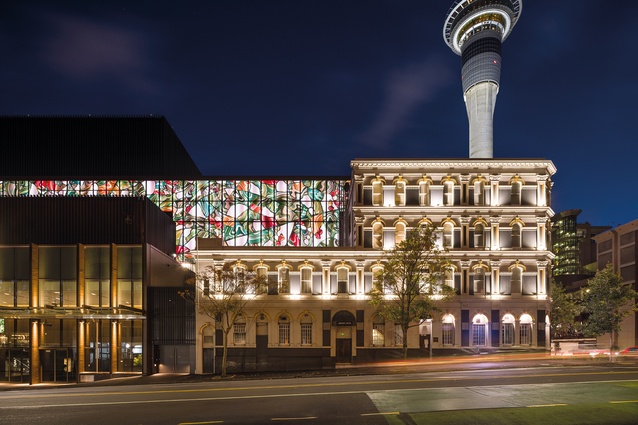
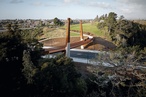
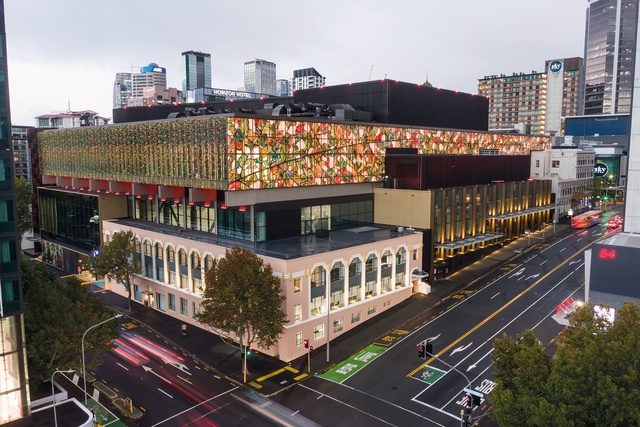
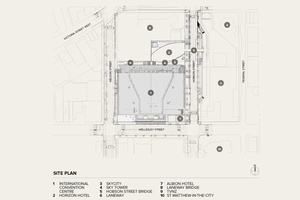
The New Zealand International Convention Centre (NZICC), viewed from the south (Wellesley Street), with the Albion hotel at the right, Sara Hughes’ glass lantern artwork in the centre and the Sky Tower at the rear.
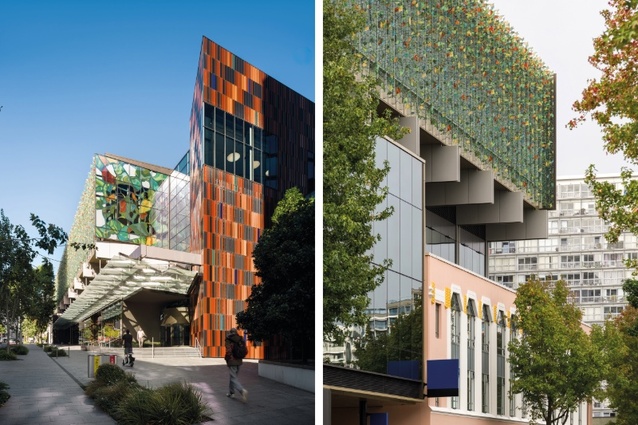
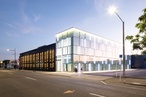
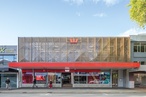
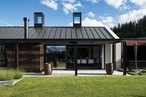
Left: Looking south along the NZICC’s Hobson Street elevation, with Peata Larkin’s sculptural ceramic wall in the foreground. Right: On the building’s west-facing (Nelson Street) edge, the glass-clad plenary level is separated vertically from the remnant of the Berlei building.
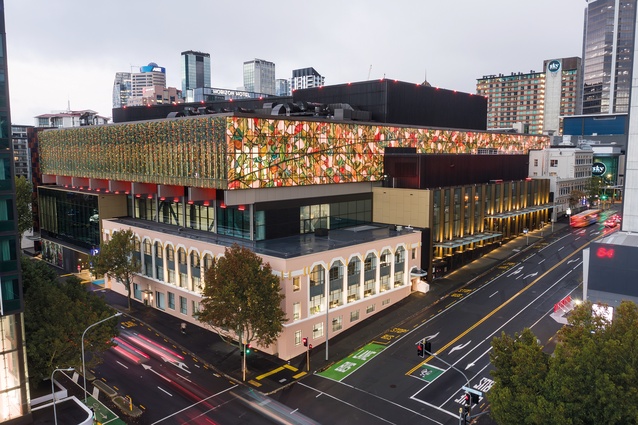
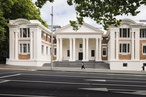
Beneath the lantern artwork, the preserved façade of Roy Lippincott’s Berlei building wraps around the NZICC’s south-western corner.
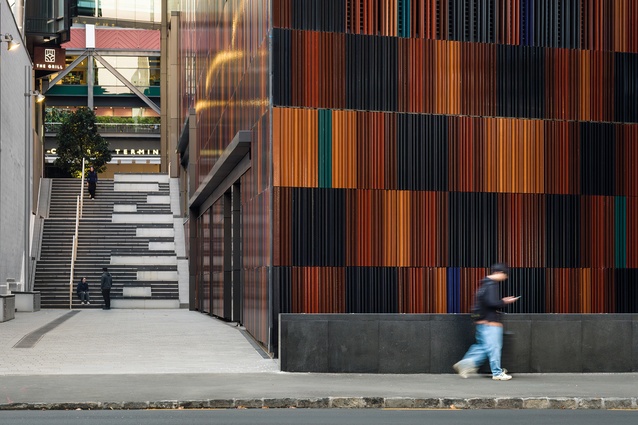
The laneway on the northern side of the NZICC, viewed from Nelson Street.
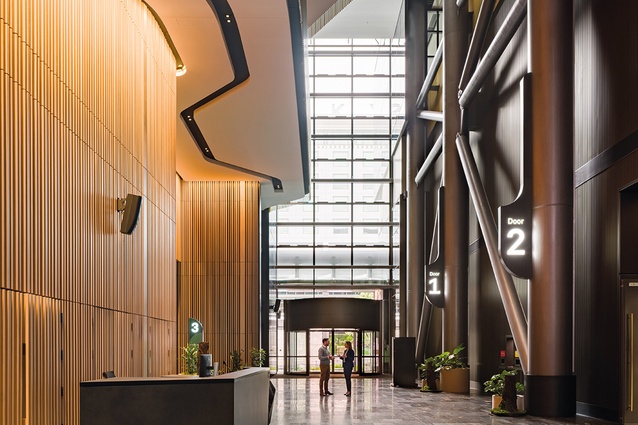
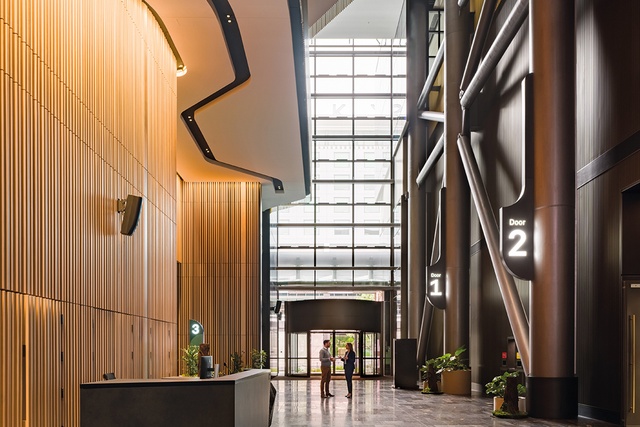
View through the atrium/foyer to the NZICC main entrance on Hobson Street.
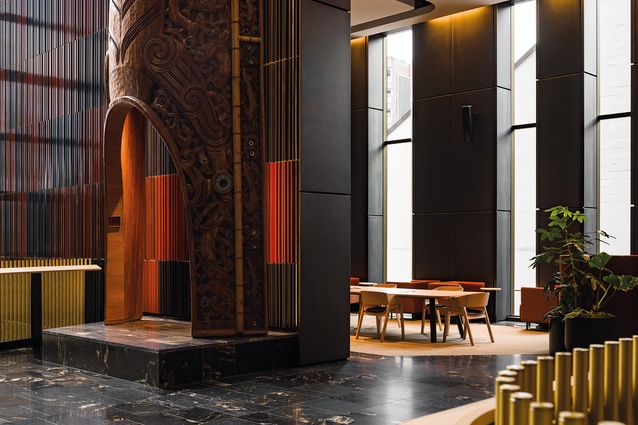
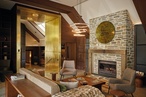
‘Public’ space in the foyer, with, at left, Lyonel Grant’s artwork, Pou Wairua Waka.
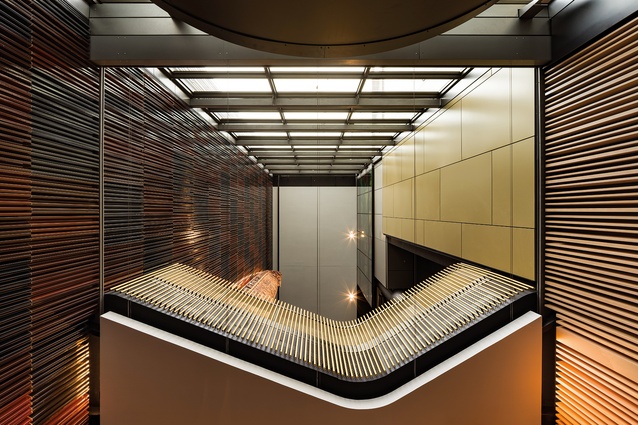
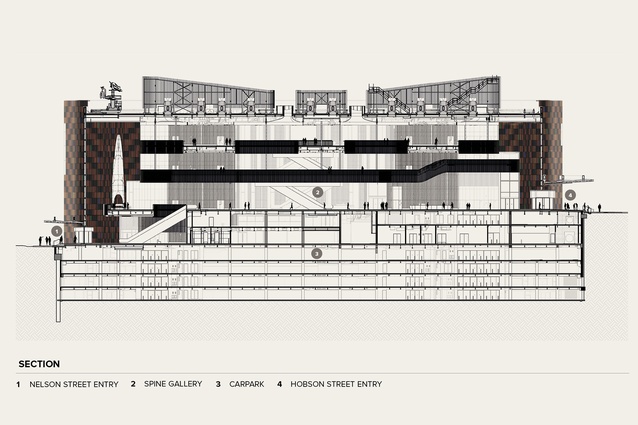
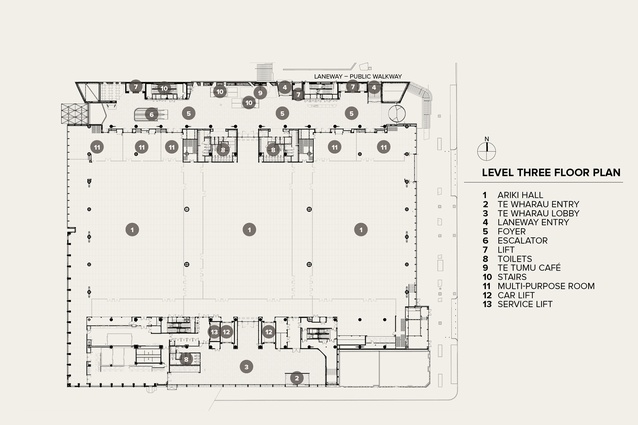
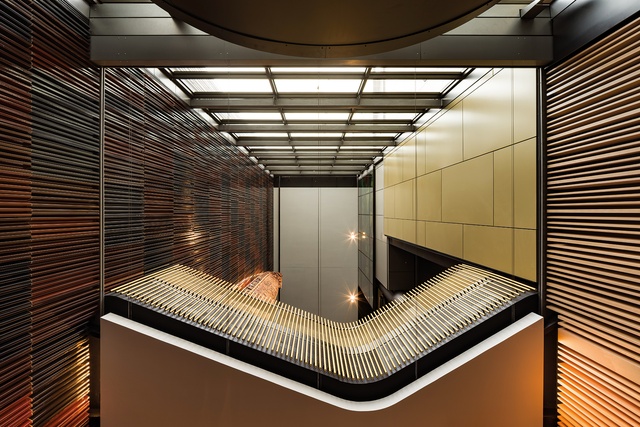
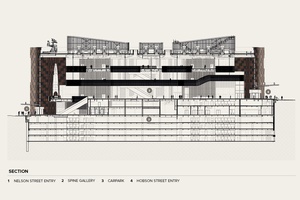
The 100-metre long ‘spine gallery’ connects the primary spaces in the venue and is, on average, 20 metres high.
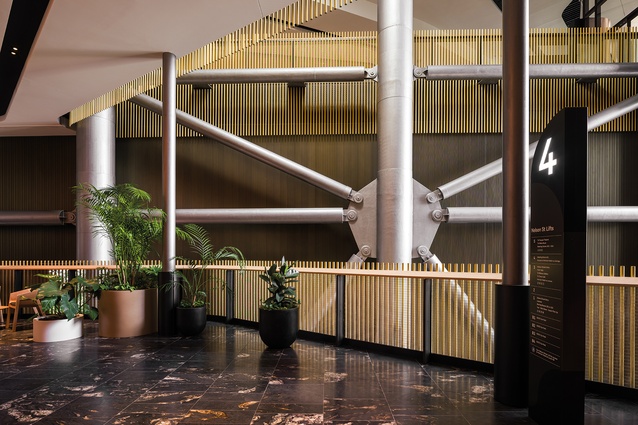
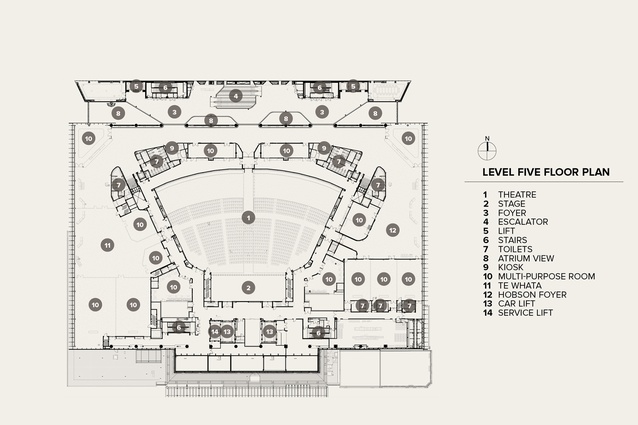
The circulation area on level 4 leads to the Horizon hotel airbridge.
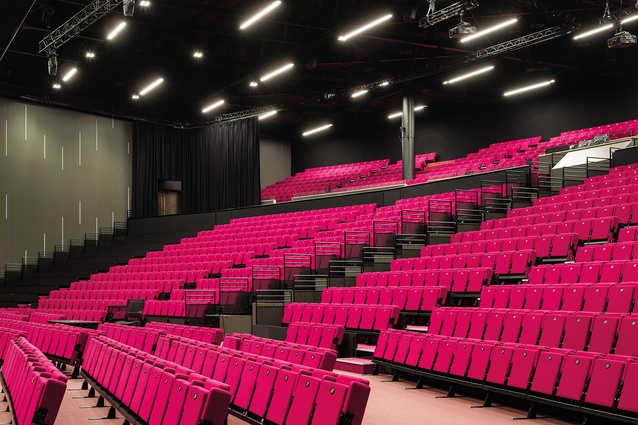
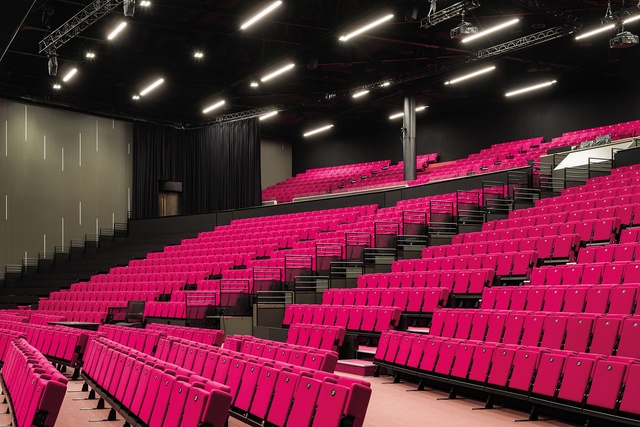
The 2850-seat plenary hall, which may be divided into two 1235-seat auditoria; the seating retracts to provide a large event space.
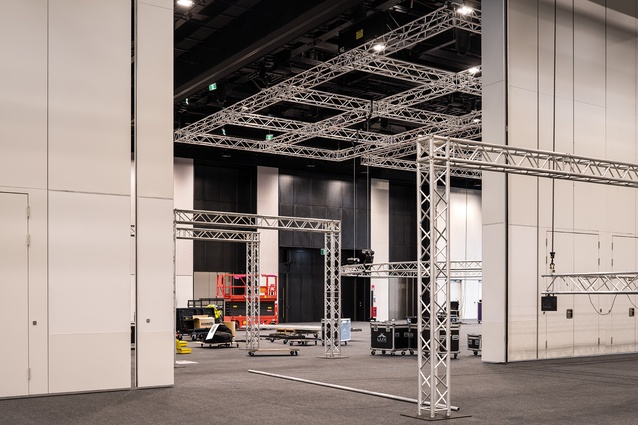
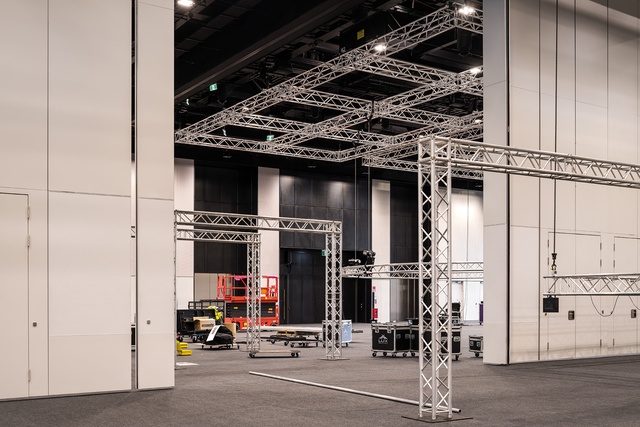
The 6700m2 exhibition hall is capable of multiple configurations. Lifts transport loading trucks from the basement car park.
John Walsh delves into the tangled history and the complex urban design thinking underlying Auckland’s 32,000m2 New Zealand International Convention Centre by Warren and Mahoney in association with Moller Architects and Woods Bagot.
Early in the morning of 11 February this year, Prime Minister Christopher Luxon, Convention Man par excellence, cut the ribbon at the opening ceremony for the New Zealand International Convention Centre in downtown Auckland. Finally, a project that was controversial and seemingly starcrossed had made it across the finishing line. Since construction of the Convention Centre began in 2016, five prime ministers have served in office, as have three Auckland mayors. But this time line captures only half the story. Construction of the Convention Centre, which was set back four years by the catastrophic 2019 fire that was also chiefly responsible for the doubling of the project’s original $450-million budget, was itself preceded by a decade in which options were explored and deals made. John Coop, Warren and Mahoney’s managing director, says his own engagement with the New Zealand International Convention Centre stretches back 16 years. A marathon involvement: at the building’s completion, project veterans must have been as exhausted as Pheidippides. (John Coop’s architectural race, it should be noted, is definitely not done.)
One day, the New Zealand International Convention Centre, as a work of architecture, may be liberated from the circumstances of its provenance and the narrative of its construction. But not quite yet. It’s not just that one lingering legacy of the complex project is a high-stakes legal dispute between client SkyCity Entertainment (SkyCity) and main contractor Fletcher Construction. It’s more that the process that produced the building had a substantial influence on its form.
To understand the Convention Centre, it’s necessary to peer through the mists of time, back to early 2000s’ Auckland, then un-Superfied but starting to exhibit post-millennium confidence after decades of development malaise. It was the era of the Auckland Waterfront Advisory Group, the new Auckland Urban Design Panel and Auckland City Council’s ‘urban design champion’, the loquacious English planner Ludo Campbell-Reid. Gordon Moller, architect of the Sky Tower (1997), two-term president of the Institute of Architects and its 2006 Gold Medallist, was everywhere. Schemes abounded; proposals were bruited about.
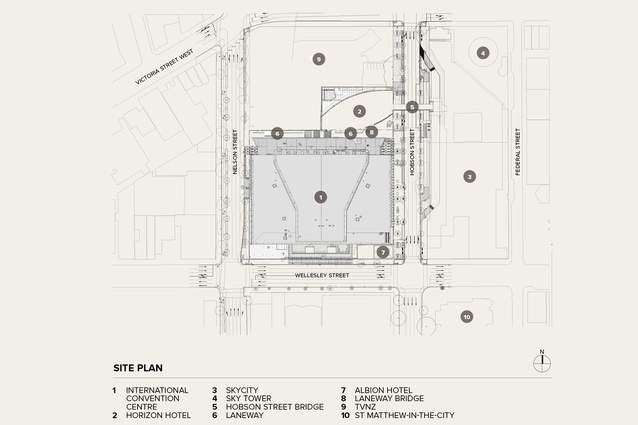
One Auckland amenity deemed to be lacking, not least by the tourism and events lobby, was a proper convention centre. Feasibility studies were commissioned and various city sites were promoted. Things got more real after the election of John Key’s National Party-led government in 2008. As well as being prime minister, Key took the portfolio of minister of tourism. In 2010, the government sought Expressions of Interest (EOIs) for the provision of an ‘international’ convention centre in Auckland. There were five serious responses. SkyCity, which already had convention facilities attached to its casino and hotel complex, proposed building a convention centre on the adjacent sloping site bordered by Hobson, Nelson and Wellesley Streets. Other EOIs came from groups advocating for sites at Quay Street, Wynyard Quarter, the Aotea Centre environs and the Greenlane showgrounds. The funding model — public, public-private or private — had not yet been declared, although it was already clear that the Key government did not want to commit public money to the project.
It also became clear that SkyCity had the Convention Centre inside-running. In 2011, the government announced it was negotiating with the company, whose proposal it had accepted. A 2013 Auditor-General’s report criticised the evaluation process; it was not ‘transparent’ or ‘even-handed’, and unfairly favoured SkyCity’s bid. The report tended to apportion responsibility for an ‘inadequate’ process to government officials, not ministers, although it did draw attention to one occasion when the prime minister left a fingerprint on the process. As early as 2009, as ministers considered convention centre procurement options, Key had annotated a ministerial briefing paper with the remark: “We should close off the Sky City angle first.”
The attraction of SkyCity’s convention centre proposal, especially compelling in the wake of the 2008 Global Financial Crisis, was that it would not require public funding. It was, however, dependent upon concessions from the government. In return for SkyCity building the Convention Centre, parliament, divided on party lines, passed the New Zealand International Convention Centre Act 2013. Key’s art-of-the-deal legislative change — a manoeuvre that anticipated the 2010 anti-union ‘Hobbit Law’ enacted at the behest of Peter Jackson and Warner Brothers — gave the company a 27-year extension to its Auckland casino licence, which was due to expire in 2021, and permission to operate 230 additional pokie machines and 40 more gambling tables.
Why all of this matters to an architectural project is that it moved the Convention Centre, to some extent, into the public realm. (Of course, the building, which occupies much of a large city block, has, by virtue of its scale, a substantial urban presence: a rather different matter.) SkyCity is aware that many people do not like it, for political or moral reasons. The company is regularly buffeted by bad-news stories: the gambling mother who left her five children in a van in a SkyCity casino car park, for example; the temporary casino closure following the failure to stop a problem gambler losing more than a million dollars on the pokies; the $4-million penalty for breaching Anti-Money Laundering and Countering Financing of Terrorism obligations. It’s no wonder SkyCity, and presumably the government, preferred to keep the company’s brand off the New Zealand International Convention Centre. The company’s reputational challenges, and the controversial genesis of the Convention Centre, may have encouraged some members of its board to entertain some good-citizen design gestures.
From the architects’ perspective, what they were wrestling with was the typology of the convention centre: notoriously, a big box, self-concerned and self-involved. From the outside, such buildings are usually mute occupiers of acres of space. On the inside, occupants feel they could be anywhere, or nowhere. Warren and Mahoney, along with partners Moller Architects and Australian practice and convention centre specialist Woods Bagot, set out to humanise the 32,000m2 New Zealand International Convention Centre, to connect it to the city and give it a sense of local and national belonging — without, that is, plastering silver ferns all over it — while satisfying the building’s programmatic requirements.
John Coop identifies the design’s ‘big moves’: giving the building four distinct edges; vertically stacking the principal functional spaces — five levels of below-ground parking, a 6700m2 exhibition area and a 2850-seat plenary hall; and imparting horizontal order to the building via a 100-metre-long east-west spine, which is the main route through the block-wide building. Flexibility and adaptability are essential to the Convention Centre’s offering and operation. The plenary hall, for example, can be divided into two 1235-person auditoria or, with seats retracted, a large dining room or super-sized mosh pit. The building has more than 30 meeting rooms of varying capacity; the modern convention centre must pay its way as a multi-purpose venue. It already employs 500 full or part-time staff.
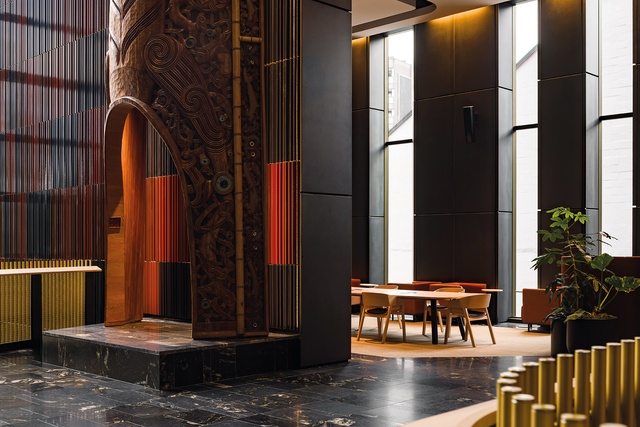
The most sympathetic of the spaces that the architects worked hard to design — and, laudably, realise in a novated project subject to constant value management — are the foyer areas and the generous upper-level circulation and gathering areas. The assembly or breakout areas outside the plenary hall offer natural light and expansive views of the city. The prospect of Ponsonby and view of a portion of the upper harbour from the upper-western side of the building are particularly welcome. The public has access to the foyer, although the space does not exactly signal its publicness. There’s a small, rather notional, café in the foyer, and proximity to two impressive artworks, the 15-metre-high Whakapiri atu te Whenua by Shane Cotton, painted in 1996 and previously, and less happily, situated in the SkyCity casino atrium, and Lyonel Grant’s 17-metre-high Pou Wairua Waka (2025).
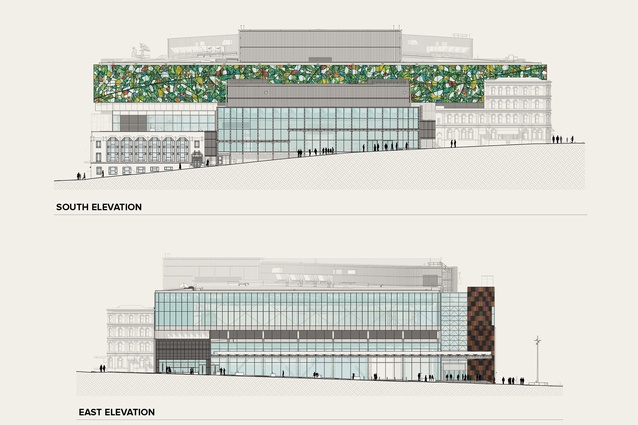
For the city at large, that is, for citizens not visiting conventioneers, it is the exterior of the building that matters. The building is certainly massive, but not as singular as contemporary buildings by Warren and Mahoney at Wynyard Quarter, nor, especially, as Te Pae (2021), the Christchurch Convention Centre, designed on a far less constrained site by Woods Bagot, in collaboration with Warren and Mahoney. Tellingly, John Coop describes the Convention Centre as being as much an urban design as an architectural project. The complexity of the building’s form is most evident on its southern (Wellesley Street) and western (Nelson Street) sides. At the building’s Wellesley Street corners, the architects had to deal with heritage hangovers: the Albion hotel (Edward Mahoney 1884) at the south-eastern corner and, at the southwestern corner, the façade of the Berlei building (1930), designed by the interesting and idiosyncratic American émigré architect Roy Lippincott.
The owners of the Albion wouldn’t sell; the façade of the Berlei building was retained in a successful bid to head off public notification of the intent to demolish a listed and scheduled building. (Auckland City planners argued for the entire building’s retention; the council-appointed Independent Commissioners over-ruled them.) The architects have given a bay’s depth to Lippincott’s typically graceful and ornamental façade, and vertical separation from the building floors above. Space precludes a lengthy digression about the merits, or faults, of façadism, but the retention of two walls of the Berlei building and the Albion hotel certainly adds to the impression that, on its southern and western sides, the Convention Centre is a sum of at least four parts.
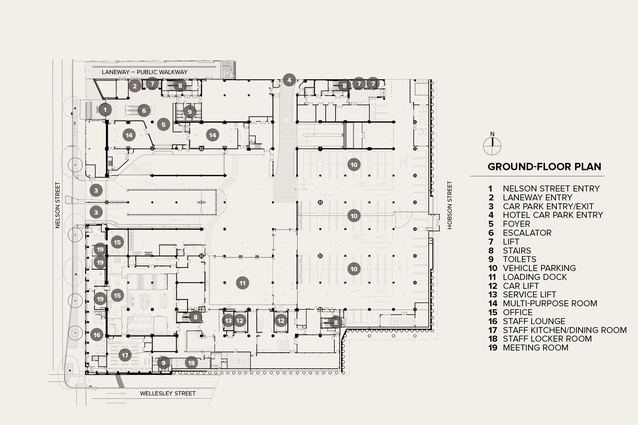
One of these parts is the lantern-like artwork Iwa Rau/Many Leaves, One Canopy (2025), by Sara Hughes: 475 large, coloured glass panels that wrap around the top of the building. On the Hobson Street façade, the vivid artwork compensates for the dull stretch of the exhibition hall’s street-level glazed wall. (The idea is that the public can view the activity in the hall when it is in exhibition mode.) The scale and ambition of the glass canopy is matched by Peata Larkin’s Te Pekerangi (2025). The ceramic artwork clads the Convention Centre, and masks its services, on the façade facing the laneway connecting Hobson and Nelson Streets that the architects managed to insert on the building’s northern side. (It is possible, and would be desirable, that the laneway may, in future, be activated by hospo businesses.) On the other side of the laneway are the SkyCity-operated Horizon hotel (Warren and Mahoney and Moller Architects) and the southern wall of the TVNZ building (Warren and Mahoney, 1989).
A public-good benefit of the Convention Centre is the widening of the Hobson Street footpath along the length of the building. The footpath fattening, which serves the pragmatic purposes of providing bus-parking and people-milling spaces, has removed a lane of car traffic from a block of one of the most unpleasant roads in Auckland. (Nelson Street is even worse; its footpath, being at the building’s rear, did not receive the same level of attention in the Convention Centre project.) The expanded footpath allows pedestrians not just a safer but a more leisurely stroll, giving them a moment to appreciate the architecture that does, in fact, exist in the Convention Centre’s neighbourhood: St Matthew-in-the-City (John and Frank Loughborough Pearson, 1902); HomeGround (Stevens Lawson Architects, 2022); and the little So-Cal modernist warehouse (Mark-Brown & Fairhead, 1960) on the south-western corner of Wellesley and Nelson Streets.
Another benefit of the Convention Centre project is the reduction of more than 20 vehicle crossings on the site’s footprint to one, the Nelson Street entrance to the Convention Centre’s carpark. And if conventionattendees, or members of the public, want a car-free transit of Hobson Street, the rather prosaic airbridge can transport them from the upper foyer of the Convention Centre and deliver them, via the Horizon hotel, to SkyCity, its hotel and its bars, and its casino, with its battery of ever-ready pokie machines.