The supply chain is broken: The architect as a harvester opportunity
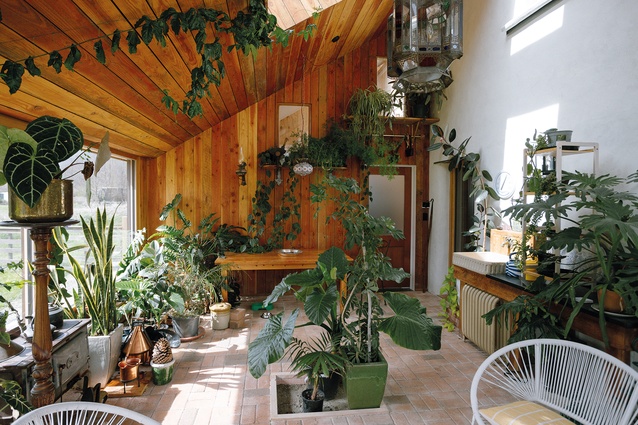
Hiberna Modular’s Winter House.
In our third sustainability thought piece from Te Kāhui Whaihanga New Zealand Institute of Architects, Rachel MacIntyre considers the economics of specifying sustainable materials in the design process
The sustainability argument has moved on. What was once a moral case is now an economic one, built on stability, sovereignty and supply chain survival and it demands a new kind of architect: one who understands that the most radical design decision they can make concerns which materials they specify and where they come from.
A container ship that left Rotterdam six weeks ago is carrying your next project’s insulation, manufactured using petrochemical feedstocks, loaded onto a vessel whose freight rates can swing sharply, and moved through shipping lanes increasingly vulnerable to disruption. When it arrives — if it arrives on time, at the quoted price — you will install it. Then, a few months later, you will start again. Approximately 90 per cent of construction products sold in New Zealand are either imported finished goods or made locally with imported components.1
That dependency has not changed but the world around it has. Global energy and trade shocks now show up directly in project budgets and programme risk. In 2026, the assumption that supply chains are inherently stable is no longer tenable. The structural conditions that made imported, petrochemical building materials the default — cheap energy, predictable shipping, stable trade relationships — are fracturing in ways that may not reverse. This is not a temporary disruption; it is a permanent shift and the window of opportunity for architects to lead that response is now.
This is a dependency problem not a sustainability problem
For many years, the case for bio-based building materials in New Zealand has been made primarily on environmental grounds: lower embodied carbon, better
life-cycle performance. Those arguments are sound but they have not been sufficient. Regulatory responses have been slow and always on the side of caution.
The stability argument is different and it is the one that matters right now. It does not ask architects to care about the planet; it asks them to care about their projects and their clients’ budgets. A wall insulated with New Zealand wool is far less vulnerable to a Middle Eastern energy price shock and hempcrete from plants grown in Taranaki is far less exposed to Red Sea disruption, than are similar products from overseas.
These are the key risk variables in every construction project in the country right now. The industry continues to treat supply chain exposure as unavoidable rather than a design decision that can be changed. That decision belongs to you, and it needs to change now.
Twenty-three countries each have an industrial strategy: We have a forestry export.
Some of the world’s more advanced economies have recognised that the shift to locally sourced, bio-based construction materials is not just an environmental measure — it is an industrial strategy. Twenty-three countries have made a formal national determination to develop bio-based material supply chains.2 New Zealand has not. New Zealand already has the feedstock: 1.76 million hectares of productive plantation forest,3 and a hemp sector that expanded from 259 hectares in 2018 to 1200 hectares by 20204 and a straw waste volume of approximately 900,000 tonnes.5 But we export our logs for offshore processing, then buy back value in imported products. New Zealand radiata pine is converted into panel goods in China — value-add captured offshore while we retain the land-use emissions of a log-export model. In a volatile global trade environment, that choice is becoming harder to justify.
The economics have changed the specifications haven’t
Petrochemical building materials appear cheap because production costs are not fully reflected in their price. Energy inputs are subsidised by geopolitical arrangements which are now fracturing. End-of-life costs are externalised to landfill. Supply chain risk is borne by the client when the container is late or the price has moved. Shipping costs have demonstrated they can triple in less than two years. The cost comparison is shifting in ways that most specifications have not caught up with. Wool insulation grown and processed in New Zealand is not subject to the same energy price exposure as is mineral wool. A straw panel produced regionally from agricultural waste has a cost rooted in local land and labour.
The VUW research6/sup> found that, with economies of scale, bio-material price premiums reduce substantially. The circular logic matters; bio-materials appear expensive because they are not specified at scale, and they are not specified at scale because they appear expensive. The break point is the architect’s specification. Every project that defaults to imported insulation delays the scaling that would make wool cost competitive. Every project that specifies it accelerates it.
The harvester is upstream, the dependent specifier is not
The architecture profession does not wait for regulation to engage with performance-driven design. Where policy exists, such as acoustic compliance or accessibility, architects embed it into their practice. Where it does not, such as detailing of thermal bridging or mainstream bio-material use, leadership still depends on the profession anticipating performance and risk, not on waiting for a mandate. Scaling supply is a critical barrier to bio-material adoption in New Zealand.7 Scaling requires demand and demand in construction is created by specifications. A regional hemp processor will not invest to produce hempcrete at volume without reliable forward demand. That demand comes from architects writing it into briefs. The profession is not downstream of the supply chain. It is upstream of it: architects determine, over time, which materials become available.
What the harvester does in their next project
- Ask the supply chain question at brief stage. Where does this material come from? How many borders does it cross? What happens to its price if fuel costs rise 30 per cent? These are procurement risk questions — they belong in the brief alongside budget and programme.
- Make the resilience case to clients. Supply chain certainty and price predictability are convincing arguments, regardless of a client’s environmental position. A locally grown, locally processed material is far less exposed to volatility than is an imported petrochemical product. That is a financial argument. Use it.
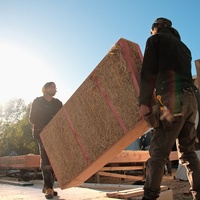
- Specify to create the market. Every consented hempcrete, straw or earth-based project and every wool insulation specification shared with the profession makes the next project’s path shorter and cheaper. You are not just building a building — you are building a supply chain. Froggy Bottom house in Otago,8 the first building in Aotearoa to use Hiberna Modular’s prefabricated straw panels, is exactly this kind of exemplar: Passive House-certified, locally grown, replicable and commercially viable.
- Engage upstream. Visit the hemp processor in Canterbury. Talk to the wool insulation merchant and the sawmill. The agricultural and forestry sectors producing New Zealand’s bio-material feedstocks may not know that construction is a market for their waste streams. The architect has the design authority and the industry reach to make those connections.
- The geopolitical order that made imported petrochemical building materials the cheapest option may not return.
The energy markets, shipping lanes and trade relationships that underpinned decades of globalised construction supply chains are under structural pressure. The profession can respond by continuing to absorb the cost and risk of imported dependency — or it can treat the instability as a force for change: the moment that finally makes the economic case for what the environmental case has not managed to do. New Zealand could grow the answer. It grows it in plantation forests and sheep paddocks and hemp fields and cereal crops, whose straw is currently burnt as waste. That material sovereignty is not a future technology. It is an existing agricultural capacity waiting for a profession ready to harvest it. The Architect as Harvester, in 2026, is a professional survival strategy.
The container ship with your project’s insulation is six weeks out. The hemp field is a few hours’ drive away and can harvest a crop annually. The specification is up to you.
References
1. E K Petrović, M Walker, M Murray, D McMeel, D Kawiti & M Young, 2025, ‘ER105 Biomaterials for low-carbon built environment: Fostering the new good.’ Victoria University of Wellington study published by BRANZ.
2. According to the OECD Bioeconomy Policy Inventory and European Commission Bioeconomy Strategy updates (2025), more than 20 nations – mostly in the EU plus Canada, Japan and South Korea – have adopted explicit national bioeconomy or bio-based material strategies.
3. MPI’s National Exotic Forest Description (NEFD, 2025).
4. David Moore, David Graham, William Li & Zabard Hartmann, 2025, ‘Facilitating growth in the New Zealand Hemp Industry’. Final report published by the Ministry for Primary Industries.
5. New Zealand generates in the order of 900,000 tonnes of cereal straw per year, much of which is currently underutilised or burned, offering a significant additional feedstock for domestic bioproduct industries.
6- 7. E K Petrović, M Walker, M Murray, D McMeel, D Kawiti & M Young, 2025, ‘ER105 Biomaterials for low-carbon built environment: Fostering the new good.’ Victoria Univeristy of Wellington study published by BRANZ.
8 Designed by Jessica Winter and Hiberna Building & Design.