Composed of shadows
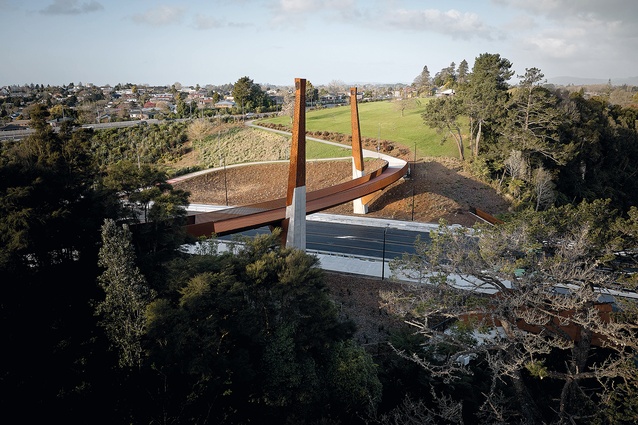
The smaller of two bridges, Taurapa lifts pedestrian and cycle crossing above the new river- crossing bridge, presenting a gateway to the new suburb.
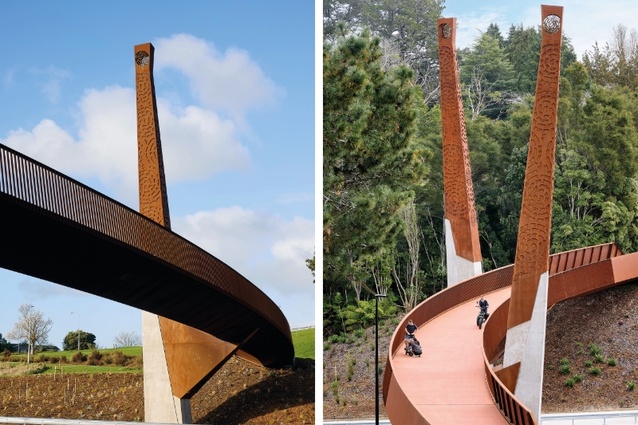
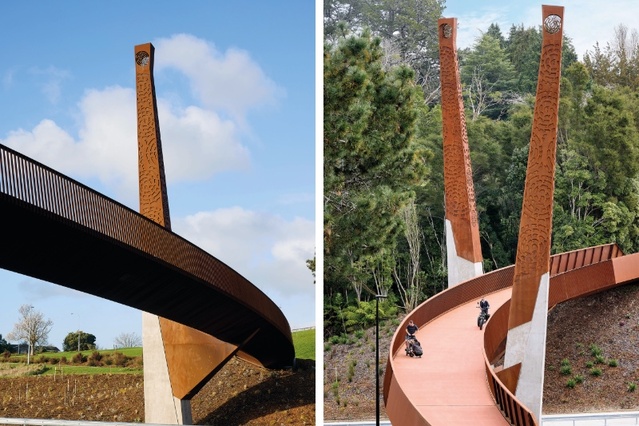
Left: Taurapa’s deck rests between the hefty corbels of two stately patterned posts, elevating common infrastructure. materials to artwork. Right: A graceful earth-red curve lifts out of the hillside, providing an uninterrupted connection for traversers of the Te Awa path.
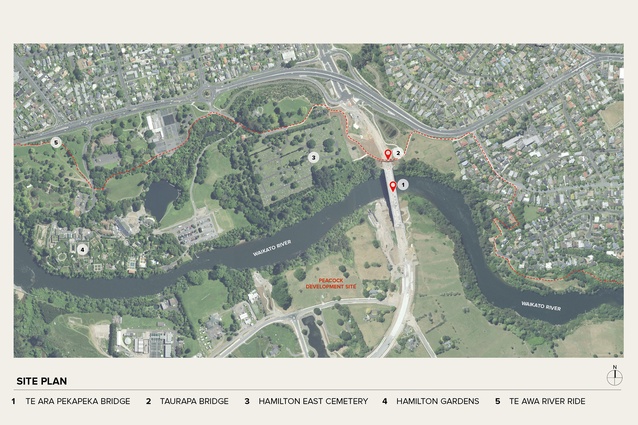
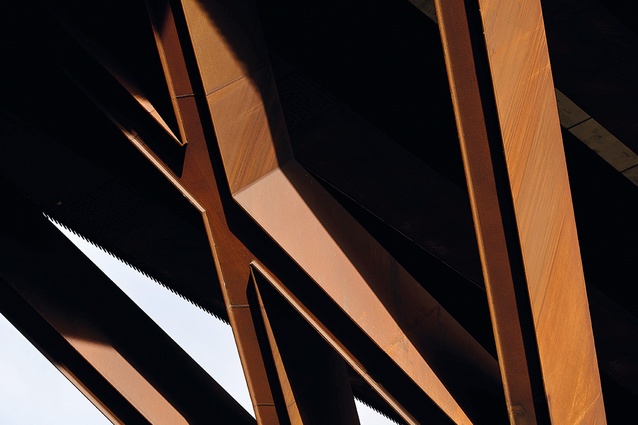
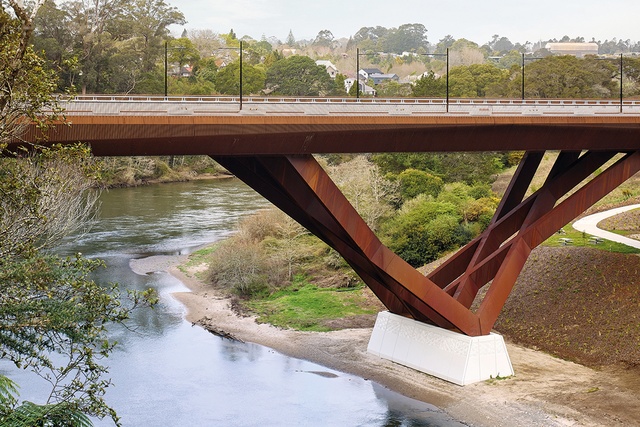
Shadow lines emphasise the laced interlock of the support pier.
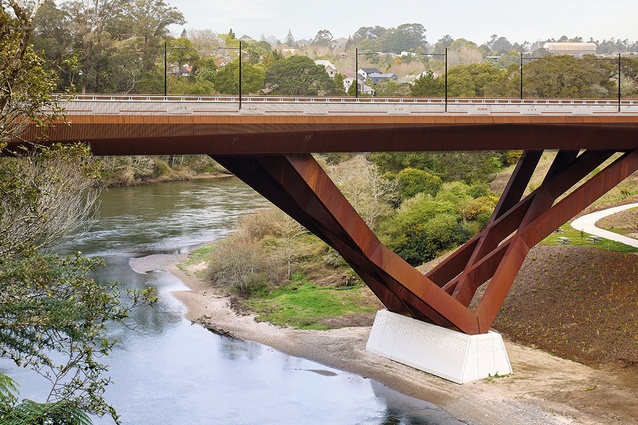
The main support of the split pier steers clear of the riverbed, resulting in the originality of the bridge’s form.
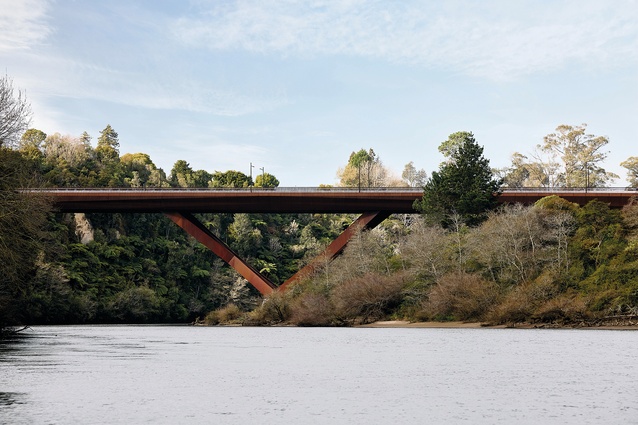
Corten balusters dissolve the massive bulk of the bridge into a surprisingly soft tectonic form.
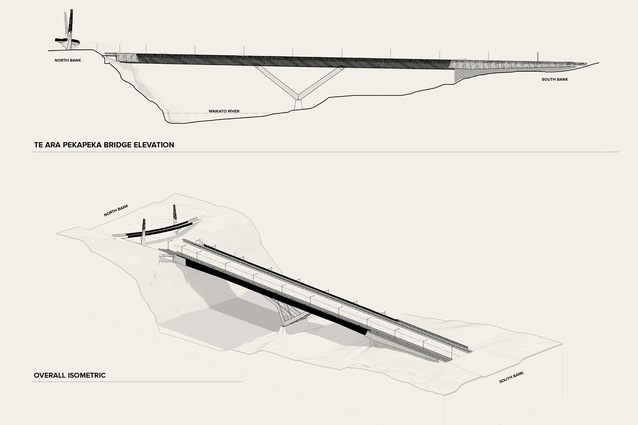
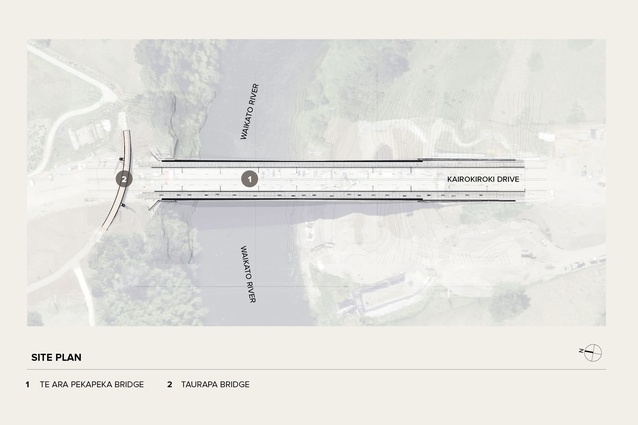
Caro Robertson investigates the soft tectonic form of Hamilton’s new Te Ara Pekapeka and Taurapa bridges, winner of the 2025 NZIA Planning & Urban Design award, by Edwards White Architects and BBO in association.
Waikato taniwha rau, he piko he taniwha, he piko he taniwha.
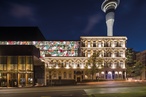
Let me start by stating what will become obvious — I am not familiar with Kirikiriroa Hamilton. My fascination was sparked on a Tuesday night, walking towards a darkened office building emblazoned with the ANZ logo. Following the suggestion of Google maps, we arrived at sliding glass doors, which opened into a vacant lobby. Turning left after a moment of confusion, we descended into a glazed double-height space looking out over the river; this turned out to be the lively, packed restaurant we were looking for. With a currently growing population, against the national tide, Kirikiriroa seems to be humming. Edwards White Architects (EWA) is also humming, turning out excellent work, with every project I have seen sensitively tailored to use, client and place.
On another trip, I walked a section of Te Awa path (River Ride) over a pedestrian bridge: a graceful earth-red curve lifting out of the hillside, resting between hefty corbels of two stately patterned posts. These posts tilt slightly outward, reflecting the bridge’s name — Taurapa, the stabilising stern post of waka. Taurapa crosses over Te Ara Pekapeka, a broad multi-modal companion bridge spanning the river, and together they won a National Architecture Award last year. I became even more curious. How did this come about?
The civic centre of Kirikiriroa is slightly west of Waikato Te Awa. Recent suburban development in the city has been located to the north, on both sides of the river. Seven bridges facilitate this, running across east-west. To the south, the river bends east and development tapers off quickly, with the suburb Riverlea at the eastern edge. Riverlea is significant in this tale, because it houses a highly motivated group of bat admirers. The kupu Maaori for bat is pekapeka.
Te ara translates as the way, or route. The pekapeka is Aotearoa’s only native land mammal; in this case, referring to a local population of pekapeka-tou-roa, tiny long-tailed bats, maxing out at 14 grams. Currently at Nationally Critical status, the last stop on the chart before Extinct, they were once numerous, described in this area as bursting upward in clouds. Around Waikato Te Awa, a network of gullies — dark crevices with water collecting at the base — perfectly supports bat habitat requirements, generating their insect diet. Andrea Graves, chair of Riverlea Environment Society (RESI), explains that pekapeka-tou-roa prefer to roost in the oldest trees available. Alongside the local community, RESI is restoring a patch of remnant bush east of the new bridges, including trees that are more than 200 years old. Arguably, the actual ara pekapeka is the shelter belt comprising this patch, traversing the river, connecting through a new suburb, Peacocke, to Mangakotukutuku Gully.
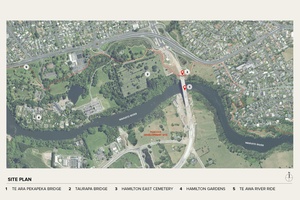
Peacocke is the reason for the new bridges; it’s the latest chunk of Kirikiriroa to be opened up for housing development. The suburb is named after the family, resident since its 1880s’ purchase of the land, that is now developing it. The previous owner was a member of parliament whose acquisition followed land confiscations, punishing the Kiingitanga movement. Suburban development in Aotearoa has regularly been heralded by earthwork vehicles bulldozing existing environments into homogenous, compacted platforms. In the Landscape Management Plan for Peacocke, written by landscape architect Adrian Morton, many references to context sensitivity and enhancement of existing ecology indicate a different order of development. Histories of M aaori and Paakehaa settlement are mentioned, with a cultural design theme arising through development partnership with Waikato-Tainui hapuu representatives, Southern Links Tangata Whenua Working Group (TWWG). As Harry Wilson explains, this is (to) make sure our things are told correctly (and to) bring them back to life. This recognition is testament to the strength of the relationship between Waikato-Tainui and the Hamilton City Council (HCC), which has been in development since the Raupatu treaty settlement in 1995.
With a subdivision application for Peacocke submitted in 2007, and an appeal to the Environment Court lodged in 2020, the regulatory process was not smooth. RESI, with DOC and Forest & Bird, challenged HCC and Peacocke’s development company over the proposed form of development. Graves says “We got quite bolshy”. And with great effect — collective wins include preservation of an 80m riparian strip, keeping the shelter belt as a bat corridor and removal of a planned road alongside the river. Challenged to be invisible to bats, the bridge’s design required mitigation of projected light to avoid disorienting the nocturnal bat and dampening of generated sound, as bats navigate primarily by echolocation.
With hapuu as co-developers and conditions shaped by local fauna enthusiasts, the brief for an unusual approach to bridge design was put to the test. The central requirement was to create a flexible bridge, adaptable over time as transport and servicing needs shift, rather than locked into the needs of the present day. Consultation with local communities brought forth interest in an expressive design: a landmark. The scope for a broadly visible expression above the river crossing bridge itself was limited, with a top-hung structure being prohibitively expensive. In a city of many bridges, each one with its own style, the opportunities for this one were more subtle, pedestrian even.
Design engineer Bloxam Burnett & Olliver (BBO) was on board with the project prior to architect involvement, inviting EWA to partner in its tender. Project lead Jeremy Gibbons explains that existing working relationships weave throughout this project, resulting in a trust and flexibility of collaborative process from the outset. This allowed the team to test what was meant by landmark, revising terminology from iconic to memorable and paving the way for a less predictable response.
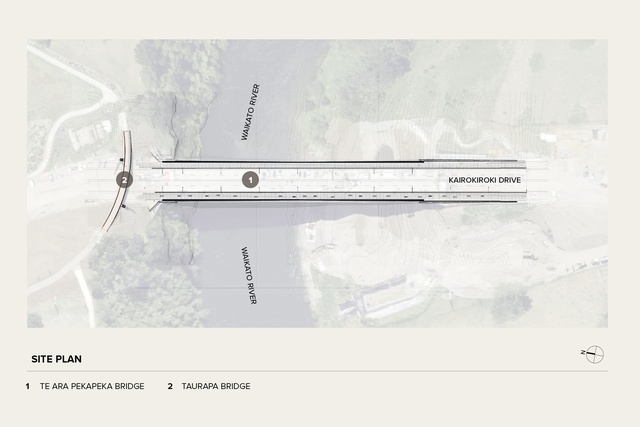
Morton called the decision to bring in a secondary bridge, separating out pedestrian and cycle crossing from the planned vehicle route across the river, a bit of a light-bulb moment. Avoiding multiple traffic-light-controlled crossings over the new four-lane road, Taurapa provides a smooth, characterful experience for traversers of the Te Awa trail, while also presenting a gateway to the new suburb.
On the surface, the river crossing uses similar language to that of the overpass, with profiled Corten balusters tempering headlight beams at night. The daytime aesthetic effect of this is alluring, filtering the view of the cascading fern canopy beyond, curved projections above the upper rail softening the edge. Pedestrian and bike lanes are generous, well protected and dotted with planters that double as seats. Stormwater subtly disappears into a delicately patterned grating.
Truly astounding design work becomes apparent on the Peacocke side of the river, taking a side path through the recently planted slope down to the river bank. From here, the depth of the balusters dissolves the massive bulk of the bridge into a surprisingly soft tectonic form, half composed of shadows, worthy of display in the Tate Modern. The protected riparian strip is in full view of what is becoming a well-loved public space, connecting people directly with the awa. Further down this path, the Y-shaped support of the bridge span is revealed, load paths woven in decussated form to resolve in a contrasting white plinth. The originality of this form derives from a TWWG requirement for the pier to stay clear of Waikato Te Awa. Hand-carved patterns cast into the plinth surface — fishing nets and taniwha — draw on the rohe history of fishing and river trading.
The overall impression is dramatic and graceful. The clarity of the design’s realisation comes down to a series of excellent working relationships. Structural opportunities and cost realities were laid out by the engineers to be considered by the architects, whose thinking process was opened up to TWWG and its elected designer, Eugene Kara. Communicating via hand gestures, drawings and computer models, conversation flowed across disciplines. Grant Edwards from EWA illustrates the interlock of the support pier by lacing his fingers. Kara describes the collaboration as cross(ing) terrain in a free and safer way, resulting in seamless integration —elevating common infrastructure materials to artwork. Drawing on Maaori cosmology, he reflects on alignment of the new crossing with the burial place of the Tainui waka. Taurapa’s taurapa are rendered with takarangi, intersecting spirals descending in laser-cut relief, representing Hani (the seeker) and Puna (the wellspring) bringing energy as they spun down from Te Kore to Papatuuaanuku.
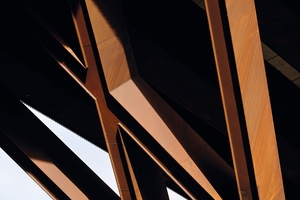
Edwards and colleague Harry Croucher note their fruitful discussions with construction engineer Laurence Brown, which resulted in forming the bridge from pieces like a jigsaw. Croucher says the details were really fun to work out — though durable, Corten surfaces can’t touch without being welded or folded, requiring minimum connection points. On a more prosaic level, Corten-clad girders hide pipes and cables, which subtly integrate the suburb with the city networks.
The design team has beautifully synthesised an array of complex requirements into civic infrastructure that is assuredly memorable. Slower-moving visitors, particularly, will be thoroughly rewarded. To do justice to its name, the environs of Te Ara Pekapeka will be monitored over time to ensure the measures taken to limit its impact on the pekapeka habitat are working. As more projects show the strength of a nuanced approach to development, creating beauty through the resolution of complex requirements, the days of cultural and geographic tabula rasa are, hopefully, receding in the rear-view mirror.